The Bank of England has started hoovering up UK government debt ensuring the GBP remains under notable pressure.
- The Pound to Dollar exchange rate is today at 1.2986, the 2016 low is at 1.2946, reached on the 8th of July.
- The Pound to Euro exchange rate is currently at 1.1713, the 2016 low is at 1.165361, reached on the 6th of the 7th.
Pound sterling is notably lower on Tuesday 9th of August as the Bank of England commences its quantitative easing programme.
Reuters reports investors rushed to sell bonds to the Bank of England on Monday after it revived its quantitative easing asset purchase programme for the first time in nearly four years
The strong demand for UK government debt from the Bank prompted the cost of UK short-term yields to rise, which in turn forced lower the yield these bonds pay.
Ten-year and five-year yields hit new record lows of 0.603 percent and 0.152 percent respectively.
British government debt (Gilts) outperformed their German and U.S. equivalent, with 10-year Treasuries offering the biggest yield premium over Gilts since 2000 at almost a full percentage point.
As the yield differential between the UK on the one hand, and the Eurozone and US on the other, grows, so too does the downside pressure on the Pound.
Typically higher-yielding jurisdictions command stronger currencies and UK yield is headed in a GBP-negative direction.
The majority of forecasts for coming months, as provided by the leading institutional research houses, do envisage a notably lower exchange rate ahead thanks to this dynamic.
The more pro-GBP predictions for GBP/USD see the exchange rate hitting a low of 1.27 on a six month timeframe, while an example of the more pessimistic views factor in 1.20.
"We continue to expect GBP/USD to remain under pressure following the Bank of England’s comprehensive package of easing measures announced last Thursday and we think data in the week ahead will likely signal that the UK economy was slowing even before the Brexit vote," says a note from BNP Paribas.
The BNP Paribas STEER model signals 2y swap rates are the key driver of GBP/USD and, while UK rates are unlikely to fall much further, analysts see considerable scope for US rates to rise.
"We still target the pair well below 1.30 by the end of Q3," say BNP Paribas.
Latest Pound/Euro Exchange Rates
  | Live: 1.1606▼ -0.03%12 Month Best:1.1659 |
*Your Bank's Retail Rate
| 1.1211 - 1.1258 |
**Independent Specialist | 1.1444 - 1.149 Find out why this is a better rate |
* Bank rates according to latest IMTI data.
** RationalFX dealing desk quotation.
More Rate Cuts to Come says BoE's McCafferty
The downward pressure on Sterling was exacerbated by a leading Bank of England policy maker who warned on further easing.
Ian McCafferty, one of the most hawkish MPC members, said the central bank should be ready to deliver more easing in the event that the UK economy slows according to the initial surveys.
"If the economy proves to have turned down in line with the initial survey signals, I believe that more easing is likely to be required, but that can easily be delivered in coming months," McCafferty told the Times newspaper.
Expectations for a weaker Sterling will likely extend from here on the basis of this warning.
"On the downside a key support can be found at 1.2798 (low from July 6th); further south a support lies at 1.20 (low from April/May 1985). The Pound should continue to trade with a negative bias as the BoE has opened the road for further monetary stimulus," says Arnaud Masset at Swissquote Bank.
Why the Move Lower Will be Steady
“That could partly be because positioning was already so skewed against the pound,” says CIBC’s Stretch.
Think of the negative betting action against Sterling being akin as shifting your car into 5th gear and putting your pedal to the floor.
Can you go even faster?
The size of the engine is the limiting factor, just as the size of the FX market is the limiting factor on selling the Pound. Unless the market grows notably larger, finding the extra participants to bet against the Pound at this stage becomes an issue.
The reason for Sterling’s resilience could also be down to markets starting to doubt whether the economy will behave quite as badly as they initially expected, with outperformance potentially seeing a rethink down the road.
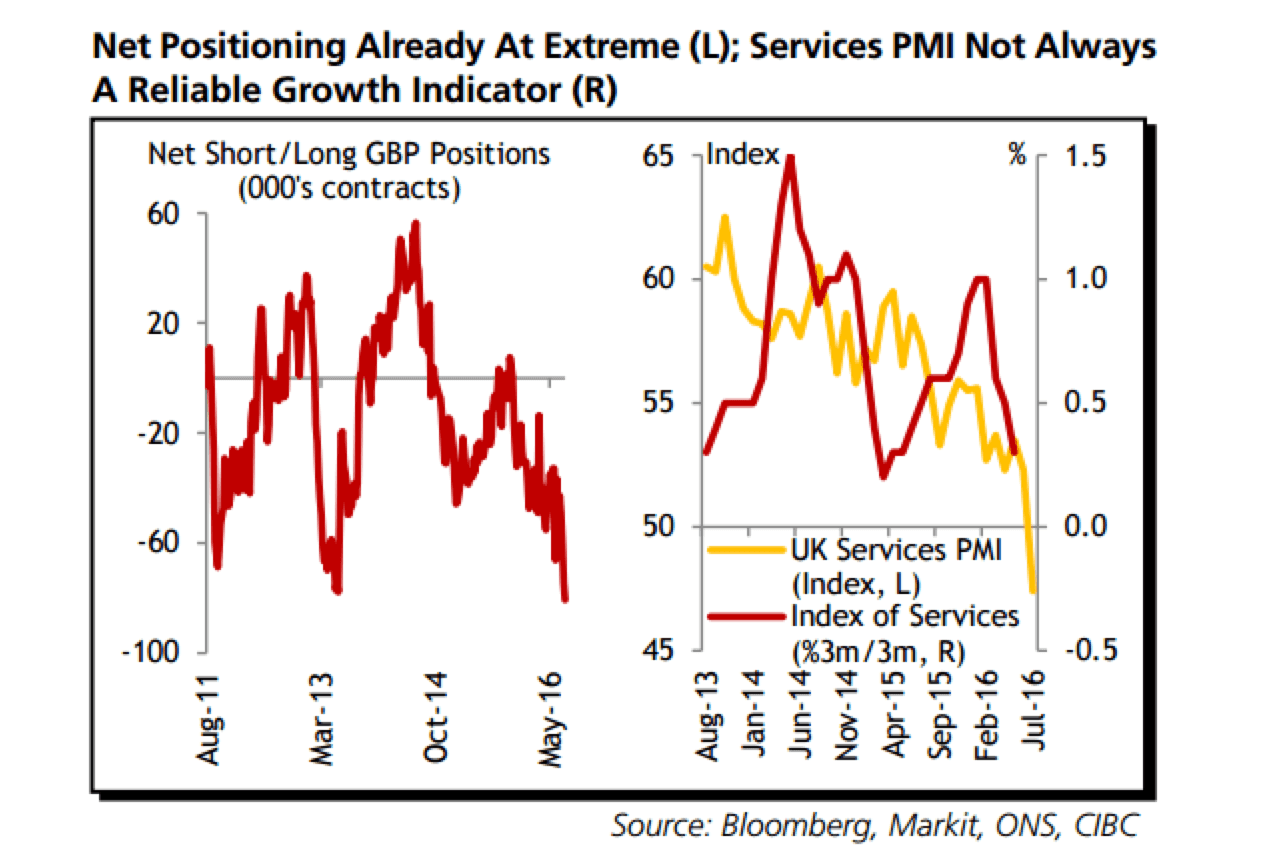
A lot of negativity was drawn from the recent IHS Markit PMI releases - the PMI surveys are intended to offer a timely snapshot of UK economic performance, as they are released days after the end of each month.
What CIBC point out is that they have a limited ability to predict the actual outcome as released by the Office for National Statistics some weeks later.
Therefore, there could be a danger in being too negative with respect to the economy.
“Certainly a lot of emphasis is being placed on the services PMI, which doesn’t always have a great correlation with GDP,” notes Stretch.
However, should the economy weaken CIBC expect Sterling to follow suit and dip to the mid-1.20’s by year-end.
There is also the argument to be made that while the Bank of England should have prompted a weaker Sterling, it too could have orchestrated the currency's resilience.
The Bank believes that the package of measures it introduced will be enough to stave of recession in the UK, with new projections suggesting the worst that can now be expected is near-0% growth.
The robust recovery seen from 2018 onwards may have many market participants unwilling to bet on further Bank of England rate cuts and policy action as a result.
Were inflation to rise at a faster-than-forecast rate over coming quarters, we could well see a stronger GBP recovery as markets start asking if the next move could in fact be a rate rise.
GBP/USD Tech Outlook: The Levels and Targets that Matter
Turning to the levels we should be observing on the GBP crosses, we see GBP/USD is ranging between 1.2750 and 1.3750 at present so as to digest previous/extended erosion.
“Macro bearish trends remain intact and indeed risk still exists for further (sizeable) declines over coming months with an eventual extension toward 1.2000 readable,” says Lucy Lillicrap, an analyst with Associated Foreign Exchange (AFEX).
Lillicrap observes some buying interest now starts at 1.2950 and given additional support around recent 1.2800 areas lows bearish risk appears limited initially.
“Provided prices can re-base thereafter 1.3350/1.3500 is not yet out of reach,” says the analyst.
GBP/EUR Tech Outlook
Turning to the Sterling-Euro rate, we note some supportive buying interest is around 1.1750 which implies an intermediate floor to GBP weakness.
Sterling values recently failed to hurdle 1.2000, and thereby secure an interim floor.
“Such a positive outcome may yet unfold but in the meantime local supports appear vulnerable to attack again and fresh rebounds now face resistance at 1.1865/75 as well,” says Lillicrap.
More substantial buying interest awaits towards 1.1500 and will probably at least slow further erosion from a daily/weekly standpoint.
“However until 1.1990/00 resistance gives way no obvious/direct path is open back up to 1.2125 or indeed 1.2250,” says Lillicrap.