Positive Australian growth data confirms the economy is becoming less reliant on mining - this should support the currency over the longer-term.
After six weeks of uninterrupted gains the pound to Australian dollar exchange rate has turned notably lower.
The rejection comes as the price hits the 50 week moving average on the charts confirming the existence of a heavy supply of sterling at the 50 week moving average.
Sterling failed to break above the 50 Month Average last week, and when combined with the shift in the EU referendum polling results, we can safely say the outlook for the pair has deteriorated notably.
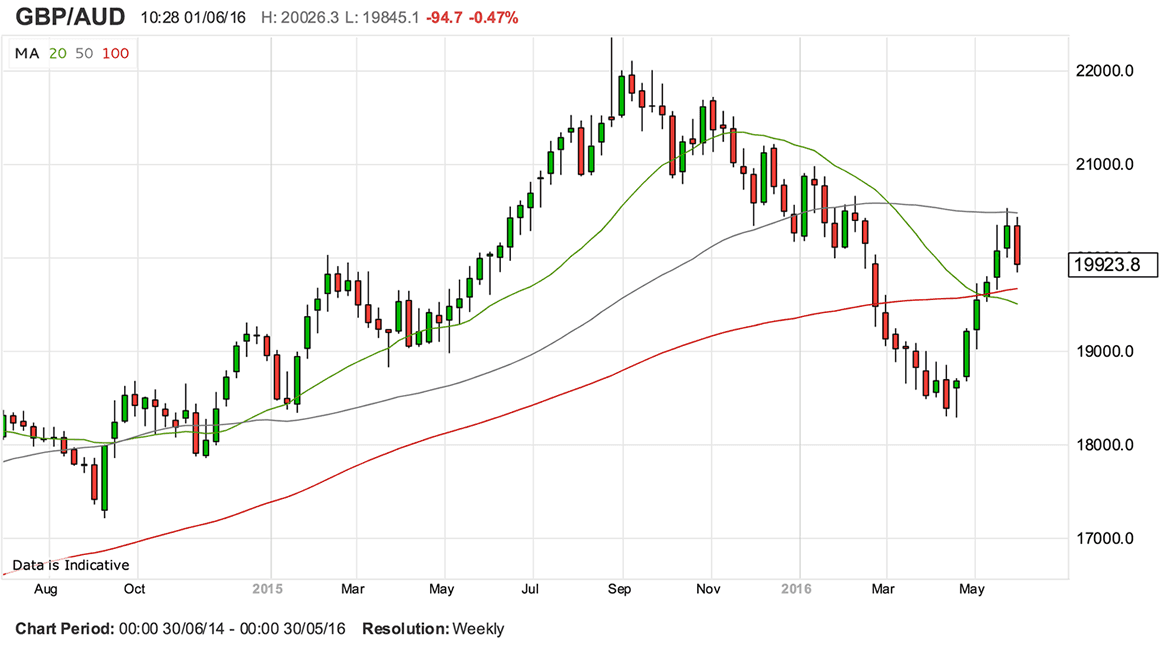
Above: The existence of a heavy of supply if GBP at the 50 month moving average has acted as a ceiling to further GBP advances.
It is about time the pound retreated against the Aussie as we have been warning of late that the rally higher had become unsustainably overbought and therefore harder to justify.
The question for us became one of what the retracement would look like - a mere consolidation or a full-blown retreat?
From where we are standing now, it looks like the latter.
The pound has come under notable pressure at the turn of the month with three sets of polls confirming that UK voters are leaning towards voting for an exit from the European Union on June 23rd.
The data comes a mere week after we were reporting that momentum was shifting in favour of the Remain camp and will be a surprise to market participants who were betting on a one way move in GBP based on an assured Remain victory.
Latest Pound / Australian Dollar Exchange Rates
  | Live: 1.88▲ + 0.07%12 Month Best:2.0851 |
*Your Bank's Retail Rate
| 1.8161 - 1.8236 |
**Independent Specialist | 1.8537 - 1.8612 Find out why this is a better rate |
* Bank rates according to latest IMTI data.
** RationalFX dealing desk quotation.
Both ICM polls - online and telephone - unusually confirmed voters are split 52 pct - 48 pct in favour of Brexit.
The big dip in GBP did however come after ORB International reported that Leave now has 46 per cent of the vote share, with Remain on 51 per cent. The five point gap is a dramatic cut from 13 points seen last week.
Australian Dollar Finds its Own Steam on Positive GDP Data
But it is not only sterling weakness that is driving the GBP/AUD.
The Aussie was the big winner overnight thanks to a better than expected overnight reading on the GDP front.
It was reported by the Australian Bureau of Statistics that Australian GDP grew 1.1% in the first quarter, ahead of analyst forecasts for 0.8%.
Annual growth now stands at 4.1%, well ahead of the 2.8% forecast.
“The 1.1% q/q gain in Q1 GDP is a strong result and suggests that the economy is weathering the downturn in mining investment well. Solid consumer spending and strong growth in both housing construction and services exports are helping to drive the transition to non-mining growth. Inflation measures remain weak, although there are tentative signs that wages growth is bottoming out,” says Felicity Emmett at ANZ Research.
ANZ believe the drag from falling mining investment is likely to be at or close to a peak and commodity prices look to have bottomed.
This is significant as should the trend continue then the AUD may no longer be classed as a ‘commodity currency’ - a status bestowed by the economy’s strong resilience on mining exports, particularly iron ore and coal.
Inflation Still a Worry, Tipped to Keep RBA on Rate Cut Path
However, the Australian dollar is by no means 'out of the woods' yet and the June 1st data confirms prices remain a threat to the economy.
The GDP deflator fell by 0.6% q/q and the household consumption deflator fell 0.1% q/q to be only 1.2% higher than a year ago.
The average wage rate bounced 0.4% q/q following a 0.4% fall in Q4 and annual growth is now running at 1.2%, which, although still very low, is up from 0.5% in Q2 last year.
“Inflation is the main game for the RBA at the moment, and today’s report shows ongoing soft price pressures in the economy. While this is very tentative evidence that wage inflation may be bottoming, we continue to expect underlying inflation to remain below the Bank’s 2-3% target band until close to mid-2017,” says Emmett.
The RBA cut interest rates, and prompted a slump in the Australian dollar, in May having cited weak inflation as being behind the move.
Should we get the hint that the RBA will cut rates again, the Aussie dollar could well turn lower again.
“For policy, today’s numbers highlight the dilemma the RBA is facing. On the one hand, activity and labour market data suggest the economy is strengthening. On the other hand, inflation remains very low. We think that the weakness in inflation is likely to keep the Bank in easing mode, and we continue to expect another cut in the cash rate of 25bp to 1.5% at the August board meeting,” says Emmett.