
The Australian dollar’s soft patch is by no means over with a number of factors pulling together to suggest more weakness will be realised over coming weeks.
A typical phrase repeated by currency commentators over the past two weeks is “the worst performing currency today was the Australian dollar” - a stark contrast to the positive tones being expressed over the course of February, March and April 2016.
Sentiment in the Aussie dollar has taken a significant knock in May, thanks to weak Australian inflation and a Reserve Bank of Australia (RBA) that has shown it will not give an inch to inflation and will cut rates if need be.
Trying to explain to your average Australian that low inflation is a bad thing is not an easy task; but it must still be pointed out that an environment of static prices is one within which companies are unable to raise prices, regardless of their input costs.
Ultimately corporate profits then come under pressure, Federal revenues suffer and workers see their wage packets stagnate.
The RBA is desperate to avoid such a scenario and to stimulate prices rate cuts are necessary. The side effect of lower interest rates is a lower Australian dollar as foreign inflows of capital seeking out the return offered by higher Aussie interest rates wane.
Further pressuring the Aussie dollar towards a new 2 month low this week are falling iron ore prices, a symptom of weaker demand from China.
It was reported in early May that Chinese stockpiles of Australia’s number one export climbed 1.4% to 99.9mt last week marking the highest reading since Mar/15 suggesting demand for iron is falling.
Should this trend continue then Australian miners could well see profits come under pressure yet further.
Latest Pound / Australian Dollar Exchange Rates
  | Live: 1.88▲ + 0.07%12 Month Best:2.0851 |
*Your Bank's Retail Rate
| 1.8161 - 1.8236 |
**Independent Specialist | 1.8537 - 1.8612 Find out why this is a better rate |
* Bank rates according to latest IMTI data.
** RationalFX dealing desk quotation.
Four Reasons to Expect Further Australian Dollar Weakness
The outlook for the Aussie is not constructive with the consensus view that the RBA will cut interest rates again over coming months.
Societe Generale have actually recommended to clients that they look to profit on this expected weakness in the AUD with an AUD/USD put trade, citing four reasons for the forecast decline:
- The RBA has not finished cutting interest rates, and markets should refocus on China woes in H2.
- AUD/USD is lagging the dovish pricing of rates
- The technical picture shows vulnerability
- Long positioning is stretched.
Let’s look at these factors in more detail.
China
In addition to the declining US dollar, “AUD/USD has been supported by the resilience of the Chinese economy. Data releases have consistently appeased markets, and our China economist has revised up H1 growth projections thanks to a recovering housing market and government-led spending. However, these factors are expected to fade in H2,” says Olivier Korber, Forex & Derivatives Strategy, at Societe Generale.
As mentioned, iron ore reserves are building up in Chinese ports, suggestive of declining economic activity.
The outlook for the real estate sector is clouded by increasingly hawkish housing policy in big cities, while government spending in H2 can only lose momentum after a stronger-than-usual H1.
The credit chain is already showing multiple signs of stress, with bank loans expected to have contracted a lot in April from March.
“A revival of the structural economic slowdown and credit woes would undermine again market confidence. After a quieter H1, the market should refocus on China woes in H2, restoring the fundamental pressure on the AUD,” says Korber.
Interest Rates
The Australian dollar to US dollar exchange rate tends to track the difference in yield on the two year swap rate between Australia and the United States.
Where the swap rate goes, the AUD/USD tends to follow. As we can see, the two have diverged:
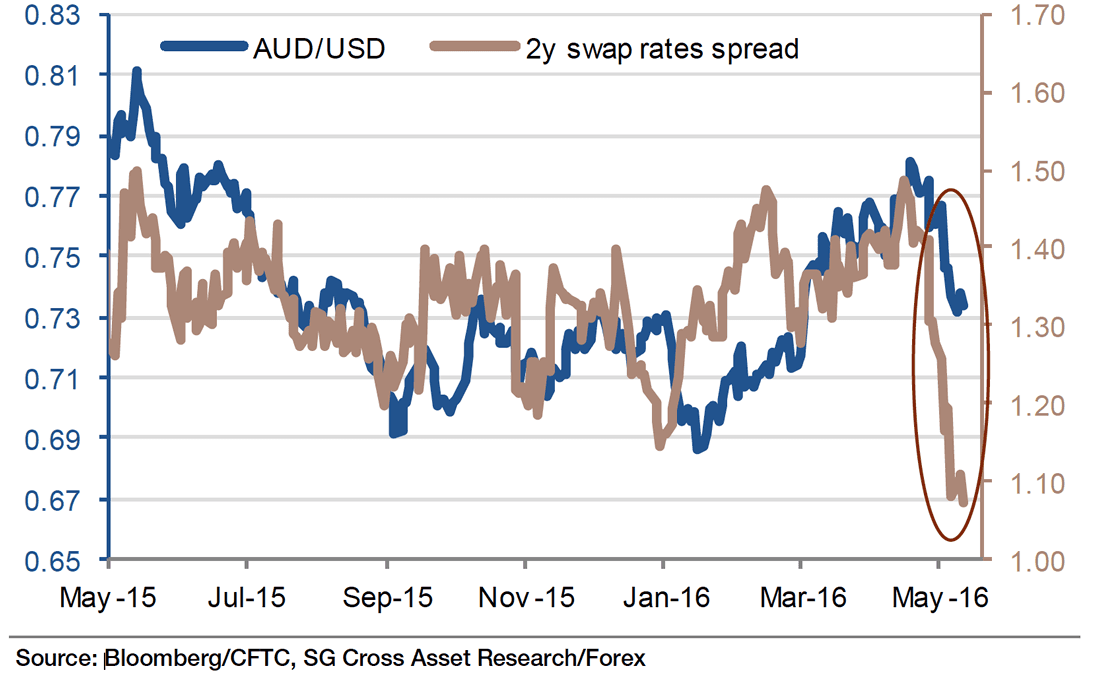
The above graphic sums up the likely direction of the Aussie dollar if it were to obey precedent.
Relative rates are now pointing to a weaker currency, with the current relationship likely to see AUD/USD heading below 0.70,” says Korber.
Technicals Vulnerable
Graphs are a good indicator of the underlying structural composition of the market and betray sentiment and where buying and selling interest will both increase and decrease.
The break of key technical levels typically confirms that traders have been cleared out of the market, while we can also anticipate where the next areas of interest will be found.
With that in mind, recent price action on the major Australian dollar pairs confirms the currency remains vulnerable to further declines.
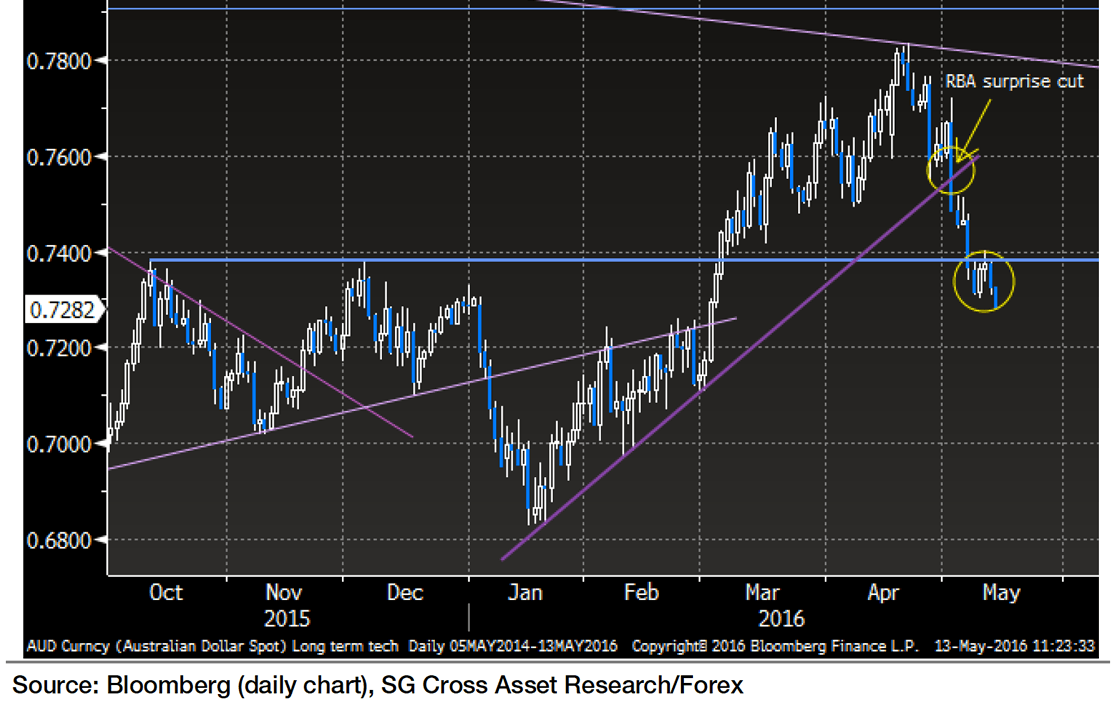
AUD/USD has seen a bullish trend since the 0.68 bottom in January, but that trend was broken the day of the surprise RBA cut.
“The fall pressured the spot below the 0.7380 horizontal level, which is not acting as an important resistance level below which the spot is consolidating. Rejecting 0.7380 would give fresh impetus to the bearish momentum,” says Korber.
Positioning
The positioning reported by the CFTC also suggests a potential turning point in investor sentiment towards the currency.
The long speculative positions slightly exceeded the peak of 2014 and are now showing signs of a
reversal.
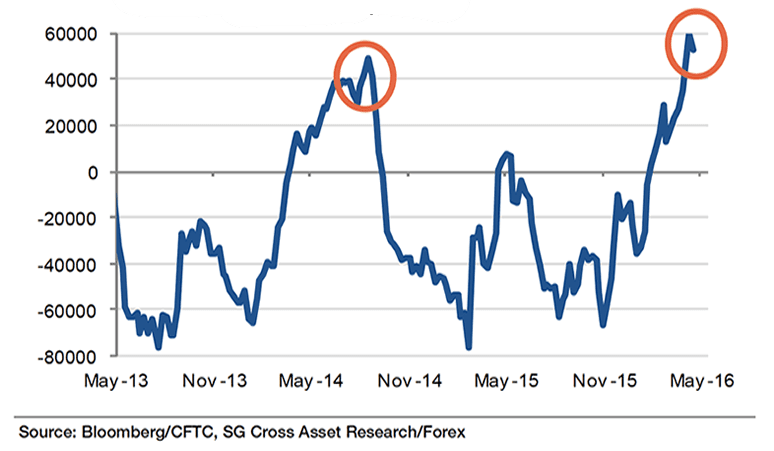
“The repricing of the RBA rate path could trigger a wave of unwinding of longs, which would accelerate the bearish move,” says Korber.
Risks to the View
Of course, the AUD could decide it has more upside in the tank and defy these expectations and rally, leaving some traders out of pocket.
While there is a risk of further policy easing this year from the RBA, if the US Federal Reserve leaves interest rates unchanged over the coming months, the downside in AUD/USD should be limited given the potential for USD weakness.
Some big-name analysts therefore anticipate AUD/USD to trade a relatively narrow range over coming months.
Going forward, watch the evolution of Australian data, as strong data could persuade the RBA to leave it to one interest rate cut in 2016, something that would surely aid the AUD.
The risks on the employment release on the 19th of April are asymmetric.
Strong data did not stop the RBA from cutting, but the market will lift the odds of more RBA cuts if the print is weak.
The strong employment growth has not been associated with strong wages. Most of this is related to growth in unskilled service sector jobs.
Markets are forecasting employment growth of 20K and wage growth of 0.5% for the first quarter.