Image © Adobe Images
GBP/USD eyes a test of 1.37 having reached 1.3720 ahead of the weekend.
This puts the market back on Tuesday lows as a hefty rally unwinds. We entered the week with GBP/USD already looking overbought and ripe for a correction; confirmation coming from a breach of 70 on the daily chart's Relative Strength Index (RSI) gauge.
On Tuesday, the pair hit a new four-year high at 1.3869 and faltered, triggering an unwind of overbought conditions. The dollar recovery builds some momentum into the weekend on confirmation of the appointment of Kevin Warsh to the position of Chairman of the Federal Reserve.
"Markets have interpreted Warsh’s appointment as a signal of potentially more hawkish U.S. policy or a shift in the central bank’s operational framework, providing immediate support to the dollar and weighing on GBP/USD," says Paul Spirgel, a Reuters market analyst.
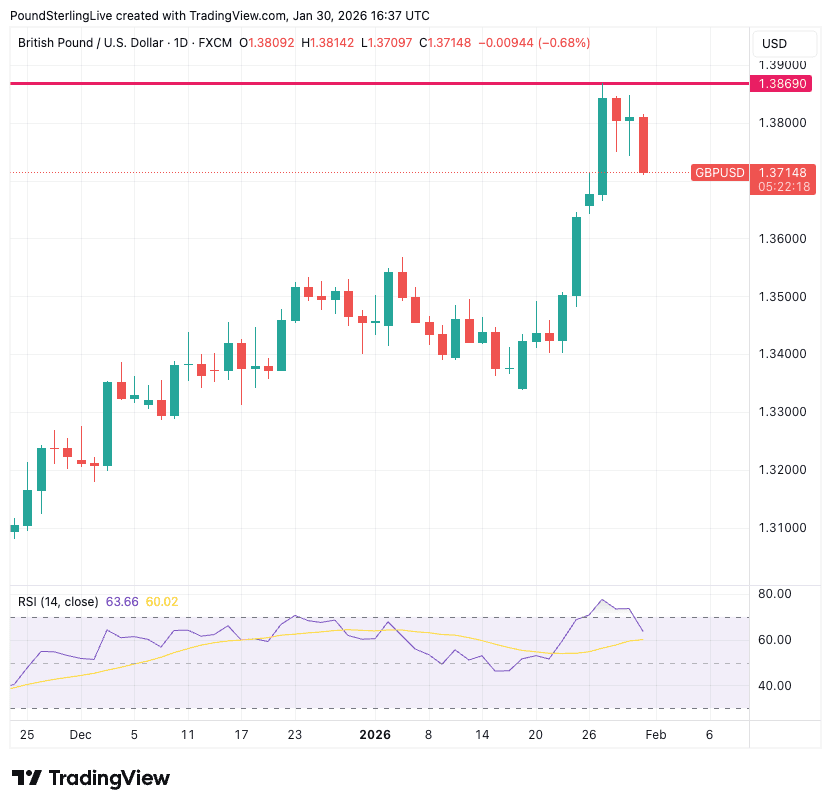
Above: GBP/USD at daily intervals with the RSI in the lower panel.
Markets were worried that the successor to Jerome Powell would be a Trump administration lackey and push for lower interest rates, even if inflation is too high.
But Warsh is a seasoned hand, having been the youngest ever appointee to the Fed's Board of Governors under the Bush Jr. administration.
He has a Wall Street pedigree and has, in the past, shown hawkish instincts on inflation.
This helps the dollar in two ways:
1) risks of a more aggressive adjustment lower in U.S. interest rates will have receded,
2) risks to the Fed's credibility on fighting inflation have been shored up.
Point 2 is important as much of the dollar's recent weakness has been blamed on fears about the unanchoring of U.S. institutional credibility.
Warsh's arrival eases those fears.
However, as an analyst from KBC Bank points out, "it’s anyone’s guess for the moment how his thinking has evolved since his stint on the Fed board between 2006 and 2011."
"Back then, he had a hawkish profile putting the Fed’s credibility high on the agenda and being a cold lover of deploying the central bank’s balance sheet," says the analyst.
However, Warsh's fixation on keeping inflation in check during the Great Financial Crisis proved a misjudgement, as the Fed was accused of being too slow to react to financial instability and a deterioration in the labour market.
Has his approach changed?
"We’ll just have to wait his first official comments to see how his thinking has really evolved and how close he aligns with US President Trump’s low interest rate dream," says KBC.