The Reserve Bank of Australia’s April monetary policy meeting saw policy makers express discomfort with the strength of the currency allowing the pound sterling to hold the gains it has made over the past 24 hours.
- Strong start to new week for sterling but S&P underline negative sentiment with downgrade warning
- Australian dollar strength questioned by RBA
There was no sustained AUD sell-off in the wake of signs the Australian central bank was growing increasingly uneasy with the strength of the domestic currency, as we have been warning at various occasions for some time now.
“The Australian dollar has appreciated somewhat recently. In part, this reflects some increase in commodity prices, but monetary developments elsewhere in the world have also played a role. Under present circumstances, an appreciating exchange rate could complicate the adjustment under way in the economy,” read a statement from Glenn Stevens, Governor of the RBA.
Since the last RBA meeting, the Aussie dollar has strengthened roughly 6.5% against the USD, 5.7% against the CNY ensuring the cost of Australian produce and services on the international market has become notably more expensive.
No doubt the fear is that this appreciation could slow Australian economic growth.
“Some in the markets were clearly expecting a stronger jawbone or even a rate cut, and the Aussie rallied 0.8% on the release,” says Angus Nicholson at IG in Melbourne, although we note the USD to AUD exchange rate has fallen back over recent hours and is back to 0.7598.
Pound Looks to Clear Hurdle
The pound is meanwhile doing its best to hold onto its recent gains but appears to be capped by the short-term resistance that is the 20 day moving average at 1.88823.
There is clearly a good deal of selling interest in the run up to this point. If buyers are able to push the GBP/AUD above here and clear out the sell orders then we could well entertain the thought of recovery with a longer duration.
Longer-term, the break below the March 23 lows saw the pair move to a new multi-month low of 1.8487 last week confirming the broader down-trend is still in control.
We see the next target being at the S1 monthly pivot at 1.83524:
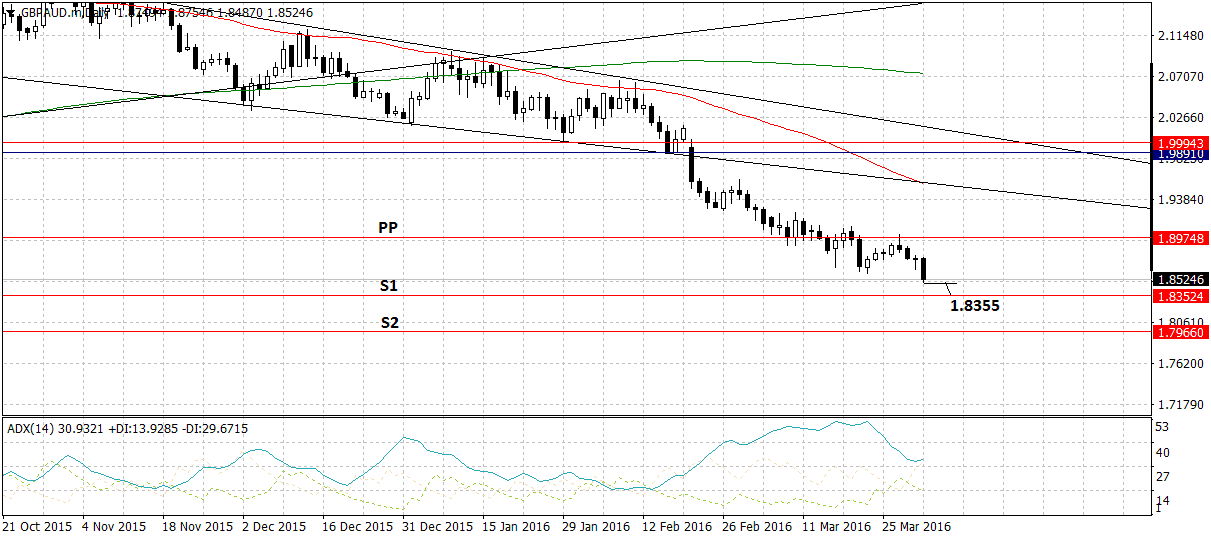
The down-trend reflects the pound’s weakness due to growing unease over the fall-out from a possible Brexit following the June 23 referendum.
Standard & Poor’s has repeated its earlier warning that Britain could lose its much-prized AAA rating if the country votes to leave the European Union.
Writing an opinion piece on the Politico website, S&P’s chief sovereign ratings officer Moritz Kraemer said:
"Brexit would further polarize the U.K.’s political system, increase risks to effective, transparent and predictable policymaking, and diminish the U.K.’s long-term sovereign creditworthiness. Brexit also heightens potential risks to economic growth and the balance of payments, as well as domestic political threats to territorial integrity.
"Consequently, a vote for “Leave” would likely lead Standard & Poor’s to lower the U.K.’s AAA rating — a rating it has held, without interruption, since 1978. While the U.K.’s rating would likely remain high given its many institutional, financial and economic strengths, the U.K. would lose its place in the increasingly exclusive club of AAA-rated sovereigns."
Latest Pound / Australian Dollar Exchange Rates
  | Live: 1.88▲ + 0.07%12 Month Best:2.0851 |
*Your Bank's Retail Rate
| 1.8161 - 1.8236 |
**Independent Specialist | 1.8537 - 1.8612 Find out why this is a better rate |
* Bank rates according to latest IMTI data.
** RationalFX dealing desk quotation.
All Eyes on the Reserve Bank of Australia
The main event for the Australian Dollar is the Reserve Bank of Australia (RBA) April policy meeting on Tuesday April 5.
Most analysts do not see a very high chance the RBA will cut interest rates again as Australian domestic economic data has been quite positive since the previous meeting when the RBA said future policy depended on how economic data came out.
The Unemployment Rate, for example, fell from 6.0% to 5.8% in February, which removed any lingering doubts the RBA might feel the need for further easing.
An increasing number of analysts are warning the RBA may now be concerned about the rise in the Aussie, which has been mainly stimulated by a mixture of a recovery in commodity prices and Fed back-tracking on interest rate hikes.
Analysts at the world’s largest foreign exchange dealer, Citibank, warn that the AUD/USD is now approaching levels that are likely to “test the RBA’s patience.”
Reading between the lines, this would suggest Citi see a more muscular RBA approach to the exchange rate ahead.
This also chimes with comments from RBA governor Stevens, who when asked at an ASIC event whether he thought the AUD warranted its new level elevated plane of activity in the 0.77s, answered:
“Unless you think that the commodity price trend now is different and we are heading back to a world of considerably higher prices for an extended period, and you think the Fed is never going to lift rates, it is not clear that that situation will warrant a much higher exchange rate than this and there is some risk actually that the currency might be getting a bit ahead of itself”.
If these comments are reflective of the board in general, then we may see a mention in the RBA statement that the Australian Dollar may be ‘getting a bit ahead of itself’ or words to that effect.
This may have a sobering effect on the currencies relentless climb.
The Longer-Term Outlook: Australian Dollar to Face Headwinds
A verbal assault on the Australian dollar by the RBA is unlikely to shift the longer-term dynamics pertaining to the Aussie dollar.
The unwind of bearish bets against the currency since the start of the year has resulted in a building of long positions with investors taking advantage of AUD’s high-quality yield status in carry-friendly conditions.
"Signs that the worst is now over in China means that a move sub-0.70 looks hard to come by," says Chris Turner at ING in London.
However, Turner cautions that while sentiment may be turning the corner, he and his team still see a range of headwinds limiting AUD upside.
"Lingering uncertainty over China remains the key threat; but a choppy risk environment, underlying data weakness and an overvalued currency are also a concern," says Turner, "as such, momentum in the AUD rally could fade."