The Australian Dollar was the past weeks third best performer in the G10 FX space, being in the top three has become a habit for a currency that continues to enjoy a stellar run. But has the currency appreciated to levels the Reserve Bank of Australia will be uncomfortable with?
The Aussie has enjoyed a stratospheric rise recently and the chatter amongst the world's leading currency analysts is increasingly becoming one of how high will the currency be allowed to go by its central bank.
The Australian economy retains a healthy growth rate but the danger of an ever more expensive currency could cap this growth as Australian goods and services are priced out of the international market.
In short, these gains could push an otherwise hesitant RBA to cut rates again in the months ahead in an attempt to stifle the country's attraction as a destination for global capital.
Australia's base interest rate at 2% remains one of the highest in the developed world ensuring vast sums of international capital is parked in Australia as investors look to take advantage of this yield.
The inflows keep the Aussie dollar bid, but by reducing the interest rate the RBA could attempt to limit this demand and limit demand for the Aussie in the process.
Then there is the question of valuation; should the currency actually be this strong?
One of Australia's leading currency analysts this week asked whether the Australian dollar can justify existing at these levels.
Richard Rennie, FX Strategist at Westpac Bank, suggests that the Aussie should probably not be so strong, but global factors may keep the exchange rate supported, at least until the end of Q2.
However, I’m getting a bit ahead of myself…
A Conversation with Glenn Stevens
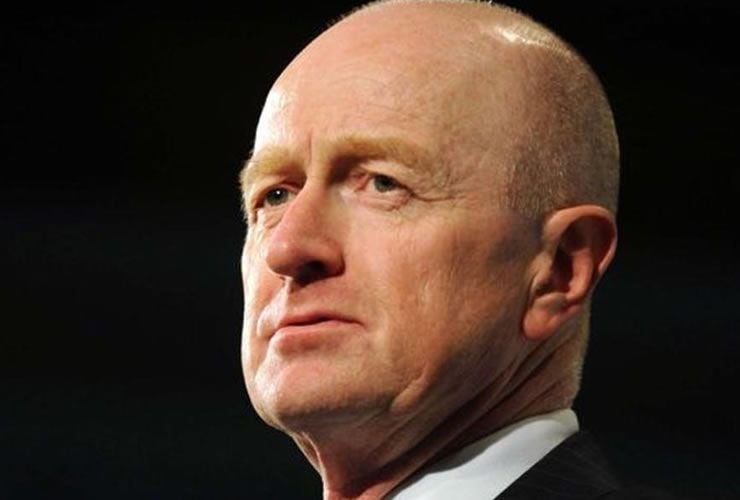
Rennie recently met Reserve Bank of Australia’s Governor Glenn Stevens at a recent ASCI (Australian Securities and Investments Commission) Annual Forum in which he asked the governor whether he thought the Aussie had finally moved out of the 0.70-0.74 range and entered a new ‘higher plane’.
Tellingly, Stevens answered:
“Unless you think that the commodity price trend now is different and we are heading back to a world of considerably higher prices for an extended period, and you think the Fed is never going to lift rates, it is not clear that that situation will warrant a much higher exchange rate than this and there is some risk actually that the currency might be getting a bit ahead of itself”.
It is this answer that has prompted Rennie to investigate the two assumptions underpinning the governor’s answer - that of the likely trajectory of commodities, and of US interest rates.
Latest Pound / Australian Dollar Exchange Rates
  | Live: 1.8891▲ + 0.02%12 Month Best:2.0851 |
*Your Bank's Retail Rate
| 1.8248 - 1.8324 |
**Independent Specialist | 1.8626 - 1.8702 Find out why this is a better rate |
* Bank rates according to latest IMTI data.
** RationalFX dealing desk quotation.
Commodity Rally is Mostly Driven by Speculation
The rush higher by AUD in 2016 has arguably progressed on the back of a rising commodity prices, especially Iron Ore, which has moved above 60 dollars a ton.
Rennie argues this has mostly been on the back of rampant speculation, especially in China, where day-traders trading non-deliverable futures contracts (non-deliverable means the contract does no actually end with delivery of the commodity but is used for the purposes of speculation alone).
“I see signs of increased speculative activity as playing an important role in this recent bounce in commodities, especially in iron ore.”
The Westpac analyst uses and analysis of contracts traded on the Chinese Dalian Futures Exchange to infer that most of the trading of Iron Ore was only speculative:
“On several days over the last couple of weeks, Dalian has traded just over 9 million contracts. On the 10th of March, just over 10 million contracts traded. Each contract is based on 100 metric tonnes. That means that futures contracts on the 10th March turned over the equivalent of 1.045 billion tonnes of iron ore, well above the amount that China imported in the last year.”
For more Iron Ore to be traded in one day than was imported by China in the whole of 2015 must indicate the active hand of speculators.
“I suggested recently that Chinese day traders were hard at work speculating about fiscal policy and new works programmes, pushing iron ore sharply higher. Rightly or wrongly, I think there is a lot to be said for the idea that the move higher in iron ore indices has been driven at least in part by speculation rather than fundamentals,” says Rennie.
Higher prices cannot be sustained by speculation alone as they will eventually return more in line with fundamentals.
Iron Ore Fundamentals: Supply set to Rise
So what of Iron Ore's true economic fundamental value, as determined by the inviolable, timeless laws of supply and demand?
Rennie argues that the rising price has led to an increase in production as mines which were previously closed due to unprofitability come on line again as prices push up to more profitable levels:
“The other factor that needs to be considered is the potential for increased iron ore supply from other producers given the recent bounce in prices.”
He cites the example of the Tonkolili mine in Sierra Leone, which closed after, “Exports from Sierra Leone disappeared.”
However, in April China’s state-owned Shandong Iron and Steel Group bought the mine.
And, “It re-commenced operations in February of this year. This should mean that production/ exports from Sierra Leone should continue to rise.”
The conclusion is that Iron Ore prices are capped, because with rising prices comes more supply, and this then soaks up the excess demand, which then has the effect of pushing prices back down again.
The Outlook for Interest Rates in the US
As suggested by Governor Stevens in the introduction the other main determinant of the AUD/USD fair value is the outlook for US interest rates.
“If you think the Fed is never going to lift rates,” the vaunted AUD/USD rate is warranted.
So what does Rennie think about when the Fed will raise interest rates?
On the one hand he seems to argue that die to ‘extenuating circumstance’ and outside influences the Fed may be constrained as to when it can raise rates.
For example, he cites the Fed’s June meeting as problematic as it comes a week before the UK’s EU referendum. But it’s not the only clash in 2016, as he goes on to point out:
“The July meeting comes a week after the (likely contested?) 2016 Republican National Convention. Too soon? The November meeting comes less than a week before the US Presidential election. Too close?”
Omitting all the dates which clash leave the “only ‘clear’ dates are September 21 and December 14 suggesting the next Fed could be six months away.”
He also discounts the possibility of an early hike in April as a result of Yellen’s recent cautious address.
In the end Rennie sticks with the Westpac’s official view that the Fed will hike in June and December 2016.
However, he states that a delay of 6-9 months suggested by the inappropriateness of June given its proximity to a potential Brexit, would indicate a substantial wait which would warrant AUD/USD remaining above 0.70-74.
“However, if Yellen is signalling greater caution about risks associated with global developments/ economic disturbance, and if the next Fed move is still 6/9 months away, then it seems entirely possible we see a period of further strength in the A$.”
Japanese Demand for Aussie Assets
One factor which the Westpac analyst argues could support the Australian Dollar ‘getting a bit ahead of itself’ in Q2, is the probable increase in Japanese demand for Australian higher yielding assets.
This is due to the excessively low - negative even - return provided by Japanese assets. JGB’s or Japanese Government Bonds, for example, only give a -0.08% return, which means investors must pay for the privilege of owning them.
Thus Japanese investors will probably seek higher yielding bonds or other assets from Australia where interest rates are higher, given the central banks interest rate is 2.0% alone.
Rennie sees this trend for investors, especially in Japan, seeking Aussie assets as accelerating after April 1 when the new Japanese financial year begins.
Rennie’s Conclusion
In the end does Rennie answer his own question - has the Australian Dollar got ahead of itself?
Judging from the outlook for commodities being divorced from fundamentals and that the Fed will probably hike rates at some point in 2016 - it has.
However, given the new source of demand from Japan accelerating into April, the recent run of data in Japan showing signs of deceleration and “increased risks of additional QE from the BoJ in April”.
As well as additional ECB QE, reduced concerns about China, Westpac’s Robert Rennie concludes that:
“No increase in Fed pricing and this backdrop of strong demand for higher yielding assets means the A$ could remain a ‘little bit ahead of itself’ for much of Q2.”