
We reported hours ahead of the RBNZ meeting a warning that there was a good chance decision-makers would cut interest rates to cool an over-heating New Zealand Dollar.
- Markets now in agreement that another interest rate cut to 2% is on the cards
- Pound to New Zealand dollar exchange rate climbs higher at NZD's expense
- Lloyds forecasting a stronger Aussie going forward but not confident on the NZ dollar
The New Zealand dollar exchange rate complex suffered declines in the region of 2% in the wake of a surprise interest rate cut at the RBNZ.
The decision to lower rates to 2.25% from 2.50% caught almost every economist and investor off guard and sent the currency spiralling lower.
The Bank noted the trade-weighted exchange rate had risen 4% higher than projected in December and we see this as being the deciding factor for decision makers.
Weak inflation was also cited as a reason while the dairy sector was noted to face difficult challenges despite domestic growth being supported by "migration, tourism, a pipeline of construction activity and accommodative monetary policy."
"Looking ahead, we expect the RBNZ to lower the OCR by another 25bp to 2% as soon as June. This is mostly priced in by financial markets after the RBNZ downgraded their interest rates forward guidance by 40bp this year and 50bp next year compared to the previous assessment in December," says Roy Teo at ABN Amro.
Inflation is projected to decline further but bottom in the middle of this year before rising to 2% in early 2018.
On the exchange rate the RBNZ estimates that the NZD is likely to fall by another 2% against its basket of currencies by the end of this year.
"Our year end NZD/USD forecast is 0.61," says Teo.
Full Marks to ANZ's Sharon Zollner: A pre-Emptive Strike on the Kiwi's Strength is Exactly What She Called
Nearly all economists were anticipating no change in the Official Cash Rate, and market pricing agreed a cut was unlikely.
However, we reported the following:
"Since the Governor’s February speech in which he sounded reluctant to cut the OCR further, evidence has mounted that he will probably need to, sooner or later," says Sharon Zollner, Senior Economist at ANZ in Aukland.
While the economy still looks pretty solid, Zollner says financial conditions have tightened markedly, reflecting a stubbornly high NZD, weak commodity prices (dairy), an Auckland housing market that’s taking a break (albeit while other regional markets pick up the baton and sprint), and higher bank funding costs that she thinks will persist.
"Roll all that together and it suggests growth will slow below trend at a time when CPI inflation is already well below target. Even flexible inflation targeters have to sit up and take note of that. One could certainly make a case for “why wait?”, and RBNZ Governor Wheeler has proven himself not afraid to surprise the market – indeed, for NZD impact a surprise might be helpful," says Zollner.
Latest Pound / New Zealand Dollar Exchange Rates
  | Live: 2.3309▼ -0.35%12 Month Best:2.3553 |
*Your Bank's Retail Rate
| 2.2516 - 2.2609 |
**Independent Specialist | 2.2982 - 2.3076 Find out why this is a better rate |
* Bank rates according to latest IMTI data.
** RationalFX dealing desk quotation.
Forecasting the Pound Recovery to Coninue To 2.16
The rally in the British pound continues to gain traction with the GBP to NZD exchange rate having moved from lows just below 2.08 in late February to the present levels at 2.1385.
A positive signal was delivered in the wake of the RBNZ decision with the pair breaking above the 20 day moving average at 2.12; this is a positive momentum signal and advocates for further gains near-term.
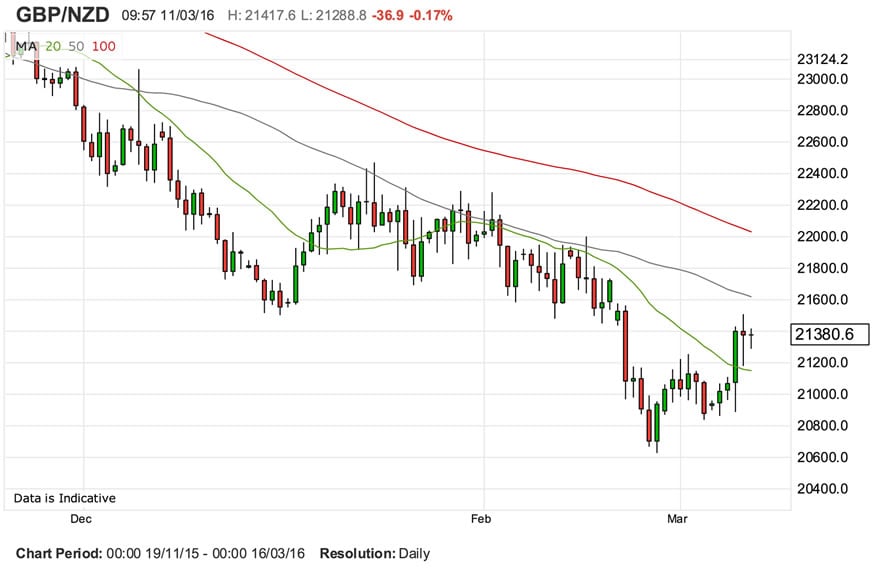
We are forecasting the recovery to extend at least until the 50 day moving average at 2.16, signified by the grey line in the above chart.
We would suggest GBP will struggle to advance beyond here having noted an inability in sterling to cross the 50 day moving average threshold against a number of other pairs.
Sterling is titled lower against most majors and we expect suggest an improved global outlook is required befor any sustainable recovery can be called.
Another Rate Cut to Come
Part of the reason the NZD's decline has been so deep lies with expectations for further rate action.
Following the RBNZ rate cut this morning, Citi Economics now expect a further 25 bps cut in April for a new low of 2.00%.
Once there, Governor Wheeler is likely to provide qualitative guidance that further policy easing may be required though Citi does not expect the OCR to plunge further.
RBNZ Decision "Galling' say BNZ
BNZ have meanwhile accused the RBNZ of lacking "common sense" by deciding to cut interest rates.
"We should have known better. The RBNZ has taken the above-expected TWI, the lower than expected inflation expectations outcome, weaker global growth and a drop in commodity prices and poked all these things mechanistically into its model," say BNZ in a note to clients.
The end result of that process is that inflation forecasts fell (which we knew with a large degree of certainty) and, accordingly, the model demanded a reduction in the overnight cash rate to compensate.
BNZ say what's missing in this process is:
- Consistency with past RBNZ commentary;
- Any strong rationale that the rate cut will affect the desired objective of getting inflation to 2.0%;
- Any evidence that low inflation is causing a significant problem to the economy anyway.
"For us it's the consistency aspect, or lack of it, that is most galling," say BNZ in a note to clients.
Concerning the outlook for the currency, Toplis says he thinks the NZD will continue to drift lower but it's less to do with what will happen onshore than what we expect to happen offshore. "And, of course, if this further reduction in interest rates does give the economy another boost then investors tend to demand the currencies of relatively well performing economies mitigating any impact that any interest rate differential change might impart," says Toplis.
New Zealand Dollar Forecast to Weaken by Lloyds
While Lloyds see the Aussie dollar heading higher through 2016 the same strength is not necessarily expected for the New Zealand dollar.
Lloyds predict the currency will weaken from its current level and fall in the short-term down to its range lows at 0.62 before against the US dollar, “before staging a recovery and consolidating around recent range highs.”
They cite continued week milk prices and policy at the Reserve Bank of New Zealand (RBNZ) as major factors influencing the weakness.
RBNZ Governor Wheeler has repeatedly voiced concerns about the overheating housing market and the currency which he has said is, “too strong.”
It’s quite possible that Wheeler and the rest of the board will reduce base lending rates from their current 2.5% in order to alleviate these problems.
It would also reduce the amount of speculative buying of the currency from international carry traders taking advantage of the relatively high interest rate.
Carry traders use currencies with low interest rates such as the euro to buy currencies with higher interest rates, such as the New Zealand dollar, so that they can park their money in New Zealand bank or broker where it will earn superior interest from that which it would earn in its country of origin.
This has been a major factor in the Kiwi's persistent strength.
Commodity Prices Remain Supported to Kiwi and Australian Dollar
Both the NZD and AUD are notably higher in mid-week trade as the commodity currency sector track improved sentiment in global commodities.
Leading the charge are oil prices which have shot higher with Brent crude establishing itself above the 40 USD a barrel marker.
US light crude is nearly 4% higher and about to break the 50 USD a barrel marker too. The rally comes despite inventories rising by 3.9M barrels, 0.9M barrels over the 3.0M forecasted by markets.
But gasoline inventories fell 4.5 million barrels, much more than the polled number of 1.4 million barrels.
"Gasoline is the star of the show today. Ongoing strength in demand has yielded a large draw to gasoline inventories despite a rebound in refinery runs," said Matt Smith at energy data specialists ClipperData.
The bottom line? Sentiment is improving fast in the commodity sector, this can only be a good thing for both the CAD, NZD, AUD and ZAR.
Latest Pound / Australian Dollar Exchange Rates
 | Live: 1.879▲ + 0.06%12 Month Best:2.0851 |
*Your Bank's Retail Rate
| 1.8151 - 1.8226 |
**Independent Specialist | 1.8527 - 1.8602 Find out why this is a better rate |
* Bank rates according to latest IMTI data.
** RationalFX dealing desk quotation.
Lloyds Backing Further Australian Dollar Gains
The Australian dollar is predicted to gradually appreciate against the US dollar and reach the vicinity of 0.78 by the end of the year, provided global risk appetite remains stable.
The prediction is made by Lloyds Bank in the latest edition of their International Financial Outlook which cites increased optimism about domestic-driven growth in the Australian economy, a more hawkish central bank and stabilising global risk sentiment as major contributing factors to the pro-AUD stance.
Analysts at the bank single out as key the Australian economy’s success in shifting from a resource-driven, heavy industry model to a more service-orientated economy:
"Australia is seemingly reaping the benefits of diversification away from commodity-based industry towards the services sector, as GDP growth for Q4 2015 rose to 3% and the trade deficit narrowed from A$3,535m to A$2,937m."
The Reserve Bank of Australia (RBA) has kept interest rates at 2.0% for several months now and appears to be shifting out of its easing cycle after positive Q4 GDP data supported the outlook.
Risk sentiment has stabilized on a rebound in commodity prices and less volatile movements in the Chinese currency, a reflection of stabilising confidence in the Chinese economy.
Nevertheless, according to Reserve Bank of Australia’s Governor Stevens, “the key risk to Australia remains the outlook for China’s growth.”
An active Peoples Bank of China (Pboc) appears to have reassured markets about how they are handling the slow-down in China, as well as recent upbeat commentary from its leaders, although how valid such rhetoric is remains questionable.
Also aiding the Aussie’s outlook is the change in outlook for Federal Reserve monetary policy.
Rate expectations have been pushed back with the money markets now pricing the first 50/50 probability of the next rate rise taking place in September.
The dollar has for some time relied on the assumption that it would be supported by no less than four rate rises in 2016.