Iron ore prices experienced their largest weekly rise in over two years providing fresh fuel for the 2016 rally in the Australian dollar. Can it continue or will today's Chinese data put a lid on gains?
- News that iron ore prices had jumped 19% has fuelled the A$ rally of late, whether iron's recovery is sustainable is debated
- Suggestions being made the AUD has risen too fast, too far.
The impressive 2016 surge in the Aussie dollar continues into the mid-week session.
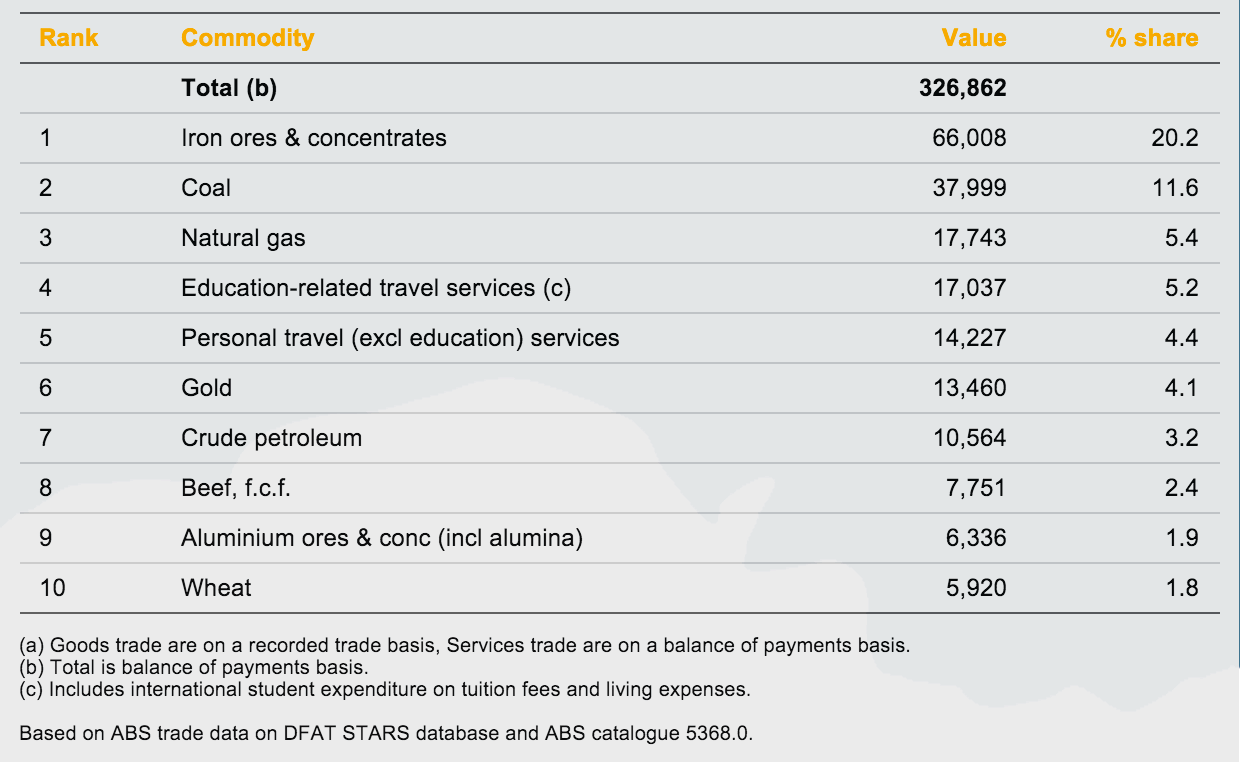
Hopes that China’s stimulus programme could resurrect demand for iron ore is being seen as the spark to the latest move higher considering iron ore is Australia's largest export.
Iron ore’s stellar performance is part of a recent general rise in commodities - led initially by a reversal from bear to bull market in zinc; followed by oil, gold, silver and the other metals like copper.
It is therefore important to ask whether the rally in iron ore prices can continue.
Cameron Bagrie, Chief Economist at ANZ is sceptical.
"Positioning looks to have been influential; a 19% surge in iron ore smells of a massive short covering rout. Without going into the ins and outs of various commodities, history points to shakeouts as being protracted in length with supply adjustments sticky,” says Bagrie.
Latest Pound / Australian Dollar Exchange Rates
  | Live: 1.88▲ + 0.07%12 Month Best:2.0851 |
*Your Bank's Retail Rate
| 1.8161 - 1.8236 |
**Independent Specialist | 1.8537 - 1.8612 Find out why this is a better rate |
* Bank rates according to latest IMTI data.
** RationalFX dealing desk quotation.
Moreover, it is argued, China needs to deleverage, which does not fit with the announced 6.5-7% growth target, and the world does too.
“And the market is taking an incredibly demure view of the Fed (funds rate) given unemployment and core inflation signals,” says Bagrie suggesting the currency markets may be shocked by a strong rally in the US dollar should the Federal Reserve signal further interest rate rises over coming months.
Goldman Sachs also warn about getting carried away on the current commodity bounce.
In a note to clients analyst Jeffrey Currie, the head of commodities research, says the recent surge in iron ore prices was the result of a short-term rise in Chinese steel prices.
Mills that have shut down during the rout may need to temporarily restart ahead of the peak construction season.
“The physical shortfall in steel supply can be filled easily and the subsequent deterioration in steel margins is likely to put iron ore prices under renewed pressure,” says Currie.
"Overall we find that the likelihood of a sustained improvement in Chinese demand during 2016-17 is low, and we remain strongly of the view that the structural bear market drives that have contributed to metals declining 20 per cent over the past year and 50 per cent over the past five years remain intact," says the investment note.
Aussie's Economy is Purring Along
Taking a look at the bigger picture, do exports such as iron ore actually matter as the economy diversifies away from mining?
The rally in AUD/USD has been supported by the stabilisation in risk sentiment, the relatively hawkish stance of the RBA (which maintained its policy rate at 2.00% in its February meeting) and growing optimism around the domestic economy.
"Australia is seemingly reaping the benefits of diversification away from commodity-based industry towards the services sector, as GDP growth for Q4 2015 rose to 3% and the trade deficit narrowed from A$3,535m to A$2,937m," say Lloyds Bank in a recent financial market briefing to clients.
The Australian economy appears to be performing better than many had expected, and this month’s business survey gives no signs that this is wavering.
The NAB Business Survey showed a notable improvement in business conditions during February, jumping to +8 points, more than unwinding the decline from last month, which was primarily driven by Australia’s mining states.
The data follows on from the positive GDP growth data for the fourth quarter last week, which showed a higher-than-expected rise in growth of 0.6% (versus 0.4% expected) and Q3 revised up to 1.1%.
This better growth statistic considerably reduced the probability that the Reserve Bank of Australia (RBA) would have to inject more money into the economy by reducing interest rates at its next meeting.
This further supported the Aussie Dollar as it would be expected to weaken if the RBA moved to reduce rates.
This is because lower borrowing rates increases the amount of money in the economy, which dilutes the value of the currency.
Lower interest rates also reduce the amount of foreign capital entering the country and depositing in its banks to take advantage of its interest rates.
From a technical point of view, the increasingly bullish fundamentals are supported by a more bullish looking chart.
AUD to USD Forecasts: Time for a Pullback?
"AUD remains bearish against USD in our view as we anticipate a further pullback on excessive gains, as well as on likelihood of retreat in risk appetite," say Hong Leong Bank in their assessment of the technical underpinnings of the recent rally.
Analysts at the Malaysian bank set sights on AUDUSD testing a lower of 0.7355, below which there is scope to drop to 0.7297.
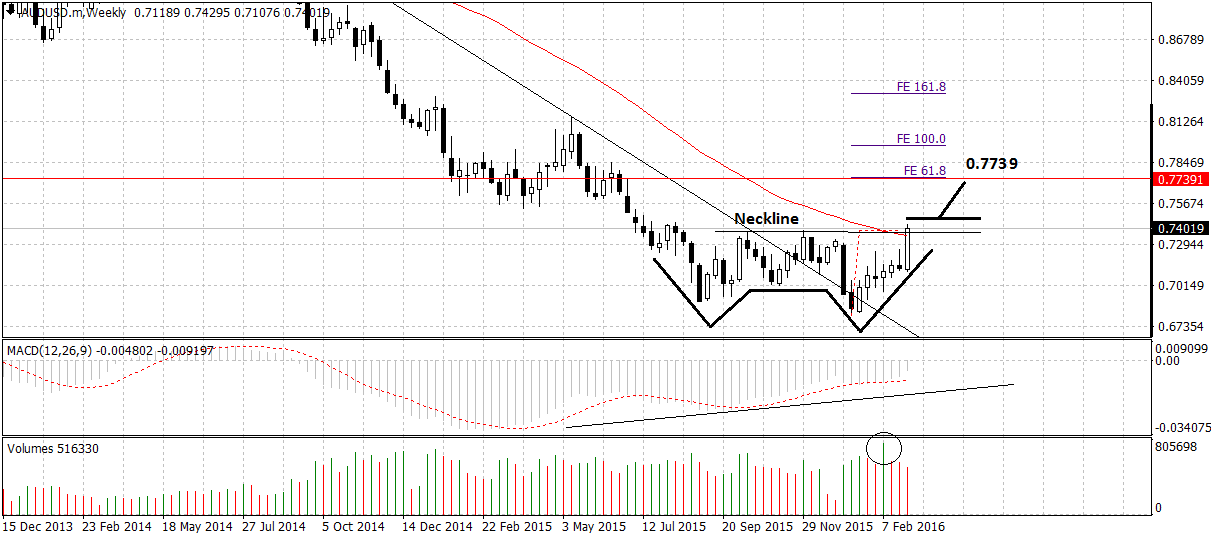
Looking at the longer-term picture, the AUD to USD charts show the pair formed a double-bottom reversal pattern, increasing the bullish potential of the chart.
A double bottom is a pattern which occurs at the end of a down-trend and signals prices are going to reverse trend and move higher.
It is formed when prices move down and form a trough, recover and then move down again and form another trough.
Prices then recover again and this time break higher at the neckline, which is the level of the inter trough recovery high.
The break above the neckline is the signal traders look for, for confirmation of a change of trend.
Prices are then expected to rally an equal distance to the height of the double bottom extrapolated higher – or at a minimum, 61.8% of the height of the pattern.”
The neckline of the double-bottom on the AUD/USD weekly chart has at 0.7400, has already been breached but the confirmation level at 0.7450 has not yet been broken.
If it is breached, then it will help confirm a continuation higher to the next target at 0.7739.
Converging momentum and the volume spike circled on the chart are further indications a reversal is unfolding.
GBP to AUD: Decline Accelerates
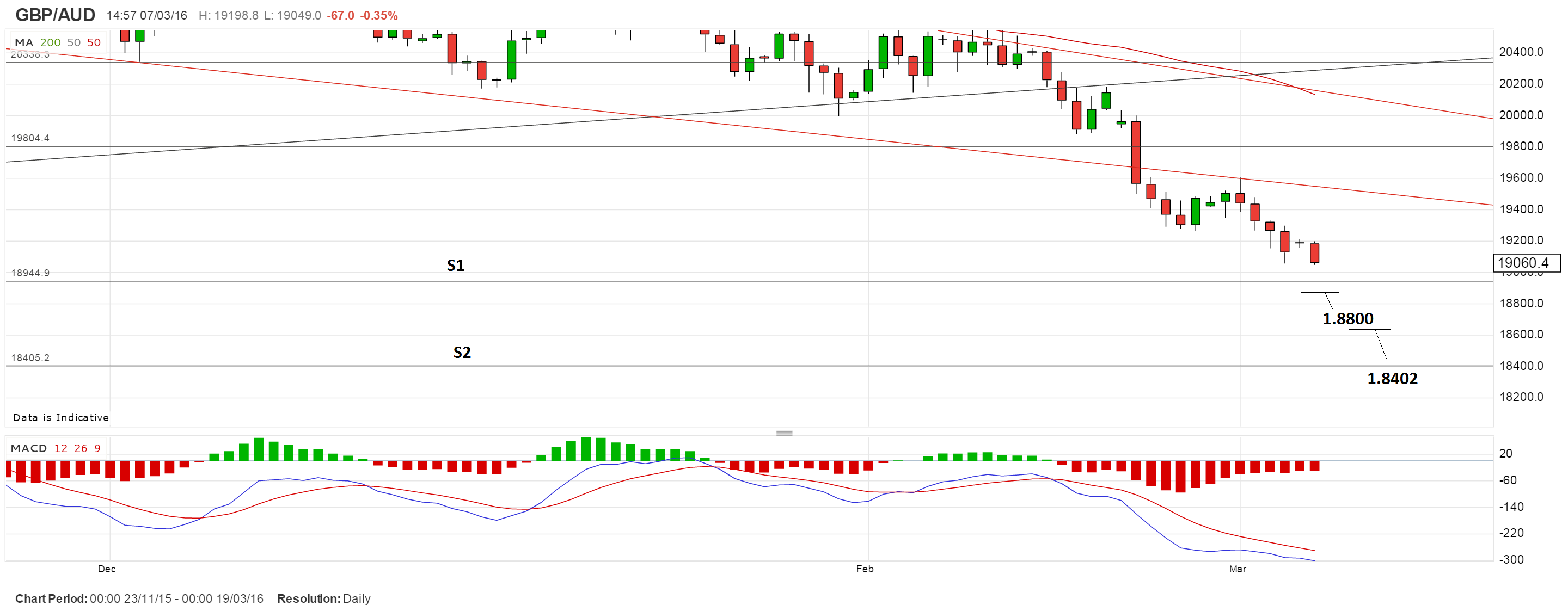
The pound to Australian dollar exchange rate has accelerated its decline breaking down below the lower boundary of its descending channel.
The pair has already broken below the 1.9250 lows helping to confirm an extension to its next target at the key 1.9000 psychological level.
The S1 Monthly Pivot lies not far below our 1.9000 target at 1.8942.
Pivot levels provide an obstacle to falling (or rising in an up-trend) prices and they often stall and consolidate at pivot levels.
For confirmation of more down-side we would ideally wish to see a break clearly below the pivot and a move below 1.8890 to an initial target at 1.8800.
Likewise a breach of 1.8790 would probably confirm a move downt to 1.8700.
And so on down, to an eventual mid-term target at 1.8402, at the S2 Monthly Pivot.