The Aussie dollar remains a firm favourite on forex markets thanks to a strong run of domestic data and rising commodity prices.
- Australian dollar recovers losses received in wake of soft Chinese trade data
- Pound to Australian dollar rate could continue down to 1.90 if longer-term trend remains intact
- The AUD to USD could be on target to rise to 0.7450
The Australian dollar's stellar run is likely to continue despite news that China’s Trade Balance data for February read at 32.59 BN USD, well below consensus forecasts for 50.15 BN USD and almost half the 63.29 BN reported in January.
Exports fell 25.4 percent year-on-year, double the amount analysts had forecast the decline to read.
Commodity-sensitive currencies such as the New Zealand and Australian dollars were understandably lower following the data.
We did warn walking into this week that the strength in some key AUD pairs was looking overdone suggesting short-term weakness is increasingly likely as markets become prone to a much-needed correction.
We expect corrections to be short-lived though, so those with outstanding Aussie dollar payments should be aware that the currency's weakness will likely be brief.
Latest Pound / Australian Dollar Exchange Rates
  | Live: 1.88▲ + 0.07%12 Month Best:2.0851 |
*Your Bank's Retail Rate
| 1.8161 - 1.8236 |
**Independent Specialist | 1.8537 - 1.8612 Find out why this is a better rate |
* Bank rates according to latest IMTI data.
** RationalFX dealing desk quotation.
Iron Ore Rally Won't Last
The dip in the AUD has ultimately proven to be short lived, particularly against the pound.
Much excitement has been made concerning the 19% recovery in iron ore prices over the weekend. This is significant as this commodity is one of Australia's leading exports and really has an impact on the country's international accounts, and therefore the currency.
The 19% surge followed China’s National People’s Congress meeting over the weekend showing commitment to supporting economic growth, "which markets interpreted as a positive for the outlook for steel consumption, and has also appeared to wash out short positions," says a foreign exchange briefing from ANZ Research.
Elserwhere oil prices rose nearly 6% at the start of the week with WTI crude climbing to its strongest level year to date.
"In addition to oil, the price of gold, silver, copper and iron ore also extended higher, paving the way for gains in the Canadian and Australian dollars," says Kathy Lien at BK Asset Management referencing the improved sentiment towards the commodity blioc.
Lien offers a warning though having noted the gains in these currencies should have been stronger given the magnitude of the increase in commodity prices.
This brings us on to the question of whether the commodity-inspired rally can continue to deliver the fire needed for further AUD gains. Will commodity price uplifts be sustained?
Cameron Bagrie, Chief Economist at ANZ is sceptical.
"Positioning looks to have been influential; a 19% surge in iron ore smells of a massive short covering rout. Without going into the ins and outs of various commodities, history points to shakeouts as being protracted in length with supply adjustments sticky,” says Bagrie.
Moreover, it is argued, China needs to deleverage, which does not fit with the announced 6.5-7% growth target, and the world does too.
“And the market is taking an incredibly demure view of the Fed (funds rate) given unemployment and core inflation signals,” says Bagrie suggesting the currency markets may be shocked by a strong rally in the US dollar should the Federal Reserve signal further interest rate rises over coming months.
Goldman Sachs also warn about getting carried away on the current commodity bounce.
In a note to clients analyst Jeffrey Currie, the head of commodities research, says "demand hasn't really changed, it takes lower prices to push and keep supply below demand to create a deficit."
Oil prices are particularly unlikely to see a sustained improvement as the relief brought by higher prices will throw a lifeline to struggling producers.
"Overall we find that the likelihood of a sustained improvement in Chinese demand during 2016-17 is low, and we remain strongly of the view that the structural bear market drives that have contributed to metals declining 20 per cent over the past year and 50 per cent over the past five years remain intact," says the investment bank.
RBA Doves Locked in their Cage
The Australian Dollar has built up solid momentum of late thanks to the surprisingly strong Q4 GDP data that comes in addition to the strong gains in commodity prices. We will look for these two drivers to continue offering support over the longer-term.
Recent FX trade has seen the Australian currency fall following the marginally dovish Reserve Bank of Australia (RBA) statement on Tuesday, and then recovered following the release of higher-than-expected GDP data the following day.
All the key components in the growth data that the RBA looks at to support growth going forward, were really quite strong.
These included broad consumption which rose 0.8% qoq and 2.9% yoy, and mining investment.
The growth data effectively diminished further any expectations of a rate cut which may have been raised by the March RBA statement, putting “the doves back in the cage,” according to Westpac’s David Goodman.
Also supporting the Aussie, has been a surge higher in the price of iron ore, the country’s largest export, which has had one of the most bullish weeks for several years, rising from 35 to 38.6 dollars per ton - a pace which bodes bullish for the future.
Nevertheless, on Monday we have heard from one of the world's leading investment banks that suggests the recovery in iron ore prices may prove to be short-lived. If prices have rebounded too quickly then we will watch for a pullback, and would expect this to temper enthusiasm for the Aussie dollar.
Nevertheless it is worth pointing out that the recent surge in commodities in general, appears to come from producers strategically limiting production to resurrect prices – a completely new tactic in the commodity price context, which the possibility of further large gains if it is successful.
Pound to Australian Dollar Technical Outlook
The GBP/AUD pair has accelerated its decline breaking down below the lower boundary of its descending channel.
The next target on the radar is the 100% extension of the channel lower, at roughly 1.9000, which is also just above support from the S1 Monthly Pivot at 1.8945.
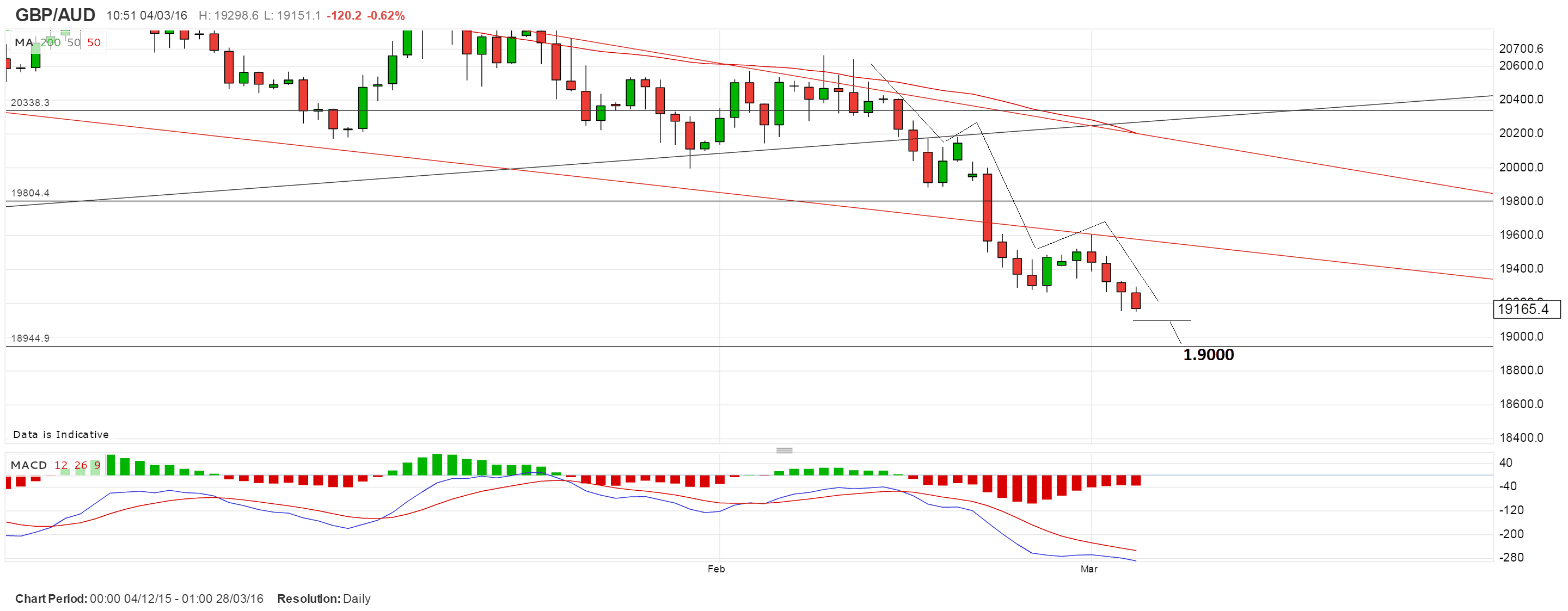
The pair has already broken below the 1.9250 lows helping to confirm an extension down to the key 1.9000 psychological level.
Downside momentum has slowed, which is a warning sign the pair could be nearing a bottom, according to the old wall street saying: “never short a dull market.”
There is a small chance the breakout from the descending channel could mark an exhaustion point for the trend, however, given no strong indications yet of a recovery, it is safe to assume bears are still in control.
For those willing to assume some risk, a break below the 1.9090 level would probably confirm a continuation down to 1.9000.
AUD to USD Exchange Rate Forecast
The Aussie has broken above the neckline of a double-bottom reversal pattern, increasing the bullish potential of the chart.
If the exchange rate moves above the 0.7450 confirmation level it will increase the probability of a move up to the next target at 0.7739.
A double bottom is a pattern which occurs at the end of a down-trend and signals prices are going to reverse trend and move higher.
It is formed when prices move down and form a trough, recover and then move down again and form another trough.
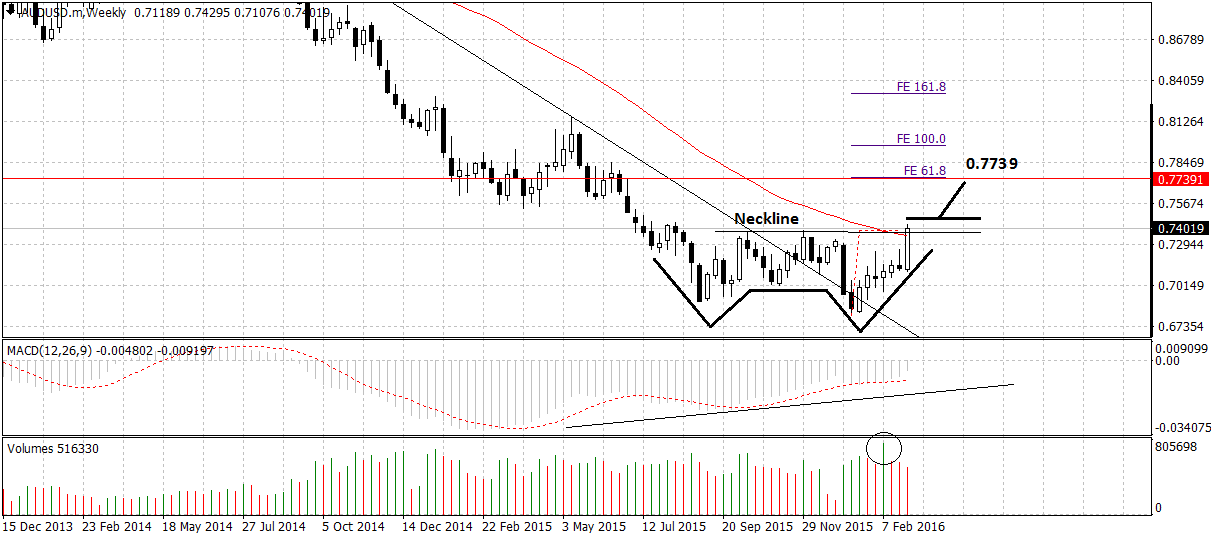
Prices then recover again and this time break higher at the neckline, which is the level of the inter trough recovery high.
The break above the neckline is the signal traders look for, for confirmation of a change of trend.
Prices are then expected to rally an equal distance to the height of the double bottom extrapolated higher – or at a minimum, 61.8% of the height of the pattern.
The neckline of the double-bottom on the AUD/USD weekly chart at 0.7400 has already been breached but the confirmation level at 0.7450 has not yet been broken.
If it is breached, then it will help confirm a continuation higher to the aforementioned target.
Converging momentum and the volume spike circled on the chart are further indications a reversal is unfolding.
ANZ Still Expect Interest Rate Cut, But Doubts Grow
Turning to the interest rate debate - a key driver of AUD strength - despite the better-than-forecast data delivered over recent weeks, analysts continue to warn further AUD-negative interest rate cuts are possible.
ANZ Research tell clients that their call for an interest rate cut in May looks too agressive and that date is likely to fall back as a result of the surprising strength in the economy.
Nevertheless, "working in the opposite direction," says ANZ's Daniel Gradwell, "are that the global growth backdrop remains fragile, our interest rates continue to look ‘high’ in a world where negative rates are more commonplace, and creeping upward pressure on actual lending rates in Australia is likely to remain from higher funding costs and tighter capital requirements."
However Gradwell notes that the strength of the Australian housing market in 2016 is only likely to work against his call for a 2016 interest rate cut "as the RBA would likely be uncomfortable reducing the cash rate further in the face of onging strength in house price growth."