The Aussie dollar is looking to end the week having secured the crown of the G10's best performer, however there are suggestions that the currency may now be overbought.

The Australian dollar is this week's top performer in the G10 currency space thanks to official data showing GDP grew a solid 0.6% on a quarter-by-quarter basis in the fourth quarter.
The data ensures the AUD to USD exchange rate remains near three month highs.
AUD remains bullish by many counts with momentum indicators advocating for further gains. Momentum indicators will however always advocate for further gains in a self-fulfilling prophecy.
"Though AUDUSD is technically bullish, we caution that further upside bias is doubtful as it is likely overextended and possibly exhausted from recent advances," note Hong Leong Bank.
As such analysts expect gains to be moderate, capped at circa 0.7385 with growing scope for a pullback.
A look at the Relative Strength Index (RSI) on the GBP to AUD conversion's daily charts shows a reading of 28. The RSI measures whether an asset is oversold or overbought with 50 being neutral. Anything below 30 suggests an asset is oversold while above 70 the asset is overbought.
Sterling-Aussie is therefore oversold and we look for a correction higher, however a correction it will be and not a turn in trend.
Latest Pound / US Dollar Exchange Rates
  | Live: 1.3395▲ + 0.27%12 Month Best:1.3867 |
*Your Bank's Retail Rate
| 1.2939 - 1.2993 |
**Independent Specialist | 1.3207 - 1.3261 Find out why this is a better rate |
* Bank rates according to latest IMTI data.
** RationalFX dealing desk quotation.
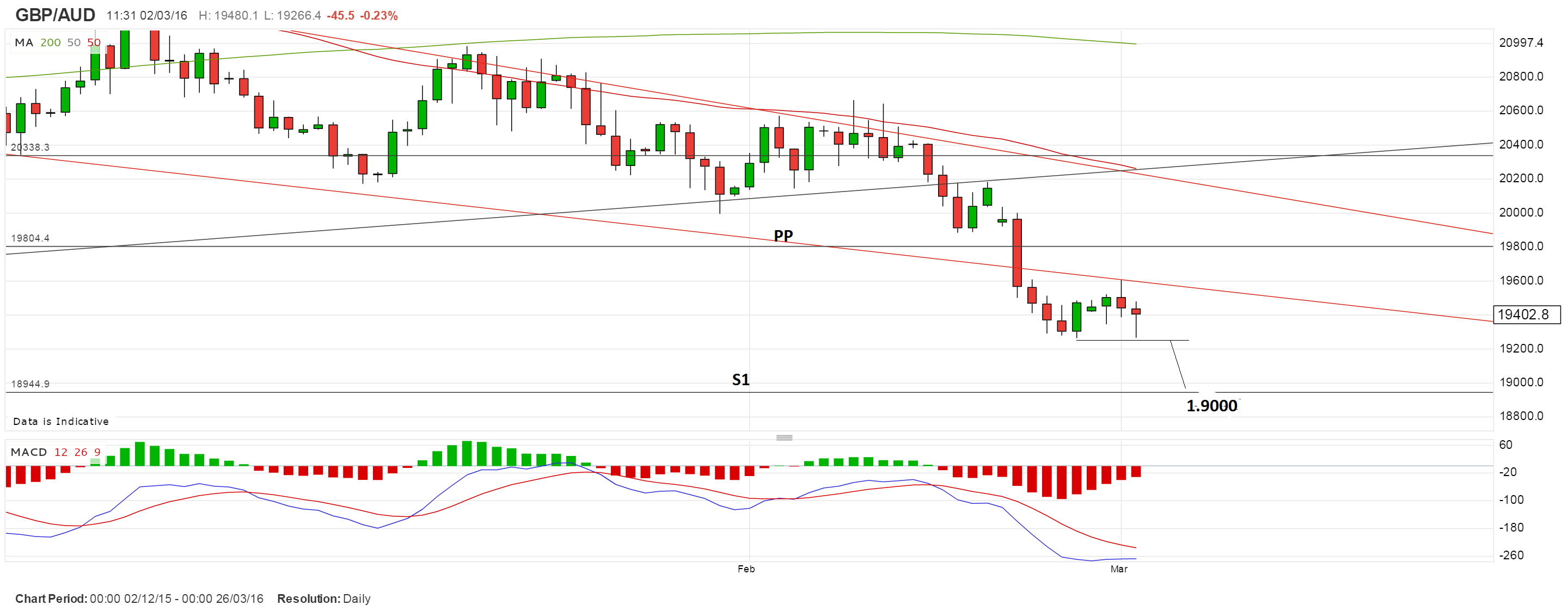
The GBP to AUD conversion has continued moving lower, although it actually accelerated its decline recently, breaking down below the lower boundary of its descending channel.
This generated an initial target at around 1.9300, which corresponds to a Fibonacci 0.618% of the height of the channel extrapolated down. The next target on the radar is the 100% extension of the channel lower, at roughly 1.9000, which is also just above support from the S1 Monthly Pivot at 1.8945.
There is a small chance the breakout from the descending channel could mark an exhaustion point for the trend, however, given no strong indications yet of a recovery, its safe to assume bears are still in control, and a break below the 1.9250 level would probably confirm an extension down to 1.9000.
Australian Dollar Gains Against US Dollar to be Capped
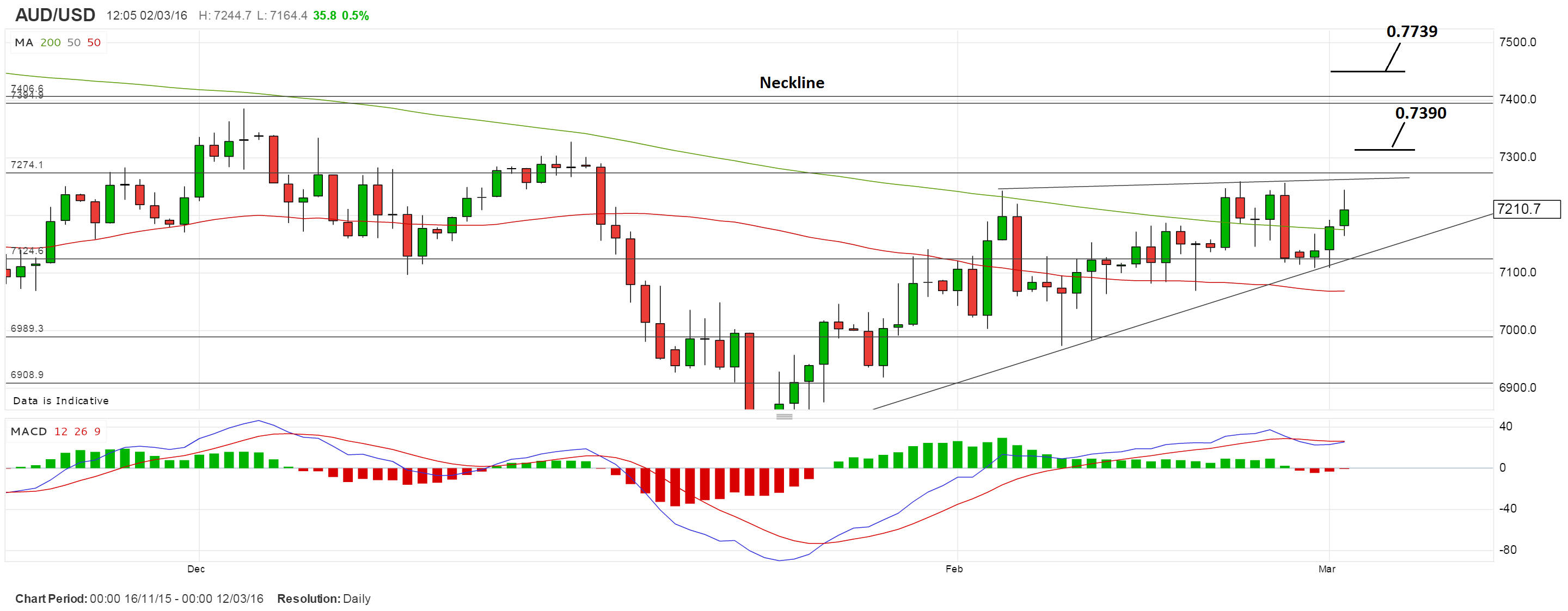
The AUD to USD meanwhile remains range-bound, oscillating in a corridor between highs of 0.7400 and lows at 0.6900.
"The more upbeat global mood should help AUD near term but investor caution over China might cap it around 0.74," say Westpac Strategy.
It is currently moving higher within the range and has formed a sort of wedge-like pattern, which it is likely to break higher out of.
Such a move would be signalled by a break above the 0.7315 level, leading to a probable rally up to 0.7390, more or less in line with the Westpac view.
On the weekly chart the pair has formed a squat double bottom reversal pattern during the current range-bound period.
A double bottom is a pattern which occurs at the end of a down-trend and signals prices are going to reverse trend and move higher.
It is formed when prices move down and form a trough, recover and then move down again and form another trough.
Prices then move up again and this time break higher at the neckline, which is the level of the inter-trough recovery high.
The break above the neckline is the signal traders look for, for confirmation of a change of trend.
Prices are then expected to rally an equal distance to the height of the double bottom extrapolated higher – or at a minimum, 61.8% of the height of the pattern.
The double-bottom on the AUD/USD weekly chart has a neckline at 0.7400, which if breached would probably confirm a move up to a minimum target at 0.7739.
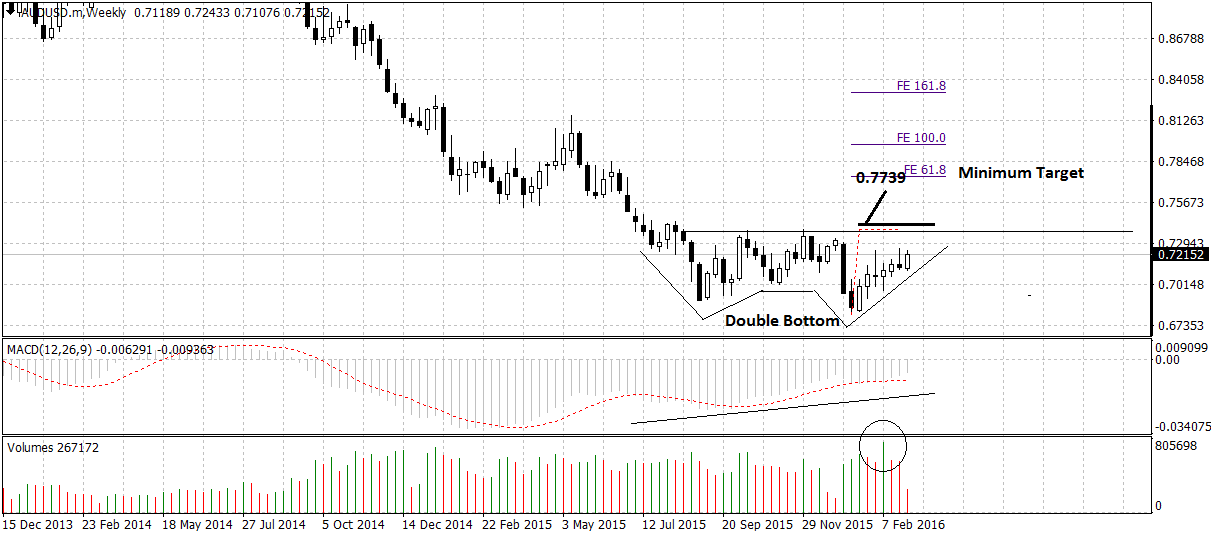
Cast-iron confirmation of a break higher would come from a rise above the neckline including a 50-point confirmation buffer - at 0.7450.
The MACD momentum indicator is diverging bearishly with price which means it slowed on the second trough, further enhancing the bullishness of the pattern.
Volume also peaked on the right trough, showing buying interest increasing and enhancing the bullish nature of the pattern even further.
Trade Deficit Narrows as Iron Ore Prices Stabilise, But Chinese Risks Linger
The good economic data keeps coming with Thursday delivering news that Australia's trade deficit narrowed in January by more than expected.
Week commodity prices and exports saw the trade deficit fall to A$2.9bn, down from A$3.5bn in December.
Stable iron ore prices in January were key in delivering the positive outcome.
"The solid trade news comes on the heels of data yesterday that showed the economy expanded at its fastest pace in nearly two years in Q4, all of which reduces the odds of further RBA rate cuts in the months ahead. Still, another flare-up in risk aversion, a selloff in Chinese markets or another leg lower in commodities could quickly see the Aussie come back under selling pressure," say Commonwealth Foreign Exchange.
Aussie Dollar is G10's Best Performing Currency Mid-Week on GDP Data
The captains of Australia’s economy have one mission - maintain growth while reducing dependence on the mining sector.
To achieve this, the Reserve Bank of Australia (RBA) has cut interest rates to ensure funding remains accessible and the Australian dollar remains cheap enough to stimulate exports.
Mid-week brought with it the release of Q4 GDP data which has had analysts questioning whether or not the non-mining element of the economy is in fact growing at a pace that will keep the RBA policy makers firmly in the deck chairs.
The answer it appears is yes - yes, the non-mining sector of the economy is growing at a healthy clip and yes policy makers will continue to enjoy their nap.
GDP rose by 0.6% in the fourth quarter, beating expectations of 0.4% QoQ; however, it was a fall from the previous quarter’s 1.1%. Q3 growth was revised up to 1.1% from 0.9% previously.
On an annualized basis, GDP rose 3.0% from 2.7% previously, and also beat expectations of a fall to 2.5%.
“The details were solid with a clear acceleration in household spending. While the economy still faces a number of headwinds, today’s National Accounts provide some encouraging signs that momentum in the economy has troughed," say ANZ Research in their assessment of the data.
The rise in household spending was a particularly positive sign for the non-mining sector of the economy.
"An acceleration in household spending is vital if the non-mining recovery is to gain traction," note ANZ, "the economy continues to face a number of headwinds, but those headwinds are fading."
Sharply falling mining investment and commodity prices will continue to be a drag on GDP growth for some time, but the drag from mining investment will peak in the current financial year and commodity prices look to have bottomed.
Fiscal consolidation will continue to weigh on public spending, but not to the same extent as the last few years.
"The turnaround in measures of national income is promising,” say ANZ who believe the RBA will be happy with the new figures.
“But we are not out of the woods yet. The unemployment rate remains elevated and further inroads are necessary before the RBA can sit back and feel as though its job is done,” add ANZ.