The GBP to AUD conversion is lower again on Tuesday on a combination of heightened risk-aversion towards the UK currency and demand for the Australian dollar thanks to a firmer commodity sector.

Woe for those who were holding out for a recovery in the pound to Australian dollar exchange rate as the move lower has now accelerated.
We wrote last week that the pound sterling continues to look heavy against the Aus dollar over the medium-term with momentum indicators suggesting further declines are possible. What we did not expect is the violence and speed of the latest lurch lower.
The GBP to AUD conversion is now at 1.9469 having closed last week just below 2.0. The break below this number is significant as there is unlikely to be much support for some distance.
The rate offered by banks for international payments is seen as low as 1.990, independent currency providers are seen offering transfers closer to 1.9250, but be aware that with market conditions being so volatile spreads are likely to remain wide and ever-shifting.
One thing is abundant, these are fantastic levels for those who export to Australia and great levels for those selling Aussie dollars.
Latest Pound / Australian Dollar Exchange Rates
  | Live: 1.9062▼ -0.14%12 Month Best:2.0515 |
*Your Bank's Retail Rate
| 1.8414 - 1.849 |
**Independent Specialist | 1.8795 - 1.8871 Find out why this is a better rate |
* Bank rates according to latest IMTI data.
** RationalFX dealing desk quotation.
Aussie Dollar in Demand on Iron Ore Recovery
AUD is also seeing gains against the US dollar having jumped to over a two-week high thanks to higher oil and iron-ore which have lead commodities and investor risk appetite higher.
"The Aussie can continue to enjoy some near-term gains, especially if commodities and equities continue higher. However, given the deterioration in the domestic economic backdrop and the resulting increase in the risk of additional RBA lending rate cuts in the months ahead, any rally in the AUD is likely to continue to be viewed as a selling opportunity by traders," says a note from Commonwealth Foreign Exchange.
Why is the Pound Under Pressure Against the Australian Dollar Today?
The big driver for GBP/AUD, though, is the GBP side of the equation.
The EU referendum is seen as offering huge risk premium to the UK currency and a late Sunday intervention by one of the UK's most influential politicians, Boris Johnson, has opened the door to further volatility.
"Even before the campaign started, Cameron has suffered his first defeat as Boris Johnson, the popular and influential mayor of London, declared yesterday that he will be campaigning for a Brexit. It was a major setback for Cameron who had hoped to enlist Johnson to those who want the UK to remain in the EU," says Lauri Hälikkä at SEB.
The mood in the 'Out' camp certainly has been lifted by Johnson's intervention, "Brilliant Boris Johnson offers hope - articulate & passionate! He's right! This is 'Last chance saloon' to grab back control of our destiny!" says David Buik, a prominent City veteran who now works at brokers Panmure Gordon and is a firm advocate for leaving the EU.
Expect the pound to come under pressure right across the board:
"I think we are likely to see further sterling weakness ahead of the vote itself, as the debate rages and uncertainty undermines confidence," says Kit Juckes at Societe Generale.
Juckes says he can't imagine the opinion polls moving decisively enough in either direction for clarity to emerge before June 23.
"In the process, I expect to see GBP/USD break 1.40 and EUR/GBP break 0.80 between now and then - possibly both at the same time. On a ‘Brexit' I'd look for GBP/USD to trade to 1.30, at least," says Juckes.
Why 1.90 is Now Likely, Westpac See a Move Back Above 2.0
Speculators will have been setting orders in the GBP/AUD market in anticipation of a recovery off the psychological resistance at 2.0.
Now that those orders are cleared out we have a kind of trap-door effect; freefall until the next cluster of buy orders.
It is an understandably difficult proposition to identify the level at this stage but the best bet is on the area just above 1.90.
Recent history does shows that back in 2015 sterling found considerable support here:
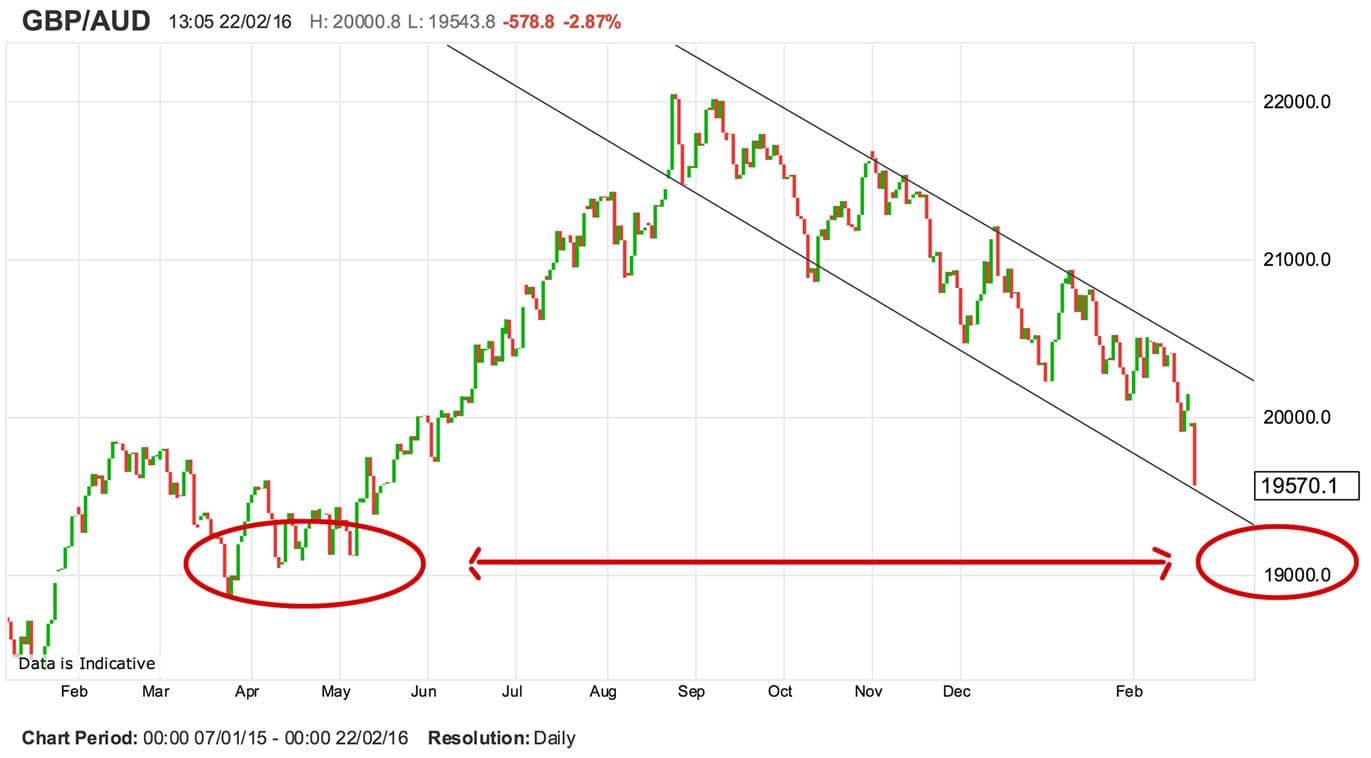
However, analyst Sean Callow at Westpac is not convinced that the GBP/AUD will fall as low as 1.90.
"There should be sufficient political risk priced into the pound and enough weight on AUD from commodity prices to see GBP/AUD stabilise. The 2015 lows around 1.88/1.89 are unlikely to be reached and the cross should spend most of H2 2016 above 2.00," says Callow.
Aussie Dollar Grows in Popularity Amongst Speculators
Latest data from the speculative community suggests the AUD is in demand.
The latest Commitment of Traders report shows speculators are reducing their exposure to the US dollar while the Aussie is favoured by speculators for the fourth week and positioning has now switched to a net long for the first time since the middle of 2015.
"The switch is also yet another sign of speculators waning confidence in the USD as they now are net short USD versus two currencies (AUD and JPY) while they at most times this autumn were long USD versus all other currencies," says Karl Steiner at SEB Bank.
The Australian Dollar’s Week Ahead
The week kicks off with commentary from Deputy Governor of the RBA Guy Debelle, who is giving a speech in Sydney.
This may be heavily scrutinised, and be more of a major event for the markets than previously expected.
Recent poor employment data has once again put the possibility of a rate hike back on the table, so analysts will be tuning in to the speech for hints as to if or when the RBA is considering a rate cut.
In a recent note, Goldman Sachs forecast a rate cut to 1.50% in 2016, with a cut as soon as May, followed by another in July.
The Wage Cost Index (Q4) on Wednesday could also cause some volatility, as a fall in the cost of wages will weigh on the inflation outlook, and increase the likelihood of a rate cut further.
Apart from that there are two middle tier releases – the Westpac MNI Consumer Sentiment Index (Feb) on Wednesday, and Private Capital Expenditure (Q4) on Thursday.
Analysts are now expecting a higher chance of a rate hike from the RBA, which has one of the highest interest rates in the world, at 2.0%.