The Australian dollar may have lost ground against sterling of late, but we are sure a sustained move below the 2.0 exchange rate is on the cards.

The pound shot up against the Australian dollar in the dying moments of Friday's trading session to end the week on a positive footing.
The move higher came as the UK Prime Minister secured a deal with European leaders that allowed him to set a date for the EU referendum on June the 23rd. This is the preferred date for 'vote in' advocates which is also clearly pro-GBP.
Despite the near-term advance, the Brexit question is likely to continue underming sterling.
A further problem for those looking to buy Australian dollars with their pounds is that the GBP to AUD conversion remains locked in a protracted downtrend.
Every time the exchange rate rises in favour of sterling, it ultimately reverts to form and is sold off again.
The cycle has been in place since August 2015 and we are yet to see any indication of a let-up in the move.
The charts confirm that a sustained move below 2.0 is nigh, therefore if you are looking to buy Australian dollars remember adopt the mantra that 'yesterday was better.'
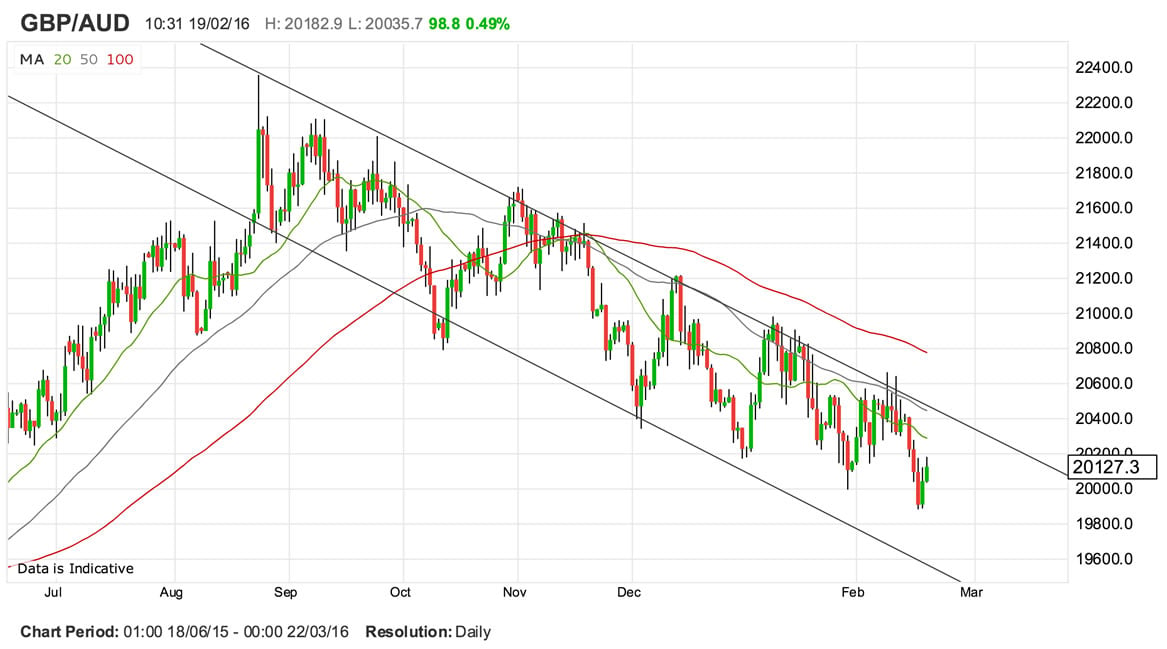
Of course spikes in the rate happen, and we could be about to witness another one, but these spikes are ultimately likely to be short lived.
Employment Data Hits the Aussie
The Australian Dollar has sold off sharply after negative employment data raised doubts about the robustness of the economic turnaround.
Data released on Thursday February 18 showed the Unemployment Rate falling to 5.8% from 6.0% previously and full-time employment fall by -40.6bn when a 17.0k rise had been the consensus estimate.
Latest Pound / Australian Dollar Exchange Rates
  | Live: 1.9059▼ -0.16%12 Month Best:2.0515 |
*Your Bank's Retail Rate
| 1.8411 - 1.8487 |
**Independent Specialist | 1.8792 - 1.8868 Find out why this is a better rate |
* Bank rates according to latest IMTI data.
** RationalFX dealing desk quotation.
Aussie employment had been improving strongly and, had become the ‘jewel in the crown’ of the Australian economy, reflecting, for many, the success of attempts to end an overreliance on heavy industry and mining, and increase the size of the Service sector, however, the data out on Thursday raised question-marks over this vaunted view of the labour market.
“The labor report missed its mark on all key components with full time jobs contracting by -40K while part time jobs rose 32K and the unemployment rate inched to 6.0% from 5.8% prior," says Boris Schlossberg, of BK Asset Management, "The only upside note to the data was the small rise in participation rate from 65.1% to 65.2% presently."
The release resulted in a fall from 0.7174 to 0.7142 in the AUD/USD pair, and a rise of almost 100 points in GBP/AUD from 1.9875 to 1.9980.
The rise in GBP/AUD coincided with the pair reaching a major support line generated from the 2015 highs.
These Jobs Numbers are Realistic
We are not worried about the impact the jobs data will have on the Aussie dollar's performance agains the pound.
“While the decline disappointed markets, on average, job growth has weakened to a more realistic pace given the below-trend pace of economy,” says Janu Chan at St George Bank.
Chan notes leading indicators continue to point to a relatively healthy labour market in the near-term, and supports the view that the unemployment rate is not about to trend significantly higher.
“Ongoing above-average conditions in non-mining sectors of the economy should also help prop up demand for employment,” says Chan
The majority of the job losses were concentrated in the two regions of New South Wales and Victoria, where oil and gas account for major proportions of the economy, and it is possible that they may have stemmed from the continuing low price of oil.
Will the RBA Cut Interest Rate in 2016
What does the jobs data mean for the Reserve Bank of Australia's policy stance? Any hint of an interest rate cut could significantly undermine the AUD.
Whilst St George’s Chan retains the house view that the RBA will keep its lending rate at 2.0%, due to the unemployment rate remaining “broadly steady” in 2016, BK’s Schlossberg is marginally more dovish and sees a stronger possibility of the RBA reducing rates:
“For all of last year Australia has defied odds as the economy continued to generate jobs despite the sharp drop off in commodity demand from China.
“The great rebalancing from mining and investment towards retail and services has allowed the RBA to remain on hold keeping rates at 2.00% for the past eight months.
“However, the decline in the commodity sector has been so vicious that the layoffs in those companies are likely accelerate as this year progresses.
“Today's data may be the first sign that the Australian labour markets are finally succumbing to the reality of the situation on the ground.
“The loss of income is sure to curtail overall demand as the year progresses and may finally force the RBA to resume its easing cycle.”
Analysts at Goldman Sachs meanwhile forecast the RBA cutting rates soon as May, followed by another cut in July:
"We believe that the RBA will reduce interest rates to 1.5% with the domestic banks likely to retain 10-15bps of of the reduction in order to protect their deposit base."
The bank cites falling inflation and unemployment, as well as widespread easing by other central banks as [primary reasons for the more dovish forecast.
Bank of America Merrill Lynch reckon the RBA is comfortable enough with current developments to sit back:
"Despite market pricing of further RBA easing, we expect the central bank to stay comfortably on hold over 2016."
"The RBA might still be dragged into easing policy further at some stage if financial conditions tighten too much via the currency channel.
"Data momentum also appears to be slowing, but there is no sense of urgency in Bank communication. Renewed speculation of easier policy should limit recent bond underperformance relative to core markets and we maintain a steepening exposure."