The British Pound is seen higher against the Dollar as analysts say the "risk-premia of holding Sterling has risen too far".
GBP was the second-worst-performing currency in the G10 space for the week ending 14th October.
"The Swedish Krona is the weakest of the G10 currencies this week - knocking the pound off its dismal perch for once," notes Kit Juckes at Societe Generale in a brief to clients, "GBP's fall may be eclipsed by the SEK move, but the pound has fallen by twice as much as any other major currency over the last month."
Sterling's weakness has caught some in the research community by surprise with forecasters at Lloyds Bank announcing this week they have downgraded their expectations for the Pound as a result.
Lloyds see a rate cut by the Bank of England in November as possible although far from a done deal, they expect the Federal Reserve to raise US interest rates in December with more confidence.
The resulting widening differential between UK base lending rates at 0.1% - supposing a BOE cut in November - and 0.75% for the US - supposing a rise in December - would likely cause a decline in the GBP/USD.
This occurs as investor flows seek higher-yielding US assets over UK assets.
However, Lloyds do not see new lows as being achieved by the pair even in the event of widening interest rate divergence.
Latest Pound / US Dollar Exchange Rates
  | Live: 1.3455▲ + 0.08%12 Month Best:1.3867 |
*Your Bank's Retail Rate
| 1.2998 - 1.3052 |
**Independent Specialist | 1.3267 - 1.3321 Find out why this is a better rate |
* Bank rates according to latest IMTI data.
** RationalFX dealing desk quotation.
“This potential rate divergence risks putting additional downward pressure on GBP/USD,” said Lloyds in a recent research note, adding:
“In spite of this, we believe the risk-premia attached to holding the Pound has risen too far.
“Furthermore the persistent GBP weakness is at odds with recent data, which suggest that the UK economy is holding up relatively well.”
Whilst they see current lows holding, Lloyds do see risks to their forecasts stemming from the course of Brexit negotiations.
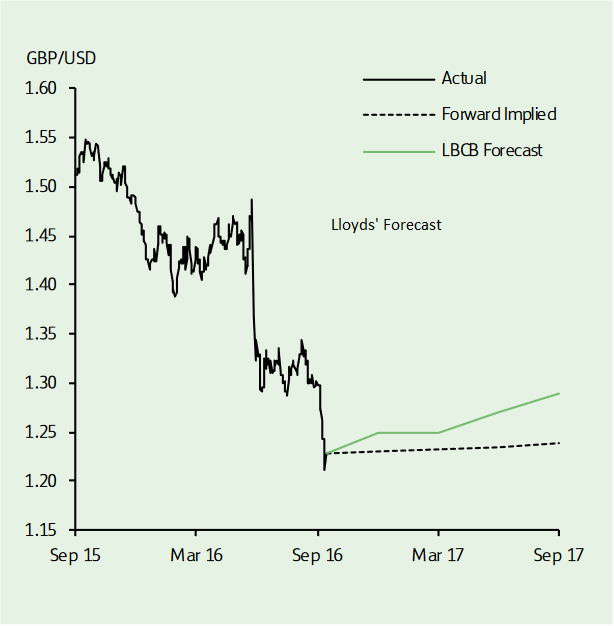
From previously expecting the UK currency to end the year at 1.3000 to the USD, they now see the pair rising only marginally from its current level of 1.2216 to 1.2500 by the end of 2016.
Looking further ahead to the end of 2017, the bank expects sterling to reach 1.3000 versus the greenback from a previous prediction of 1.3500.
Technicals: Near-Term Strength Ahead of Final Stretch Lower
Lloyd’s call for a recovery to 1.2500 is tame compared to forecasts from Goldman Sachs.
Based on technical studies Goldman’s expect a recovery to begin to above 1.2700, however, Goldman’s are more bearish longer-term, seeing the possibility of new lows once the corrective bounce has finished.
Using a type of wave analysis called Elliot Wave Theory, Goldman’s suggest the pair will rebound to the 1.2700- 1.3450 region in the months and weeks to come.

Elliot Waves are composed of five waves with 1,3 and 5 falling in line with the trend, and 2 and 4 constituting corrections.
Wave 3 is always the strongest wave, and Goldman’s analysts have labelled the wave down during the flash crash on October 7 as a wave ‘3’.
Wave ‘3’ has now probably ended and the next market move will probably be a recovery from the crash lows at 1.1500 in a corrective wave ‘4’.
Wave 4 is likely to rise to a region between 1.2700 -1.3450.
After 4 ends, however, wave 5 will resume the trend lower, potentially taking the trend to new lows below the 1.1500 lows of wave 3.