Our studies suggest that the Pound is at risk of giving up its newfound strength while Bank of America warn that markets may be too complacent with regards to the UK's economic performance following the Brexit vote.
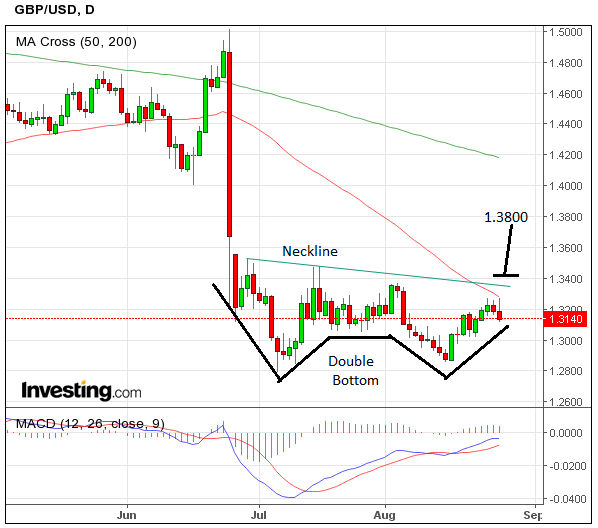
From a purely technical perspective the charts are still showing the formation of a bottoming pattern in the GBP/USD exchange rate following the Brexit sell-off.
This still looks like a double-bottom, with an eventual upside target at 1.3800 being possible.
Whilst this seems to suggest an acceleration in strength for the Pound versus the Dollar, it is only dependent on a break above the pattern’s neckline at 1.3400.
Whilst the exchange rate remains below this level, there is still a possibility of further declines taking us back down into the 1.20s again.
In fact, if we look now at the 4-hour chart (see below) we can see that the pair has broken bearishly down below a key trendline after forming a big bearish candlestick:
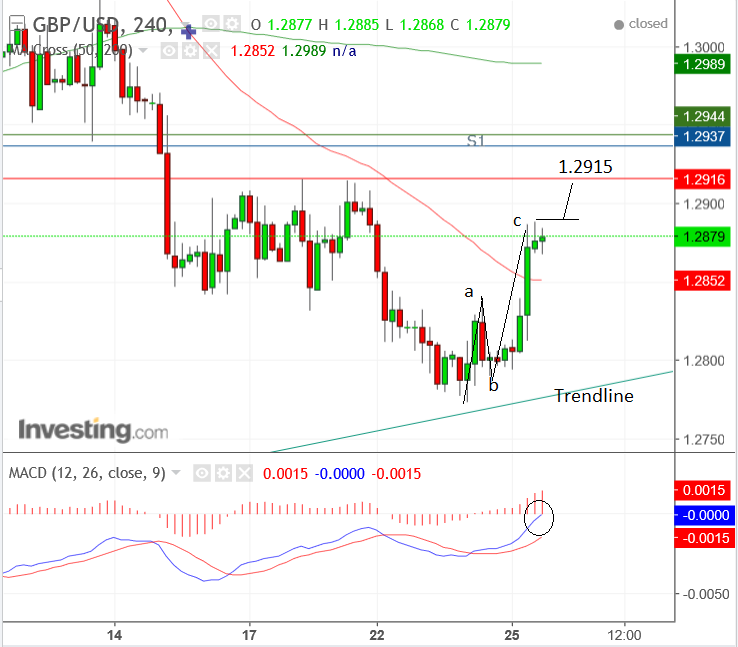
We see a combination of extremely bearish signals on a very short-term basis, which suggests a break lower, below the 1.3100 barrier.
This would potentially confirm a continuation down to 1.3035 and support from the August 19 lows.
Latest Pound / US Dollar Exchange Rates
  | Live: 1.3376▼ -0.18%12 Month Best:1.3867 |
*Your Bank's Retail Rate
| 1.2921 - 1.2975 |
**Independent Specialist | 1.3189 - 1.3242 Find out why this is a better rate |
* Bank rates according to latest IMTI data.
** RationalFX dealing desk quotation.
Weak UK Economic Performance Beckons
There is no doubt that British businesses have been heavily impacted by the vote to leave the EU.
You only have to read our latest reports in our International Trade and Strategy section to realise businesses, large and small, have in some way been affected by the referendum.
Whilst many are adapting, by, for example, focusing on new markets in America instead of the EU, the fact remains that the shock of Brexit has had far reaching consequences, both on companies’ bottom lines and on their investment and strategy goals in the future.
Whilst recent macro-economic data seems to paint a relatively benign picture of how the UK economy has held up in the month following the vote, Bank of America Merrill Lynch's chief economist, Ethan S Harris, does not see all the data as equally valid in assessing the economic health of the country post Brexit.
For starters, the strongest data appears to have come from Retail Sales, where a negative impact of Brexit would be expected to lag quite far behind other areas such as the more business orientated PMI surveys.
“We would, however, not expect the Brexit shock to show up in day-to-day spending like retail sales. Rather we think the short-term hit from Brexit likely comes from heightened uncertainty causing firms and consumers to delay investment, hiring and big ticket purchases," says Harris.
To Harris, the data looks consistent with that view: leading indicators point to sharp drops in housing transactions over the next six months while firms say they have cut their hiring plans.
Harris, suggests that as important as the vote to leave the EU, is the actual triggering of formal ‘divorce’ proceedings in the form of Article 50.
“A period of weak but not catastrophic economic performance probably beckons in our view. A key question, however, is whether the actual triggering of Article 50, when it comes, will catalyse a change in attitudes. In other words, we question now whether the big risk is not that the UK economy has a sharp short-term contraction, but rather that the Brexit drag on growth could be chronic, meaning the upturn we currently forecast for late next year does not materialise,” said the economist.
Nevertheless, in defence of the UK economy, were the relatively strong Business Investment results for the second quarter, which whilst not covering much of the period after the vote, nevertheless, would have been expected to be impacted from uncertainty in the run up.
It ought to be pointed out, however, that most of the rise in business investment was as a result of an exceptionally strong monthly result in April, when polls showed the Remain vote at its highest, so the overall quarterly data does not adequately reflect the slow-down in May and June.
Turning now to the immediate future and the main release for the week ahead for the UK will be Manufacturing, and Construction PMI’s.
Of these, Nordea Bank’s Bo Jackobsen, said in a recent note that, “The August manufacturing PMI will show whether activity deteriorated further or recovered after the slump in July, which followed the Brexit vote in June. We expect the PMI to rise to 49.0 from July’s 48.2, which was the lowest since the financial crisis in early 2009.“
The US Dollar: Payrolls Dominate the Outlook
Although the dollar had a bit of a rollercoaster ride during Federal Reserve President Janet Yellen’s speech at Jackson Hole on Friday, the end result was an almost half a percent appreciation in the dollar versus a basket of currencies.
The dollar rose on the back of Yellen’s comments that the case was strengthening for a rate hike in coming months, which increased bets the Fed will raise rates by the end of 2016.
In the week ahead the main data release is Non-Farm Payrolls on Friday, which could be seen as ‘sealing the deal’ on a 2016 rate hike.
If the economy added over 200k more jobs in August, then that would suggest the labour market was in especially rude health and increase expectations of a rate hike – possibly as soon as September – a possibility which has come on and off ‘the table’ with the rapidity of a busy Chinese restaurant serving dimsun during the lunchtime rush.