
The Pound to Dollar exchange rate is seen to be stabilising but over coming weeks is tipped to grind deeper lower into the mid-1.20's.
The British Pound has moved tentatively back above 1.30 in the wake of news Theresa May is set to become the Prime Minister of the UK following the shock resignation of her rival for the role, Andrea Leadsom.
Leadsom quitting the race is a positive for Sterling simply because a little more certainty has been delivered. Businesses no longer have to spend the next nine months awaiting the outcome of a leadership battle.
"The good news is that Mrs. May is an experienced politician who is a known quantity in Brussels. She may also get a more sympathetic hearing from other EU leaders given that she campaigned on the side of Remain and may thus be in a better position to cut a deal," says Peter Dixon, analyst with Commerzbank in London.
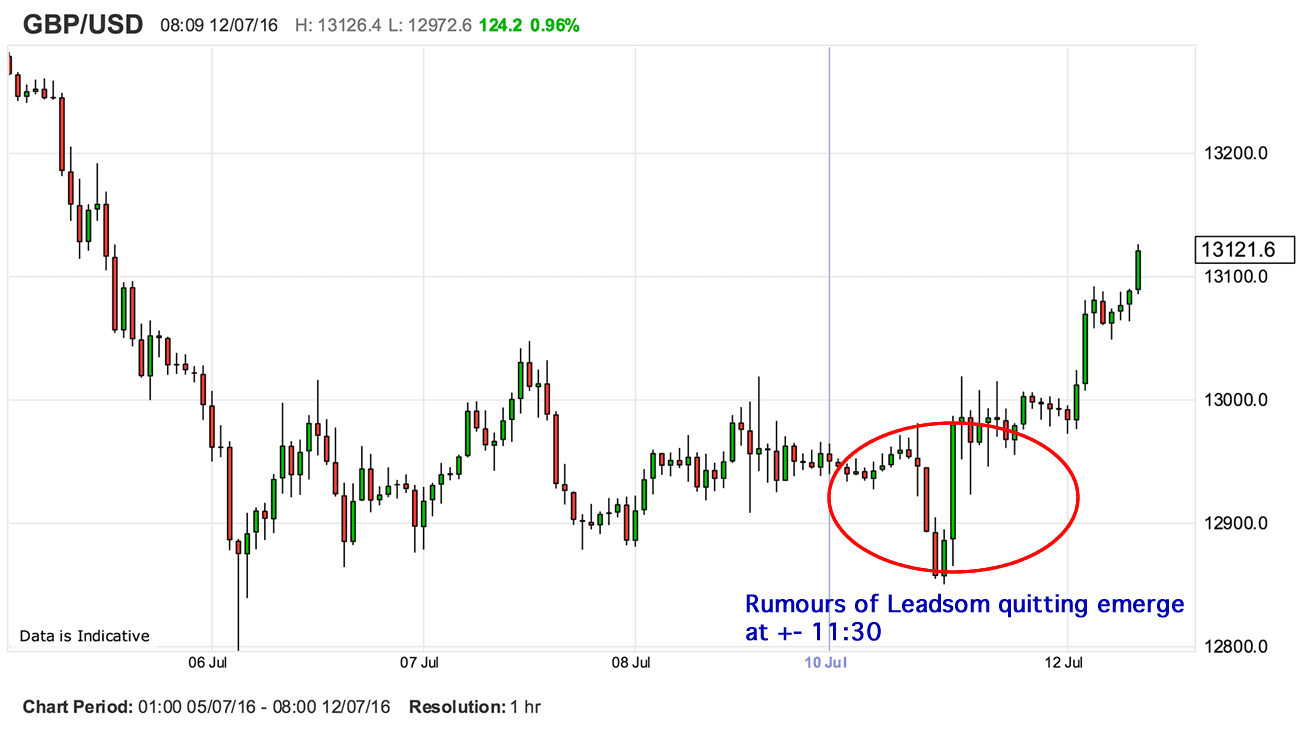
However May has a gargantuan amount of work to get through with the unenviable task of balancing pressing domestic demands with those of the EU. Progress will take time, we therefore warn those hoping for a sustained GBP recovery to be patient.
Those with international payments will be looking at a rate anywhere between 1.2642-1.2734 on their bank account while independent FX specialists are seen quoting in the 1.2890-1.2983 region.
Momentum is clearly pitted against Sterling following the 2.4% tumble in GBP/USD over the course of the previous week.
Of the world's top 31 currency Sterling has performed the worst in 2016, even pipping the Argentine Peso for the dubious accolade.
Most analysts maintain the stance that further weakness is in store with some eyeing a decline to 1.20.
Phil Seaton, a professional retail trader who runs the LS Trader system, notes that momentum continues to favour further declines in the British Pound but notes there is the prospect of further near-term consolidation:
“How much further this market has to go remains to be seen. Volume has been in decline almost every day since the 24th, which suggests that the selling pressure may be running out of steam and that a corrective rally higher may be due,” says Seaton.
We would therefore not discount consolidation taking place over the course of coming days.
We note that the exchange rate has become oversold on the daily charts with a Relative Strength Index (RSI) at 27.
Anything below 30 indicates to chartists that an asset is oversold, and due a correction higher owing to the fact that the RSI spends the overwhelming majority of its time residing between 30 and 70.
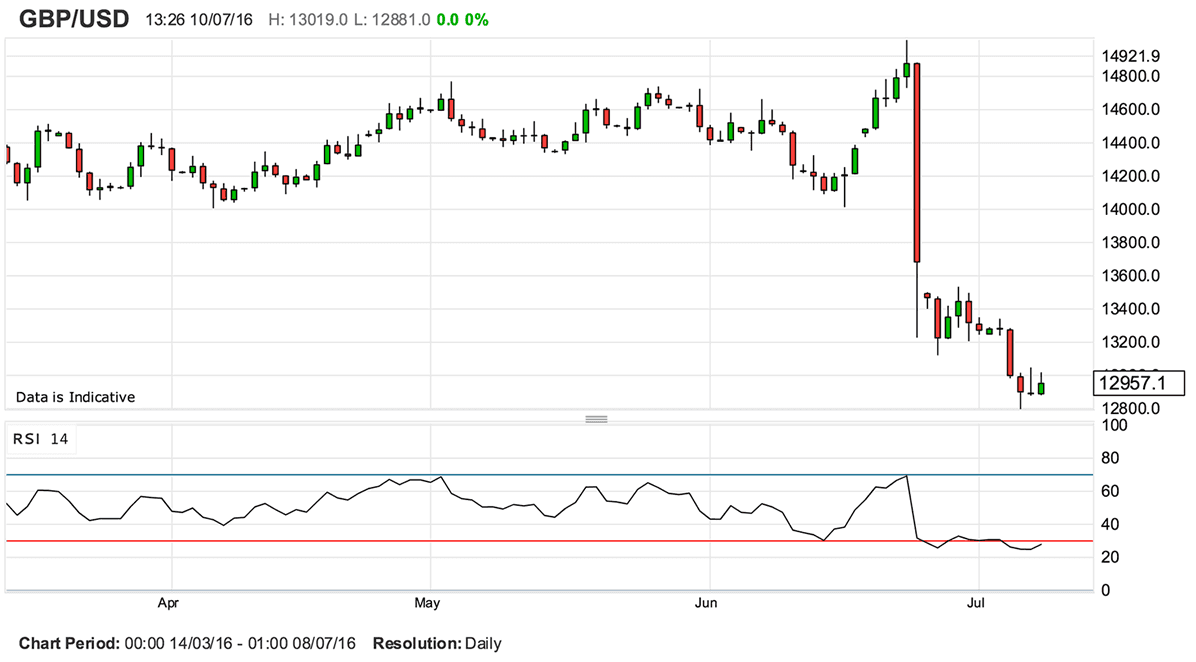
In order for a correction to take place the GBP/USD would have to either rise or tread water at current levels.
Hence the RSI doesn’t tell us a recovery is likely as its correction could also occur should the exchange rate stall.
Either way, there is now a good chance of consolidation taking place over coming days.
"We move into the 4th day of a consolidation phase over key support in the 1.2800 region and 1.3050 resistance. A rally through this resistance and then 1.3175 above is needed to suggest a broader recovery is developing," says Robin Wilkin, a technical analyst with Lloyds Bank Commercial.
Latest Pound / US Dollar Exchange Rates
  | Live: 1.3255▲ 0%12 Month Best:1.3867 |
*Your Bank's Retail Rate
| 1.2804 - 1.2857 |
**Independent Specialist | 1.3069 - 1.3122 Find out why this is a better rate |
* Bank rates according to latest IMTI data.
** RationalFX dealing desk quotation.
Morgan Stanley have, in their most recent strategy note, confirmed their studies on GBP/USD are advocating for further downside.
Elliot Wave–based technical analysis show GBP/USD started a 5- wave structure from its 2.1072 peak in November 2007 and is currently in the 5 wave.
Downside momentum appears particularly as this 5 wave is currently within a sub iii wave (green) within a 3 wave (red).
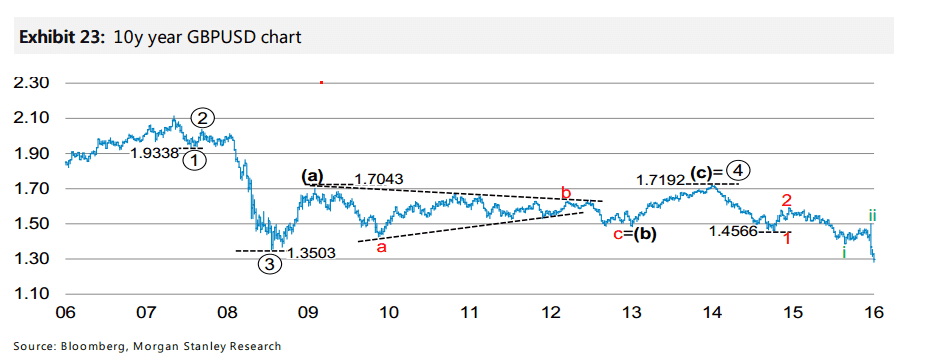
“Assuming we are correct with the 1 wave completing at the 1.9338 low in January 2008, then the 5 wave should complete near 1.24, a multiple of the length of the 1 wave,” says Morgan Stanley’s Technical Strategist Sheena Shah.
With GBP/USD breaking multi-decade lows, we have extended our chart to highlight potential key levels from the 1980s.
These are 1.1880 from May 1985 and then the 1.0545 low from 25 February 1985.
“There is an area of consolidation around 1.2500, so we could expect some support here. 1.25 is also the bottom end of the range for our year-end target and the Elliot Wave–derived target as described above,” says Shah.
Investors Will Punish GBP Strength
While Sterling could consolidate we would note any such strength will only likely be short-term in nature.
Traders are heavily biased against the UK unit and will accordingly look for any strength as an open invitation to press the Sell button once more.
“The GBP remains under pressure and the currency lost 406 pips last week. Trading the GBP pairs is going to be 'relatively' easy. We wait for retracements and we go short with a preference for the GBP/USD and GBP/AUD,” says a note from Forextell, the currency trading community.
We have noted a good number of other strategists advocate the same game plan.
Technical strategist Karen Jones at Commerzbank has told clients to wait for any correction in Sterling-Dollar to hit 1.30 before entering a fresh sell.
"GBP/USD last week sold off towards and the 1.2750/78.6% retracement of the move from 1985 to 2007. This is currently holding and is regarded as the last defense for the 1.0463 1985 low. Rallies are indicated to terminate circa 1.3065/1.3235," says Jones.
Initial resistance is found 1.3025, 1.3124 (27th June low) and then 1.353 29th June high and the market will stay directly offered below here.
Bank of England Decision Promises Volatility
Potential disruption to the GBP to USD conversion comes in the form of an highly anticipated Bank of England Monetary Policy Committee meeting due on Thursday the 14th.
The Bank of England have proven they have learnt the lessons of the 2008 financial crisis when the Bank was accused of being flat-footed in responding to crisis.
Following the Brexit vote the Bank of England has acted quickly and decisively to ease market concerns by increasing funding to the capital markets and therefore containing any potential financial fallout.
The leadership of Mark Carney and his team has contrasted starkly to the Government which has been undermined by the resignation of Prime Minister Cameron and a period of deep introspection as a new leader is sought.
Releasing the Bank’s financial stability report last week, Mr Carney warned that the outlook for the economy has deteriorated and the UK’s current account deficit is a “potential source of fragility”.
Markets are pricing in a 0.25% cut to the basic interest rate; anything in addition to this is arguably unaccounted for and therefore poses downside risks to the British Pound.
Likewise, should a rate cut not be forthcoming the British Pound could rally.
Indeed, Carney has proven himself to be a reluctant cutter noting previously that, “as we have seen elsewhere, if interest rates are too low or negative, the hit to bank profitability could perversely reduce credit availability or even increase its overall price."
Any recovery rally in the GBP/USD exchange rate could be quite aggressive in the context of a market that remains heavily lopsided - everyone and his dog are betting against the GBP at present.
In such scenarios it takes on counter-trend news bite to force traders out of the market and push the GBP/USD higher. This in turn forces yet more out of the market, and the technical move propogates.
We would suggest that those with impending Pound into Dollar payments should take advantage of any such move.
The trap is that such strength is mistaken for genuine strength.