The U.S. dollar is firmer against most of its competitors as members of the US Federal Reserve hint at further interest rate rises and investors steer clear of the euro ahead of Thursday's ECB meeting.
- Our studies show the outlook for the pound to dollar exchange rate remains constructive in near-term
- The euro to dollar rate is, surprisingly, back above 1.10.
- Against the Australian dollar, the Greenback is at risk of reversing its longer-term trend higher as the commodity dollars recovery.
The US dollar is mixed in foreign exchange trade at the time of writing, being seen higher against the pound and commodity currency complex, but lower against the euro.
The weakness against the euro is surprising if we consider this week's ECB meeting is a mere 48 hours away, why would investors buy a currency that could be about to be crushed by Mario Draghi and his posse?
USD strength elsewhere is warranted in our view though.
Latest Pound / US Dollar Exchange Rates
  | Live: 1.3341▲ + 0.27%12 Month Best:1.3867 |
*Your Bank's Retail Rate
| 1.2887 - 1.294 |
**Independent Specialist | 1.3154 - 1.3207 Find out why this is a better rate |
* Bank rates according to latest IMTI data.
** RationalFX dealing desk quotation.
Speaking up the Dollar
This week is light on data but we do have the words of US Federal Reserve board members to latch onto.
At the start of the week we have heard from Board Governor Lael Brainard and Vice President Fischer.
Fischer told the National Association of Business Economists that he sees evidence of the "first stirrings" of rising inflation. Further he says the U.S. is in the "vicinity of full employment."
Positive words that shored up sentiment towards the USD which was further boosted by Fed Board Governor Lael Brainard, a permanent FOMC voter, who told the Institute of International Bankers annual conference in Washington the she believes inflation should move higher if oil prices stabilise.
But, Brainard also urged caution: "tighter financial conditions and softer inflation expectations may pose risks to the downside for inflation and domestic activity. From a risk management perspective, this argues for patience as the outlook becomes clearer."
On balance markets have taken the comments to signal the Federal Reserve remains on track to raise rates a few more times in 2016; this support from higher interest rates will ensure the US assets retain a bid which will in turn drive demand for dollars.
The focus on inflation by the two Fed speakers echoes the focus of central bankers right across the globe all who are fighting against deflation. No doubt, the recent recovery in oil prices will make their jobs all the more easier and arguably negates the need for further interest rate cuts or expanded quantitative easing.
Pound to Dollar Exchange Rate Outlook: Resistance Halts Gains
The dollar came under pressure against the pound over the course of the start of March as a technically oversold pound fought back.
There are tentative signs of a reversal in GBP/USD, although it is too early to say for certain.
This week’s strong performance by sterling means it has formed a two-bar reversal pattern on the weekly chart.
Despite not being a ‘5-star’ grade set-up because the volume is muted and the bars are not quite the same length, it is nevertheless probably a 4-star pattern, given its placement at the end of a protracted down-trend.
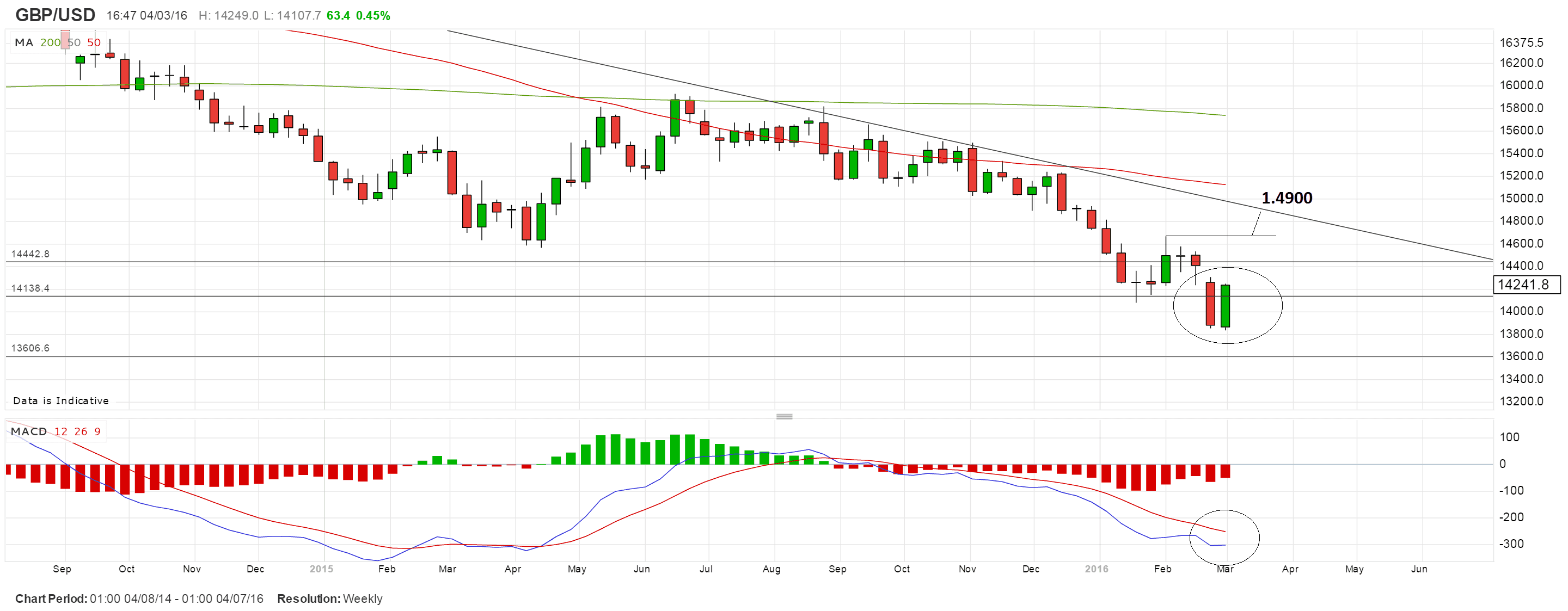
We are also within a support zone supplied by major lows on both 2008 and 2010 lending further credence to a potential reversal unfolding.
A break above the 1.4534 highs would provide confirmation of a reversal, with an initial target at a major trend-line at 1.4900.
Euro to Dollar Exchange Rate Outlook
The EUR/USD pair is still stuck within a long-term range between 1.14 and 1.05.
It recently fell from a peak at 1.1376 in a three-wave move down, to support from an old trend-line at 1.0850, and has since started rising again.
The Non-Farm Payrolls report on Friday has led to an extension of the nascent up-trend which has now moved above 1.10 again, but been repelled at first touch by the monthly pivot at 1.1025 and the 50-day moving average at 1.0976.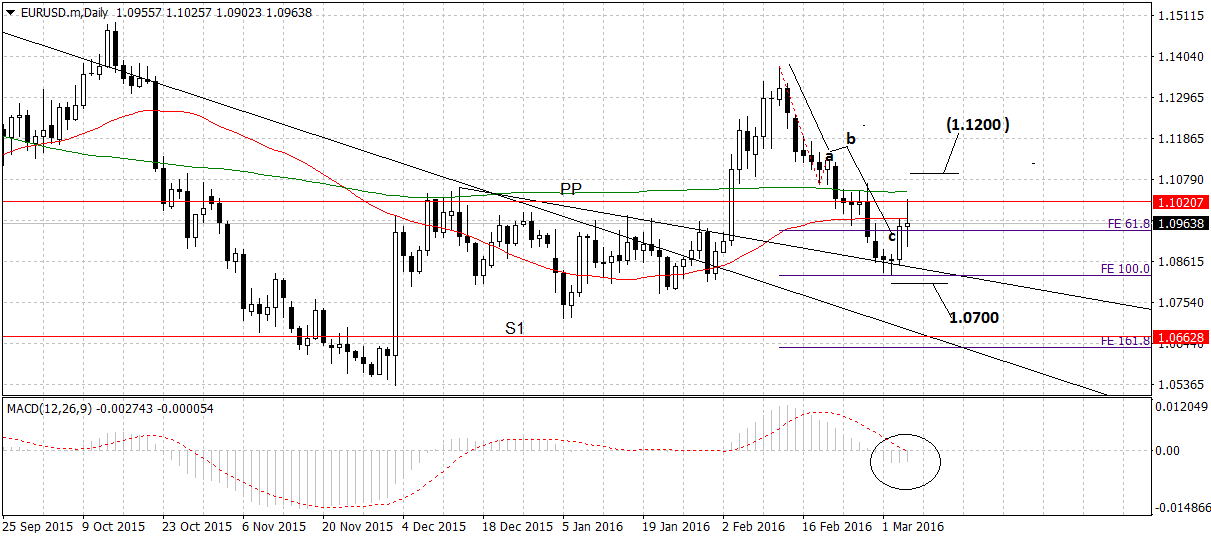
For more upside a move above this pivot, the 50-day and the 200-day - not much higher at 1.1046 - would be necessary.
Confirmation would be gained by a break above 1.1100, with the 1.1200 level providing the next target.
Alternatively, more down-side would probably come from a move below the 1.0800 handle, with the next target at 1.0700.
Momentum remains in bearish territory, as noted on the MACD indicator in the bottom pane, biasing slightly expectations for further downside.
Australian to US Dollar Exchange Rate Outlook
Dollar weakness has already been sufficient to trigger a change of long-term trend in the Australian dollar.
The New Zealand dollar could follow suit this week.
"It’s interesting to note that both of these currencies are commodity-based currencies, which goes to bolster that view that strength is returning to some commodities markets. Such a move is also consistent with a return to risk-on in the financial markets, something that is also being seen in stock," notes Phil Seaton at LS Trader.
The Aussie has broken above the neckline of a double-bottom reversal pattern against the US dollar, increasing the bullish potential of the chart.
If the exchange rate moves above the 0.7450 confirmation level it will increase the probability of a move up to the next target at 0.7739.
A double bottom is a pattern which occurs at the end of a down-trend and signals prices are going to reverse trend and move higher.
It is formed when prices move down and form a trough, recover and then move down again and form another trough.
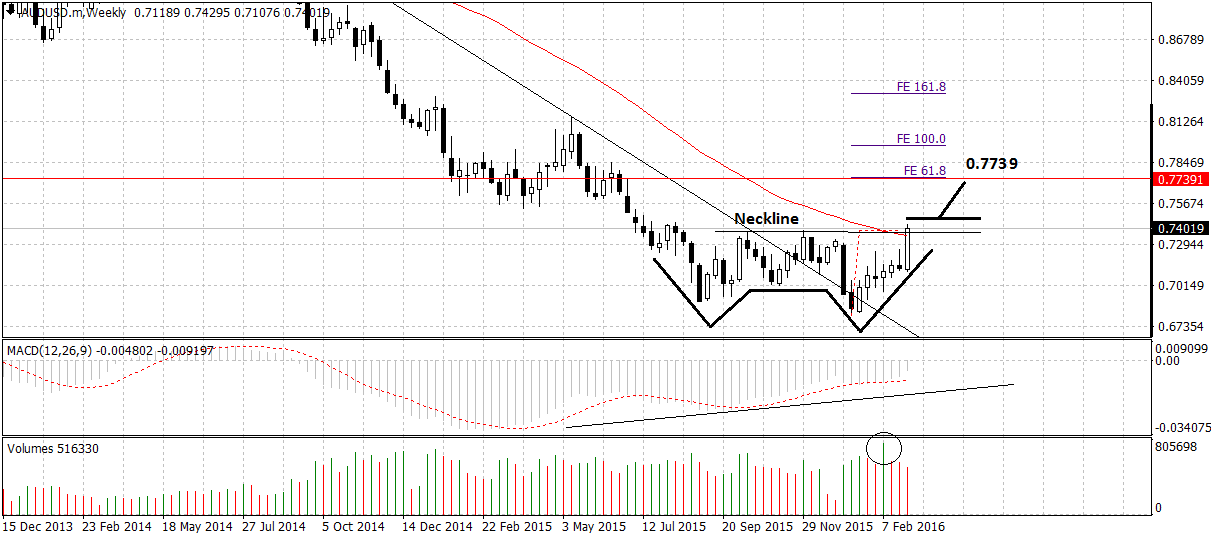
Prices then recover again and this time break higher at the neckline, which is the level of the inter trough recovery high.
The break above the neckline is the signal traders look for, for confirmation of a change of trend.
Prices are then expected to rally an equal distance to the height of the double bottom extrapolated higher – or at a minimum, 61.8% of the height of the pattern.
The neckline of the double-bottom on the AUD to USD weekly chart has at 0.7400, has already been breached but the confirmation level at 0.7450 has not yet been broken.
If it is breached, then it will help confirm a continuation higher to the aforementioned target.
Converging momentum and the volume spike circled on the chart are further indications a reversal is unfolding.
US Economic Data to Watch
Consumer Credit kicks off the week and is expected to come out at 15.00bn (from 21bn previously) - also out on Monday is the Labour Market Conditions Index.
Tuesday sees the release of NFIB Business Optimism (Feb) (93.9 prev).
On Wednesday we have Wholesale Inventories in Jan (-0.1% prev), followed by U.S Crude Oil Inventories (Mar3).
Initial and Continuing Jobless Claims are out on Thursday and the Budget Balance.
Friday the 11th sees the release of the Baker Hughes Rig Count.