Image © Adobe Images
CIBC says the U.S. dollar is likely to weaken into the first half of 2026 before stabilising and recovering later in the year, describing its outlook as "U-shaped".
The Canadian bank said “risks will push the USD lower in the next couple of quarters”, arguing that downside risks to the U.S. labour market and growth will outweigh any modest upside risks to inflation.
CIBC said unresolved questions over who ultimately bears the cost of tariffs are “stagflationary and should push USDs lower in the early months of 2026”.
It warned that if firms absorb tariff costs, they may be forced to cut labour to protect margins, while if consumers pay, inflationary pressures would rise, both scenarios weighing on the dollar.
The bank also said uncertainty over Federal Reserve independence could be a major theme early next year, noting that “the appointment of the Federal Reserve Chair has yet to be decided”.
Legal challenges to Trump’s IEEPA tariffs could further undermine the greenback, with CIBC saying a ruling against them would likely trigger rallies in trade-sensitive currencies that would “mechanically lead to a weaker greenback”.
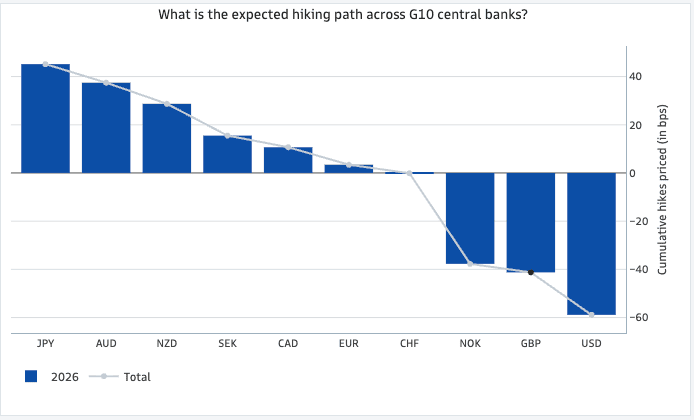
Above: Traders are betting the Fed will be the biggest cutter this year, underpinning a bearish USD consensus.
CIBC said these risks are front-loaded and “not long lasting”, arguing that markets will eventually conclude that expectations for U.S. interest rate cuts have gone too far.
The bank believes the Fed’s estimate of neutral interest rates is mispriced, saying “the true value is 50bps higher”, which should ultimately support the dollar later in 2026.
CIBC said it expects “an inflection point for the greenback to turn slightly higher” by mid-year, forecasting the dollar index to fall to 96.0 by the end of the second quarter before recovering to 97.30 by the end of 2026.
For the likes of EUR/USD and GBP/USD the implications are relatively straightforward: As long as the dollar index is falling, these pairs are rising.
All else equal, further advances into the middle of the year before falling into year-end.
✳️ Secure today's exchange rate for a future payment. You may also book an order to trigger your purchase when your ideal rate is achieved. Learn more.