

Image © Adobe Images
Wall Street’s technological footprint is shifting fast. Driven by broader capital market demands, blockchain technology now reaches far past initial cryptocurrency trading.
Decentralised finance (DeFi) introduced alternative models for lending, borrowing, and digital asset management. Parallel to this, proprietary trading houses are restructuring operations with advanced tech stacks to tighten transparency, speed up execution, and refine capital allocation.
The two sectors serve distinct market functions. Yet Web3 protocols and modern prop desks now run on increasingly similar technological foundations. Modern trading models are changing under blockchain's influence, altering the landscape of digital finance.
The Evolution of Proprietary Trading in the Digital Era
Proprietary trading used to happen behind closed doors. Desk traders relied entirely on internal firm capital, physical trading floors, and direct, low-latency market connections to capture yield.
Fintech changed that setup.
Remote evaluation platforms grew rapidly, letting independent retail traders access institutional liquidity pools under strict risk controls.
As capital allocation shifts toward decentralised networks, market participants frequently analyse how modern evaluation models function within a modern prop firm structure.
Financial markets moved online quickly. That shift created urgent demand for high-throughput trading stacks capable of handling live data streams, automated risk controls, and instant order routing.
How Blockchain Is Transforming Financial Infrastructure?
Blockchain is more than an engine for crypto coins. Today, global financial markets treat distributed ledger technology as a viable upgrade for legacy clearing infrastructure.
Distributed ledgers record transactions permanently. They offer clear data integrity alongside instant, multi-party verification. By removing isolated databases, distributed systems eliminate single points of operational failure, cut settlement delays, and lower heavy post-trade clearing costs.
Institutional leaders want resilient systems. That operational requirement drives interest in Web3 architectures across banking, clearing, and asset management sectors. Secure, shared ledgers offer a simple tradeoff: reliable trade reporting and significantly lower back-office spending.
Smart Contracts and the Automation of Financial Processes
Automated execution sits at the centre of this structural shift. Smart contracts execute agreements automatically once incoming market data triggers pre-set code parameters.
Applied to market operations, these protocols remove manual ledger checks, bypass middle-office intermediaries, and drive down per-trade operational expense. Decentralised applications handle real-time settlement, automated clearing routines, and strict regulatory checks instantly.
Proprietary trading operations still use centralised matching engines for raw execution speed. Even so, programmatic automation is resetting standards for standard back-office tasks. By standardising execution rules and payout mechanisms, automated smart contract logic sets a new benchmark for speed and reliability across digital finance ecosystems.
DeFi vs. Proprietary Trading Ecosystems
Decentralised finance and proprietary trading both focus on capital efficiency, but their core operating rules remain very different across access, risk oversight, and system control.
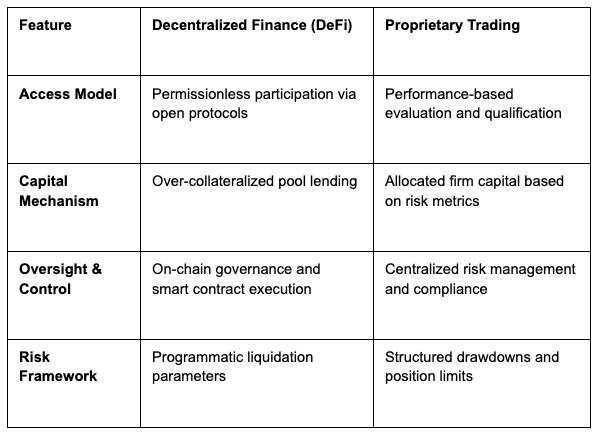
Capital rules split these worlds. DeFi runs on open, permissionless smart contract pools; prop firms rely on performance evaluations to hand out trading leverage. Yet both rely on technology to maximise return per dollar deployed. As institutional crypto markets mature, these two operational models continue to borrow structural ideas from one another.
Tokenised Assets and Future Capital Access Models
Asset tokenisation bridges traditional asset management and distributed ledger networks. Converting stocks, real estate, and bonds into digital securities enables fractional unit ownership along with continuous secondary trading.
Market participants gain access to previously illiquid instruments through a global, cross-border digital layout. For modern trading operations, the rise of tokenised assets broadens the scope of tradable instruments and introduces flexible collateral management models.
As blockchain finance continues maturing, digital securities are expected to play a prominent role in expanding global capital access and redefining asset ownership.
Technology Trends Reshaping Modern Prop Trading
Competitive trading demands aggressive tech investment. Modern prop firms deploy quantitative analytics, artificial intelligence, and cloud hosting to manage risk across global markets. AI algorithms parse market feeds to spot volume shifts instantly.
Automated risk tools run continuously in the background, liquidating positions the moment a desk breaches its drawdown limit. Real-time dashboards give managers immediate exposure stats, while custom APIs connect firm software directly to external liquidity pools.
Traders seeking competitive market access routinely evaluate the features offered by the best prop firms to ensure alignment with their strategy. Ultimately, modern trading platforms depend heavily on fintech automation to streamline operations, enhance risk management, and optimise execution.
Transparency, Trust, and Data in Financial Markets
Markets break down without reliable data. Integrating blockchain verification into financial workflows creates immutable audit trails, preventing trade discrepancies before settlement. Shared, tamper-resistant ledgers allow institutions to verify trading history instantly without relying on proprietary internal databases.
This shift toward verifiable financial transparency is raising expectations among market participants for greater openness across asset classes. As institutional adoption grows, auditable trading data and clear performance metrics are becoming baseline requirements for modern financial platforms.
Emerging Trends at the Intersection of Web3 and Trading
Looking ahead, capital markets and Web3 networks continue to mix, giving rise to hybrid financial tools. Developers are actively building decentralised identity systems to simplify trading verification, cross-chain protocols to aggregate liquidity across isolated networks, and AI modules to run real-time risk calculations.
Meanwhile, tokenised funds are blurring the line between off-chain asset management and on-chain liquidity protocols. The overall goal across these developments remains consistent: build safer, faster, and fully interoperable market infrastructure.