

Image © Adobe Stock
A stronger dollar can weigh on gold without deciding its direction.
A stronger dollar can weigh on gold without deciding its direction. Interest-rate expectations, demand for protection and investment flows can outweigh the currency effect, particularly when markets are responding to several risks at once.
The World Gold Council's Q3 outlook, published on 3 November 2026, noted strong gold ETF inflows despite higher bond yields and a stronger dollar. That observation concerns investment demand, rather than a claim that both prices rose together throughout the quarter. It illustrates why one relationship cannot explain the whole market.
Quick answer: the gold-dollar relationship is conditional
Gold responds to the combined effects of currency movements, inflation-adjusted yields, investor demand and positioning; none determines the price alone.
XAU/USD expresses the dollar price of one troy ounce of gold. A rising dollar can make gold more expensive for buyers using other currencies, while higher real yields can make interest-bearing assets more attractive. Neither channel prevents investors from buying gold for different reasons.
Before interpreting XAUUSD signals, establish three macro assumptions:
• Currency: does the idea require a weaker dollar, or could another source of demand offset dollar strength?
• Rates: is the argument about nominal interest rates or returns after expected inflation?
• Catalyst: what new information would challenge that explanation within the intended holding period?
The Forex Complex describes its gold trading signals as XAU/USD ideas with entry zones, stops, targets and market context. Those elements provide a structure to examine; they do not establish predictive accuracy. The relevant question is whether the explanation still fits after fresh information arrives.
Four drivers that often matter to gold
The WGC's mid-year outlook, published on 1 July 2026, grouped gold's influences into economic expansion, risk and uncertainty, opportunity cost, and momentum. For currency-market readers, the following four channels translate that broad framework into practical questions.
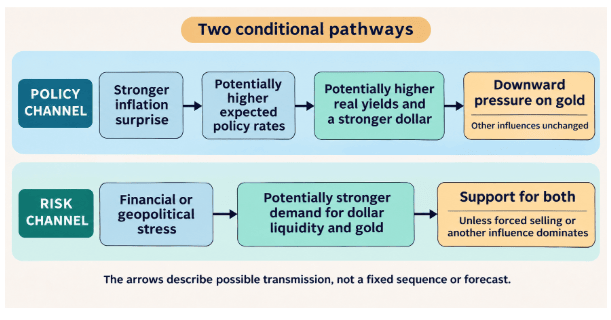
Dollar denomination and global demand
Dollar strength changes the cost of gold outside the United States. If the dollar rises against sterling while XAU/USD is unchanged, the same ounce becomes more expensive in pounds. Buyers may adjust demand, although their response depends on income, local prices and investment motives.
The exchange-rate measure also matters. A broad dollar index, GBP/USD and a particular buyer's domestic currency can move differently. Calling everything "the dollar" obscures which purchasing-power channel is relevant.
For UK readers, gold's sterling price is its dollar price divided by GBP/USD. A currency translation effect can therefore change a British investor's return even when the underlying dollar gold price barely moves.
Real yields and opportunity cost
Gold pays no coupon. Its opportunity cost is the return forgone by holding it instead of an interest-bearing asset. Inflation-adjusted, or real, yields help describe that comparison.
A nominal bond yield and a real yield are different measures. Subtracting the latest annual CPI reading from a Treasury yield does not produce the market's forward-looking assessment. Traders often watch inflation-linked Treasury yields alongside nominal yields and market inflation expectations.
A rise in nominal yields need not mean an equivalent rise in real yields. If inflation expectations increase faster, real yields can fall. Gold's response consequently depends on what changed inside the yield movement.
Risk sentiment and safe-haven buying
Safe-haven demand is a motive for buying, not protection against a falling market price. Investors may seek gold because they are concerned about geopolitical disruption, fiscal credibility or the stability of other assets.
Different concerns create different trades. A growth scare might support expectations of lower rates; an inflationary supply shock could increase both defensive demand and expected policy rates. Those channels can pull gold in opposite directions.
The useful question is which risk investors are trying to hedge. A general label such as "uncertainty" does not establish the size, timing or persistence of buying.
Positioning, central-bank demand and momentum
Prices reflect existing exposure as well as new information. An apparently supportive announcement may produce little buying if investors already hold substantial positions. Conversely, traders closing short positions can lift gold without a fresh long-term allocation decision.
Central-bank purchases operate on a different horizon from an intraday signal. They can contribute to demand without determining the outcome of the next data release. The WGC's November outlook also cautioned that official-sector buying does not establish a firm price floor.
Momentum can amplify either direction. Price strength attracts some buyers, while profit-taking or leveraged position reductions can accelerate a reversal.
Why a textbook inverse correlation can break down
Gold and the US dollar can rise together when different investors want dollar liquidity and gold exposure at the same time, or when other gold price drivers outweigh the currency headwind.
Correlation describes how two series moved over a chosen period. It does not require them to respond identically to the next event.
Risk shock and simultaneous demand for dollar liquidity and gold
During stress, businesses and investors may need dollars to settle obligations, meet collateral demands or hold liquid assets. Other participants may simultaneously increase gold allocations as a hedge.
The buyers need not be the same people, and the motives need not conflict. A dollar funding requirement can coexist with concern about longer-term financial conditions.
Stress can also produce the opposite result: gold may be sold to raise cash or cover losses elsewhere. Safe-haven demand therefore cannot establish what will happen in the first minutes of a shock.
Regime and horizon effects
Relationships change when the dominant concern changes. A market focused on inflation credibility may react differently from one focused on recession, liquidity or fiscal risk.
The observation window matters too. Gold and the dollar could rise together during a volatile session yet retain an inverse relationship over several months. Comparing a five-minute move with a monthly explanation creates a mismatch before the analysis begins.
Always identify the period and variable being compared. "Gold diverged from the dollar" is incomplete without specifying which dollar measure, over what interval and relative to which earlier relationship.
From market narrative to a testable gold trading idea
A gold signal becomes assessable when it states its assumptions, activation conditions, invalidation and financial exposure before the outcome is known.
A plausible macro story is not enough. It needs to explain what evidence would support the proposed trade and what evidence would undermine it.
What a signal should specify before an event
A usable description identifies the instrument, direction, entry condition, holding period, target and expiry. It also separates the price that invalidates a chart setup from the macro development that weakens its rationale.
Consider an illustrative idea based on a softer inflation release reducing expected US rates. The plan could require a sustained price move rather than the first spike, alongside falling real yields or evidence that dollar strength is fading. These are hypothetical conditions, not a current recommendation.
If gold rises while real yields and the dollar also climb, the original rate-based explanation needs reassessment. Other demand may explain the price, but changing the story afterwards makes the initial idea harder to evaluate.
A trade record should preserve the original rationale, the evidence available at entry and any later revision. This allows a profitable execution with weak reasoning to be distinguished from a well-specified idea that lost money.
An event-week scenario map for XAU/USD
US CPI, employment reports and Federal Reserve communications matter because they can alter the expected path of policy. The surprise relative to expectations matters alongside the headline number.
A payroll report, for example, can contain revisions, wage information and participation changes that complicate its initial message. The market's interpretation can evolve as those details are absorbed.
US inflation print: three possible interpretations, not a forecast
The table presents hypothetical pathways. It assigns no probabilities and assumes no automatic gold response.
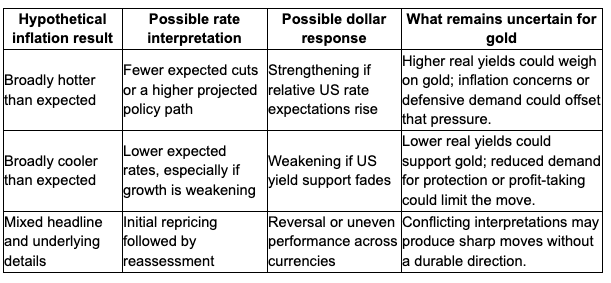
The US inflation–gold price relationship runs through expectations and competing demand, rather than a simple rule that higher inflation must lift gold. The same release can also change short-term rate expectations differently from longer-term real yields.
When to stand aside
An incomplete explanation does not need to become an immediate trade. A release may leave the rate outlook unresolved, the dollar move may reverse, or quoted prices may become too costly to execute.
Standing aside can follow a defined condition: an unusually wide spread, a move beyond the planned entry zone, or no clear invalidation point. Those are observable reasons to reject an entry, rather than vague discomfort after prices have moved.
UK reader cautions: spreads, leverage, time zones
A gold CFD gives exposure to price changes without ownership of bullion. Its spread, financing charges, contract size and currency conversion can make the account result differ from a simple gold chart.
Under the FCA's retail CFD rules, gold requires at least 5% opening margin, equivalent to maximum leverage of 20:1. Account-level close-out requirements and negative balance protection provide safeguards, but substantial losses remain possible.
In a hypothetical example, £1,000 of margin supports £20,000 of equivalent exposure. An adverse 1% move represents £200, or 20% of that margin, assuming unchanged exchange rates and excluding costs. Margin is not a sensible substitute for a separately defined loss limit.
Gold volatility around an announcement can widen spreads and worsen fills. An ordinary stop-loss triggers an order; it does not guarantee the requested execution price. Position sizing should allow for execution uncertainty.
Check event times using the release date and stated time zone. UK and US daylight-saving changes do not always coincide, so the usual clock difference can temporarily change. Broker maintenance breaks and overnight financing cut-offs require separate checks.
Conclusion: a signal needs a macro assumption and a risk limit
Reading gold requires separating the explanation for a move from the conditions for acting on it. Dollar strength, real yields and demand for protection can reinforce one another, offset one another or dominate at different horizons.
Before assessing the next alert, record its macro assumption, the evidence that would challenge it and the exposure involved. That creates a decision that can be reviewed when the outcome is known, without pretending that a convincing explanation makes the next price move certain.