Forecasts from JP Morgan show the GBP to EUR exchange rate could slip to 1.12 by as a second wave of post-referendum selling pressures emerge, prompted by the delivery of notable stimulus measures by the Bank of England.

- Pound to euro exchange rate today: 1.1948, 0.04% lower on day-to-day comparison
- Euro to pound sterling exchange rate today: 0.8370
- Bank of England's Martin Weale prompts fresh Sterling weakness as he warns of notable stimulus at August meeting
- Technical studies confirm declines to remain supported by solid buying interest at 1.1933/1.1926 area over coming days.
The outlook for the British Pound now rests almost exclusively with the Bank of England who meet on the 4th of August to deliver what is expected to be notable changes to their policy settings.
It will be the decisions made here that will likely trigger a second bout of post-referendum GBP weakness argue analysts at JP Morgan - the world's largest investment bank.
It is the belief at JP Morgan that the Pound is ultimately overvalued at current levels and therefore the exchange rate has further to fall despite already loosing +/- 10% of its trade weighted index since the Brexit vote.
A trigger is therefore needed to propel the GBP lower to its 'fair value' estimates; and that trigger will in all likelihood be the Bank of England.
Initial downside has been prompted by a noted 'hawk' on the Bank of England's Monetary Policy Committee (MPC), Martin Weale, who has indicated he is now ready to cut interest rates.
The about-turn by Weale was prompted by the worse-than-expected July PMI result on Friday 22nd July, which was the first major economic release for the period after Brexit.
“The Flash PMI on Friday was the first piece of data following Brexit and this disappointed at 47.7, a level that indicates rising recession risk. This should give the BoE the impetus needed to ease at the upcoming August meeting,” says J P Morgan’s Global FX Strategist John Normand.
Analyst Viraj Patel at ING agrees, saying he is expecting substantial stimulus to be enacted at the August meeting:
"This supports our view that the BoE will deliver a sizeable package of stimulus measures at next week’s MPC meeting (4th Aug). Moreover, Weale’s comment that 'asset purchases are still likely to be effective' suggests that there are material upside risks to our £50bn QE expansion call."
Latest Pound/Euro Exchange Rates
  | Live: 1.1793▲ + 0.09%12 Month Best:1.1828 |
*Your Bank's Retail Rate
| 1.1392 - 1.1439 |
**Independent Specialist | 1.1628 - 1.1675 Find out why this is a better rate |
* Bank rates according to latest IMTI data.
** RationalFX dealing desk quotation.
JP Morgan Forecasting Rate Towards 1.12 by 2017
JPM's Normand dismisses those who say sterling has already weakened far below its fair value, arguing that in times of crisis currencies often trade well out of step with fair value models.
“Understandably many accounts are skeptical that even extraordinary easing can weaken GBP much more since the currency already trades some 5% to 8% cheap to interest rate differentials, depending on the cross-rate and sample period used in the model. But note that this risk premium is smaller than the one which attended Lehman, and that many currencies have moved in non-linear ways when central banks pursued unprecedented monetary easing. Examples include the dollar, yen and euro during the initial phases of their respective central bank’s QE programmes,” says Normand.
In the immediate future Normand and his team actually note how Sterling has been trending higher when compared with its fair value, which is based on the difference between two country’s interest rates.
This is due to the phenomenon that currencies with higher interest rates appreciate more than those with lower interest rates, as international capital tends to flow to where it can earn the most interest:
“GBP has outperformed in the last two weeks even though UK-US rate differentials are making new lows. Indeed, 2y UK yields are modestly lower but US 2y yields have increased by 18bp in the last two weeks. The UK-US yield spread has thus made a new decade low and yet GBP/USD has strengthened over this period. As a result, the concession in sterling has been pushed to its lowest post-Brexit, as discussed earlier. Third, the concession has been much larger in periods of stress in the past with GBP/USD trading as much as 20% cheap vs. fair value following Lehman.”
“EUR/GBP should have more momentum, to 0.89 by year-end. We expect the next BoE meeting on August 4 to be catalyst this second phase of sterling weakness that will be lower-volatility than the first phase but nonetheless material in percentage terms,” says Normand.
EUR/GBP at 0.89 equates to a Pound to Euro exchange rate at 1.1236.
Societe Generale see 'Fundamental' GBP Downside
Also anticipating further notable GBP weakness ahead are Societe Generale’s who have written to clients saying they see more fundamental downside on the horizon, particularly after the new Chancellor Philip Hammond’s comments about monetary policy being the first line of defence for the economy:
“UK Chancellor Phillip Hammond's observation yesterday that monetary policy represents the first line of defence for the UK economy in the face of the economic shocks from the UK's departure from the EU is another hammer blow for sterling. So far it's stopped the pound's bounce in its tracks but before long it will deliver new lows against the Dollar for sure, and perhaps against the Euro too.”
Analyst Kit Juckes argues an increase in fiscal spending would be a more appropriate response, but this is unlikely to happen, so Sterling is doomed to further weakness:
“A substantial loosening of fiscal policy and a major round of investment in creaking infrastructure is the obvious response to the UK's self-inflicted shock. With real gilt yields deep in negative territory, forget austerity. But by the same token, to choose to try and offset the economic hit with even looser monetary policy rate cuts and more QE will drive the pound significantly lower.”
Technicals: A Break of 1.1848/80 Exposes Further Weakness
From a technical/chartist perspective we hear there is plenty of scope for volatility but the direction of travel for the GBP/EUR pair is still up for debate.
"Technically speaking the long terms support for the GBP/EUR rate is exactly where the market currently sits. €1.1950 is a pivot point between the trend and the range of the last 8 ½ years and an entirely new range below that," says David Johnson at Halo Financial.
Johnson says that were we to see a move to €1.1880 and below, then the market could be heading much lower.
"But as long as Sterling sits around this level, there is scope for further gains and €1.26 would be my target if we get any upward momentum," says Johnson.
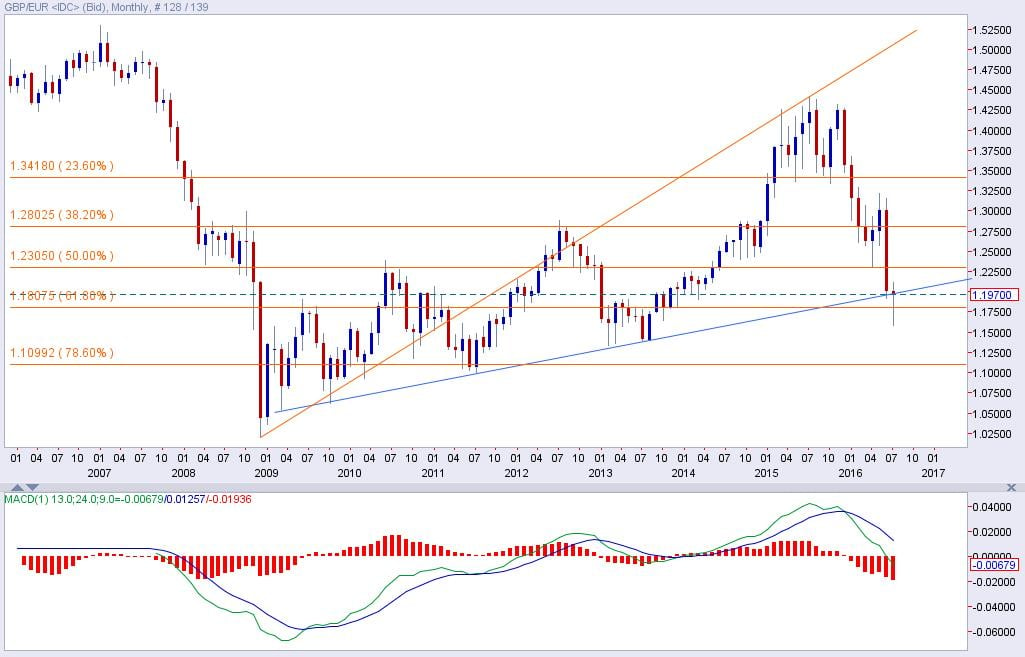
Declines appear to be supported by solid buying interest at 1.1933/1.1926.
“But in the aftermath of reports suggesting MPC member Weale now favours monetary easing at next week’s BoE meeting, the pair tests important support at 1.1876/1.1848,” says Quantitative Strategist Gajan Mahadevan at Lloyds Bank.
Technical studies of GBP/EUR conducted by the Mahadevan and his team suggest a broader correction higher from the 1.1591 region could still be seen.
Lloyds warn that a test of the 1.2270-1.2578 key medium-term resistance region remains possible.
“But with GBP at risk of being on the back foot, a move through 1.1848 would suggest further sideways trading is more likely, if not a move back to new lows,” cautions Mahadevan.
Long term, in conjunction with their view that GBPUSD is reaching the end of a long-term downward cycle, Lloyds believe the move to the bottomside is the last within the correction from the 1.4286-1.45 resistance region.
Should the exchange rate move below 1.1494, the market could be exposed to seeing levels levels of support located in the 1.11-1.0869 region.
GBP/USD Could Slip to 1.20 on Bank of England Action
While we have looked at the potential paths for the GBP/EUR in detail, what of the GBP/USD exchange rate?
For analysts at Capital Economics, the indpendent economic analysis and forecasting consultancy, the divergence in policy between the US Fed and BoE will have significant implications for the Pound / Dollar rate.
Captial Economics think that the contrast in interest rates in the next few years will be even greater than investors anticipate.
While they agree with other analysts that the MPC will cut Bank Rate soon (they forecast a 25bp reduction next week as well as a £75bn expansion of the BOE’s asset purchase programme), they disagree that the Fed will only tighten policy very slowly.
"Our view is that it will hike again as soon as September and by much more next year than investors assume. This feeds into our view that sterling will fall further against the dollar in 2017, reaching $1.20/£ from around $1.32/£ now," says analyst Alex Holmes.
Nonetheless, Capital Economics suspect that investors have gone too far in reassessing the outlook for monetary policy in the UK over the medium to long term given their view that Brexit will do little long-term damage to its economy.
"After all, they are now expecting Bank Rate to be as low in five years’ time as it is today," notes Holmes.