The GBP to EUR conversion is forecast to extend its July recovery to above 1.20 over coming days but research from the world's largest investment bank suggests the currency pair will inevitably slip back towards 1.12.
- Pound to Euro exchange rate today: 1.1903, 0.40% lower than seen at the previous day's close.
- Euro to Pound Sterling exchange rate today: 0.8401.
Pound Sterling remains in close proximity to the level it started July at against the euro - €1.1994 - this represents a strong recovery off the monthly low at €1.1585.
The question most will want answered is whether or not the recovery can extend from here and there are certainly levels that one must be aware of if we are to answer that question.
The first level to watch is the psychologically significant €1.20 - the pair has closed above this level only once in July (20th July) - suggesting that there are few buyers of Sterling above here.
A close and hold of 1.20 would be a sign that perhaps the nascent July recovery is about to extend.
Looking at the charts further, the Pound to Euro pair has formed what is known as a triangle pattern on the four-hour chart:
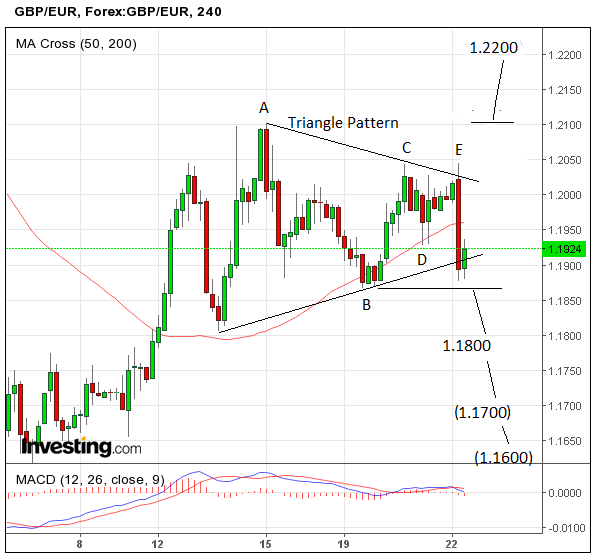
The triangle is now complete having unwound the minimum five waves (a,b,c,d and e).
It is therefore likely to break either higher or lower in the week ahead.
If the exchange rate moves above 1.2100 that will probably confirm an upside break and lead to the pair extending its rally to 1.2200.
Alternatively, a move below 1.1850 level would confirm a downside break with an initial target at 1.1800, followed by 1.1700 and 1.1600.
Latest Pound/Euro Exchange Rates
  | Live: 1.1792▲ + 0.08%12 Month Best:1.1828 |
*Your Bank's Retail Rate
| 1.1391 - 1.1438 |
**Independent Specialist | 1.1627 - 1.1674 Find out why this is a better rate |
* Bank rates according to latest IMTI data.
** RationalFX dealing desk quotation.
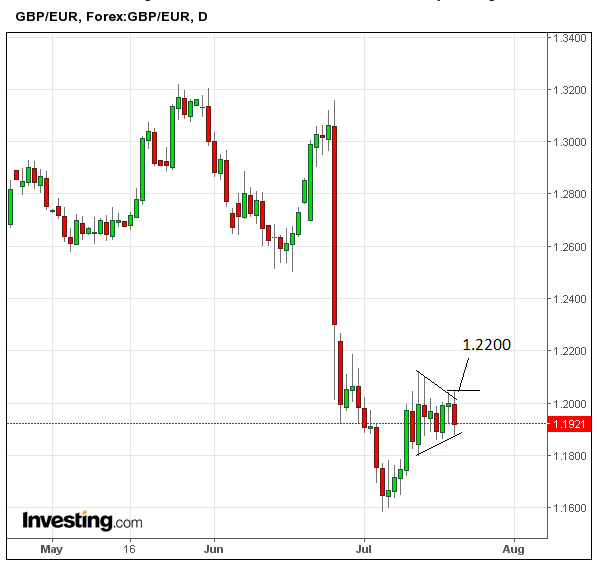
Looking at the daily chart now (below) and we see the long post-Brexit down-trend preceding the triangle, which is now smaller, however, owing to the greater distance on the wider daily timeframe.
The daily chart produces an overwhelmingly sense that the exchange rate will break out of the triangle higher rather than lower.
There is something not quite right about a downside break occurring at this juncture, and there is definite sense that the pair will unfold a leg higher out of the triangle, which on the daily chart looks like the middle ‘B’ wave of a three wave correction.
As such the daily makes us prefer a bullish scenario over bearish, with a break above 1.21 leading to a move up to 1.22, and then possibly 1.23.
Lloyds Bank's technical strategist Robin Wilkin believes a broader correction higher from the 1.1592 region could be seen, with a test of the 2.2270-1.2579 even being possible.
If that is the case, then a 'higher low' should develop in the 1.1848-1.1933 region, "and so far price action has been supportive of this," says Wilkin.
Last Friday’s decline was supported at 1.1876. Wilkin believes a move back below these levels would suggest further sideways trading is more likely, if not a move back to new lows.
JP Morgan Forecast a Second Wave of GBP Selling
Although Sterling is down almost 12% trade-weighted since the Brexit vote, it is up 3% from its early July lows and is unchanged month-do-date.
Analysts at JP Morgan say we can blame Bank of England communication for the recovery, which seemed to guarantee a July 14th rate cut though instead deferred a decision until August 4th.
JP Morgan continue to expect the Bank to cut base rates to 0% this summer and to relaunch QE with £75bn of asset purchases, a view that is only partially priced in rates markets that see only less and more gradual easing (about 33bp of cuts by late 2017).
Really easy money should be more toxic for the currency of a country running such a large external financing requirement, like the UK’s -6% of GDP current account deficit.
The GBP/USD target is tame (1.28) because they are neutral-to-positive on EUR/USD (1.15 target by December.
However, EUR/GBP should have more momentum with analysts expecting it to reach 0.89 by year-end.
0.89 in EUR/GBP translates into 1.1235 in GBP/EUR terms.
JP Morgan's Meera Chandan says Sterling outperformance has pushed the concession in the currency to a post-Brexit low.
"GBP valuations are not cheap enough on multiple frameworks and warrants additional weakening, especially now that economic momentum has turned firmly negative," says Chandan.
Short GBP thus remains a high conviction view at JP Morgan:
"We hold these vs. RUB and USD. Short GBP vs. EUR was stopped out at a loss and versus JPY at a modest profit."
German Business Data Supportive to the Euro
Better than expected data on German business morale helped the Euro maintain a position of strength against both the Pound and US Dollar.
The influential Ifo survey moderated slightly to 108.3 in July, defying forecasts to weaken to 107.5. The data suggested German business optimism hadn’t markedly dimmed in the wake of Britain’s Brexit vote that’s muddied the outlook for growth across the region.
The euro heads for big risk events Wednesday on U.S. monetary policy and Friday on euro area inflation and unemployment favoring its back foot.
Hawkish news in the U.S. combined with subdued news on key corners of the 19-country economy would risk further falls in the euro, potentially toward its trough for the year around 1.07 against the dollar.
Outlook for the Euro: Inflation Data and Italian Banks
The most significant hard data for the euro in the week ahead will be July inflation data (HICP) due for release on Friday 29th.
It is expected to come out at 0.1% - the same as June.
The European Central Bank is dedicated to getting inflation levels back to their mandated target at 2.0%, and have been trying to do so via cutting interest rates and purchasing corporate and government bonds. The side-effect of such action has been an historically weakened Euro.
Any suggesting that inflation remains stubbornly low could prompt markets to bet that further Euro-negative policy measures are likely over coming months, therefore the data could set a negative tone for the Euro heading into the weekend.
The ECB’s July meeting on Thursday suggested a change of stance to a more ‘wait-and-see’ approach in regards to more stimulus; this was viewed as a shift to a more neutral stance by analysts, many of whom had seen a high probability of easing in the autumn.
The results from the European Banking Authority’s (EBA’s) EU-wide bank stress tests will also be published on Friday.
Whilst the majority of banks are expected to pass the tests, there are some in certain countries, which may struggle.
Italian banks have struggled to keep their capital ratios in line with regulator’s guidelines as a result of a mixture of Brexit impact on bank stock prices and the high number of non-performing loans on their books, weighing on their profitability.
In relation to the stress tests Nordea Bank’s Tuuli Koivu, comments that:
“At the aggregate level, we do not expect the results to bring surprises given the generally rising trend in banks’ level of capital. However, continuously weak economic development has raised risks in some countries as banks are suffering from non-performing loans and low profitability which has complicated banks’ efforts to improve the capital ratios. Thus, it is likely that the stress tests find a need for improvement at least in few banks.”
Foreign Exchange Markets: A Big Week for Central Banks
There are no major data releases due for the UK in the week ahead, and the British Pound will likely be swayed by global conditions.
Central banks are in focus with the US Federal Reserve and Japanese Central Bank due to deliver decisions this week.
Friday’s Bank of Japan meeting begs the now familiar question for central banks - will it ease policy?
And, perhaps more important, what will governor Haruhiko Kuroda say about the prospects of fiscal stimulus?
The Federal Reserve has previously said Brexit poses little risk for the US, and with expectations growing that second quarter economic data due Friday will be strong, drums have started to beat for another increase in interest rates, what would be the second such move in almost a decade.
RBS Warns of Negative Interest Rates on Bank of England Cuts
Sticking with the theme of central banks, RBS has written to customers warning of the prospect of negative interest rates should the Bank of England cut its base rate towards 0%, something which it is expected to do by a number of economists.
RBS warned: "Global interest rates remain at very low levels and in some markets are currently negative. Dependent on future market conditions, this could result in us charging interest on credit balances."
This is a clear sign that many savers would not welcome any agressive rate cuts at the Bank of England, and the issue could become a political one if negative rates come to pass.
It is therefore a reminder to those watching the Pound and the Bank of England that deep rate cuts are by no means a guarantee.