
The pound to dollar exchange (GBP/USD) has taken a hefty 0.75% haircut ahead of the week's close.
As it stands sterling is on course for its second weekly decline against the US dollar with one pound currently buying 1.4350 US dollars on the open markets.
The last time we saw such levels was three weeks ago.
The pound is being offered alongside a host of other perceivably 'risky' financial assets - stocks, commodities and commodity-orientated currenices.
On the receiving end of the liquidated investments are German bunds, the yen and the US dollar.
Hence, we are in a binary world of risk-on / risk-off and the latter is where we sit at the close of the week.
German bund yields have plummeted notably with the 10-year German Bund yield hitting a record low of 0.027% which, “combined with Britain’s record drop, shows just how fragile major markets all over the world currently are,” notes Dennis de Jong, MD at UFX.com.
de Jong notes, “there’s a huge amount of uncertainty with the UK’s EU referendum less than two weeks away and continued concerns about the Chinese economy and the Fed’s interest rate plans in the US. Investors are sitting tight, while inflation figures suggest consumers are following suit.”
Latest Pound / US Dollar Exchange Rates
  | Live: 1.3247▼ -0.06%12 Month Best:1.3867 |
*Your Bank's Retail Rate
| 1.2797 - 1.285 |
**Independent Specialist | 1.3062 - 1.3115 Find out why this is a better rate |
* Bank rates according to latest IMTI data.
** RationalFX dealing desk quotation.
The Dollar's Strength is not Guaranteed to Last
The GBP/USD does however remain well within recent ranges when we consult the weekly charts.
Yes we are about to register a second consecutive weekly down-day, but the exchange rate has been edging higher since the end of February where lows of 1.38 were recorded.
And, heading into a new week dominated by the US Federal Reserve's monetary polict decision, there remain questions as to whether the dollar can extend its strength.
"The warning signal for the dollar bulls is that Treasury yields have barely budged, if anything they are consolidating their breakdown. Yesterday the US 10 year Treasury yield broke to a new 3 month low and as yet shows little sign of a recovery," says Richard Perry, a market analyst with Hantec Markets.
Perry believes the dollar's rally was built on very little, with only really marginally better than expected Weekly Jobless Claims to point to as a reason.
"Sometimes there is no discernible reason for a rebound and it can sometimes be technically driven, however I do not believe that this dollar rally will be long lasting," says Perry.
This should allow the British pound some relief going forward.
UOB's Ser Leang believes that sterling is likely to enter a phase of consolidation against the dollar going forward.
"The anticipated GBP weakness exceeded our expectation by taking out the 1.4465/70 support (low of 1.4447). With no signs of stabilisation just yet, further decline appears likely but at this stage, a move below 1.4410 is not expected. On the upside, only a move back above 1.4525 would indicate that the downward pressure has eased," says Ser Leang.
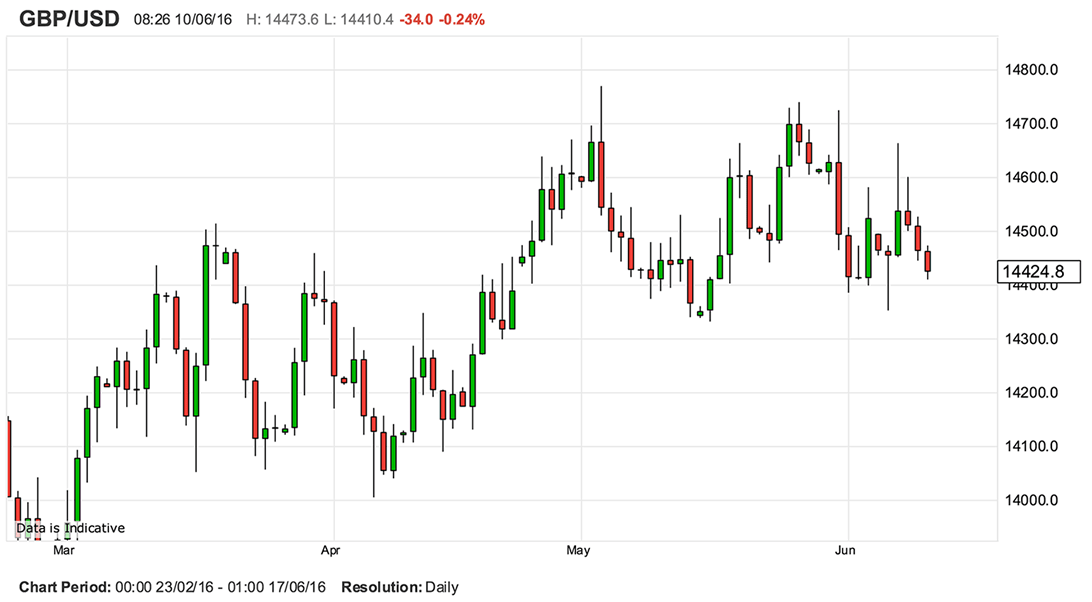
Perry's view is that the initial support at $1.4433 could come under pressure now, with the uptrend support dating back to February lows coming in today around $1.4370.
"This would suggest that for the bulls there are some key levels in the next 100 pips to the downside with Monday’s low at $1.4350 and then the key May low at $1.4330. Daily momentum indicators have also drifted lower again but in truth there is still no decisive direction to be derived," says the Hantec analyst.
British Pound Lower Despite Strong Trade Data
Sterling was seen lower follow a report from the official statistics body that showed the UK’s trade balance was in deficit to the tune of £10.53BN in April, less than the £11.20BN forecast by economists. The previous month’s deficit was lowered to £10.65BN.
The report shows that UK exports grew by the largest monthly amount since the first quarter of 2010, and a weaker pound can take the plaudits suggest analysts.
As can be seen the UK continues to be a net exporter of services, indeed with services accounting for over 80% of the UK economy, this is a good thing, and should be expected.
It seems though that when it comes to goods - i.e manufactured produce, the UK remains unable to break out of its deficit.
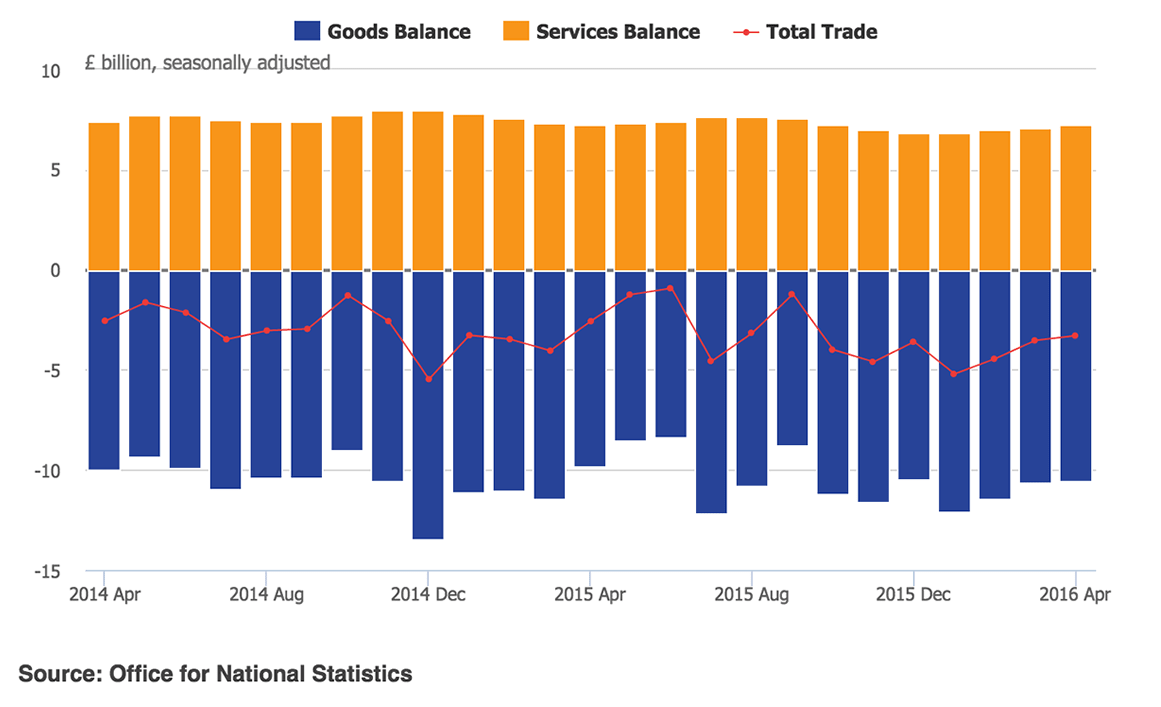
The trade deficit is incredibly important for the UK currency as the value of the pound should, theoretically, reflect the balance of import and exports. i.e it is a function of the UK’s bank balance with the rest of the world.
It it were not for foreign investor inflows, which offer the impact of the UK’s trade deficit, the pound would ultimately be lower. One of the big worries concerning the UK voting to leave the EU would be that the counterbalance of foreign investor inflows will dry up, therefore ensuring the GBP will more closely reflect the levels implied by the trade deficit.
However, a lower pound will likely have a stimulatory effect on the British export sector. After all, the boost to exports have a weaker pound to thank.
“These figures show exports grew by the largest monthly amount since the first quarter of 2010, mainly driven by an almost 10% increase in the export of goods. This coincided with the pound depreciating," says Michael Martins, Economist at the Institute of Directors.
The pound has fallen through 2016 in response to the uncertainties implied by the impending EU referendum.
“The cheaper pound may have helped exports of goods like chemicals and machinery, but while depreciation can help exporters, the flip-side is that if the pound stays low it means higher prices for importers," says Martins.
GBP a Mere Brexometer
The inability of sterling to react to improved data reflects the currency’s lacklustre response to surprisingly strong industrial and manufacturing figures released a day earlier.
This confirms that for GBP, the only game in town remains the referendum due in a mere two weeks time.
Sterling is trading soft with polling data giving little indication of how the vote will turn out.
 Furthermore, Lord Hayward, one of the few election experts who has successfully predicted the general election results, says that unless something "substantial" changes, the "balance of probability" suggests the UK will likely vote to Leave.
Hayward has spent months talking to people, and found that the voters who should be backing Remain according to the polls "overwhelmingly deviate towards the Leave side". They diverge from what the polls suggest to such an extent that Lord Hayward has now concluded that they are "probably over-emphasising the Remain vote".
While sterling trades with a heavy tone, the GBP to USD exchange rate continues to consolidate and now holds just above 1.4500 with the 1.4723-69 area (the 200d MA, and downward sloping trend line) providing a firm cap on further gains ahead of the EU Referendum on June 23rd while the 1.4200 level supports.
I think the big message to be aware on with regards to GBP/USD is that trading is mixed, echoing the view that the GBP market place is a highly volatile space at present.
If you are trying to make sense of the market then watch for resistance on the hourly charts residing at 1.4660, the 07/06/2016 high. Stronger resistance is located at 1.4770, or the 03/05/2016 high.
Yann Quelenn, a strategist with Swissquote Bank in Gland, Switzerland, says he expects GBP/USD to show renewed bullish momentum toward resistance at 1.4770 as support at 1.4300 (21/04/2016 low) is not monitored and selling pressures seem slight.
Taking a step back and observing the bigger picture, Quelenn says the long-term technical pattern is negative and favours a further decline towards key support at 1.3503 (23/01/2009 low), as long as prices remain below the resistance at 1.5340/64 (04/11/2015 low see also the 200 day moving average).
“However, the general oversold conditions and the recent pick-up in buying interest pave the way for a rebound,” says Quelenn.
Euro vs Pound Sterling Rediscovering Upside Momentum
The euro to pound sterling exchange rate is meanwhile looking more perky this month having arrested sterling’s May recovery.
“EUR/GBP's medium-term momentum seemed to have ended but is now reborn,” says Quelenn, “hourly resistance can be found at 0.7905 (06/05/2016 high) while hourly support can be found at
0.7720 (03/06/2016 low). Bullish pressures are definitely on.”
In the long-term, the pair is currently recovering from recent lows in 2015.
“The technical structure suggests a growing upside momentum. The pair is trading very close from its 200 DMA. Strong resistance can be found at 0.8815 (25/02/2013 high),” says Quelenn.