Consensus projections for the next four quarters, compiled from leading investment banks.
Access the full forecast →
Image © European Central Bank, reproduced under CC licensing
What's changed this week: European Central Bank (ECB) interest rate hikes are clearly in scope for 2026, but euro exchange rates reflect embedded concerns.
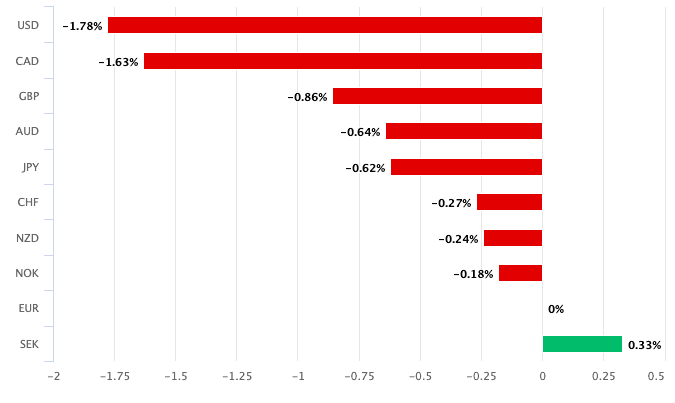
The euro is the week's second-worst performing G10 currency, with Sweden's Krona being the worst. Both have lost ground in an environment where the Middle East conflict commands the market.
The euro's underperformance might surprise some: It defies a significant shift in expectations for ECB policy: The market implied probability of a hike in 2026 rose to 65% on Thursday.
Just a week earlier, the odds were at 50/50 for a rate cut.
"We tend to think that a prolonged episode of clearly higher energy prices would lead to tighter rather than easier monetary policy," says a note from Nordea Bank.
Performance tells us the big driver of the euro is not interest rates, but energy prices:
The European wholesale gas benchmark - TTF - surged 40% earlier this week and has held the gain as the closure of Middle East natural gas export hubs and shipping lanes severely curtailed global supply and triggered competition for available supplies.
ECB meeting minutes released Thursday showed policy makers are ready to either cut or raise interest rates, depending on developments. The market thinks developments are clearly pointing to higher rates.
On cue, Governing Council members who spoke Thursday - Rehn, Nage and de Guindos - warned an extended period of high energy prices would raise inflation across the board.
"ECB policymakers have learned from the Ukraine war in 2022. Back then they wrote off the energy-led price spike as transitory," says a note from KBC Bank. "That may have been the case in the bygone era of a structurally low inflation. But things have changed."
Typically, rising short-term bond yields would lift a currency, but despite this, the euro has struggled.
"A looming energy crunch after the European economy barely recovered from the one in 2022 dents the appeal of regional assets," explains KBC.
EUR/USD has dropped around 2% since late last week and EUR/GBP has fallen 0.8% since Monday, and the single currency is on course to record a first weekly decline against sterling since the final week of January.
"Highly sensitive currencies to oil and/or natural gas, such as the EUR, the yen or parts of industrial Asia (eg, the KRW) have been hit hard, as one would expect given their sensitivity to energy prices," says a recent note from Barclays.
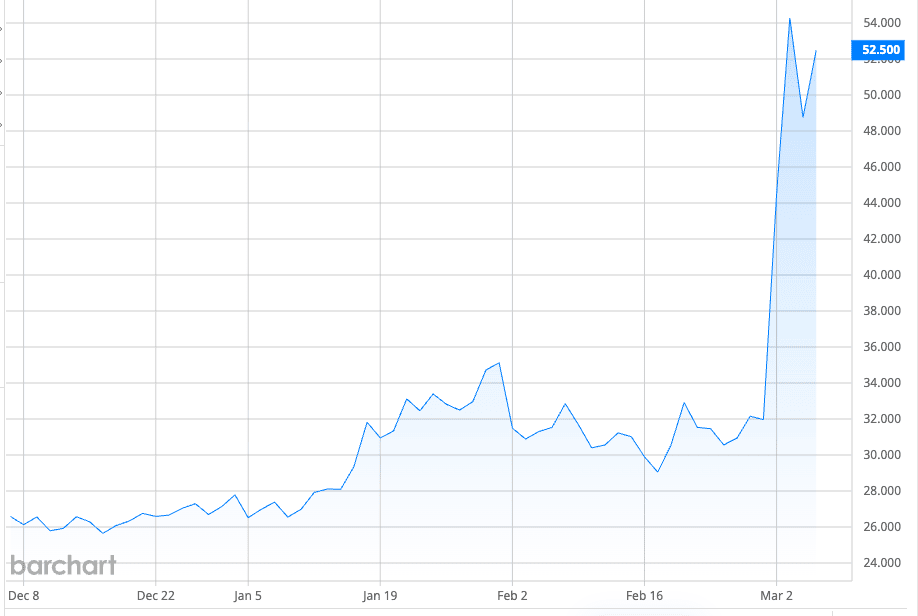
TTF, the European benchmark for wholesale gas prices.
Economists at the bank say historical precedents suggest the recent euro decline is broadly consistent with the scale of the current energy shock:
"As a reminder, the broad dollar gains c. 0.5-1% for a 10% move higher in oil prices, while the EUR tends to drop by c.0.25% for a 10% move up in natural gas prices, based on the Ukraine invasion precedent. The c. 2% move lower in EURUSD since late last week is well within the estimated impacts for the c. 15-20% move higher in oil and 80% in natural gas."
Jeremy Stretch, an analyst at CIBC Capital Markets, says the energy price spike remains problematic for the Eurozone.
"Rising import costs drag on the trade surplus, while the ECB is mindful of the inflationary consequences of a protracted energy price spike," he explains.
Polymarket, the prediction market place, sees a 50/50 chance that a ceasefire is agreed by the end of April.
The odds are closer to 30% for end-March.
This means this euro-negative backdrop could be with us for a few weeks yet.