
Image © Adobe Stock
Analysts see limited prospects for the euro to dollar exchange rate (EUR/USD) to advance beyond 1.18 in the near-term.
The euro's rebound against the dollar looks to be nearing its limits, opening the door to a renewed pullback.
This is the assessment of a number of analysts we follow in the wake of recent price action and global developments.
Euro-dollar slides to 1.1698 on Thursday, having tested 1.1768 on Tuesday, amidst a recovery in the U.S. dollar thanks to news U.S. President Donald Trump has dropped his threat to tariff European nations over their refusal to back his purchase of Greenland.
"The US dollar has rebounded modestly against other major currencies after President Trump dropped his threats of military action and/or imposing tariffs on fellow NATO members," says Lee Hardman, Senior FX Analyst at MUFG Bank.
The dollar slid after weekend news Trump would tariff some European countries 10% starting February 01 unless they backed his plans to acquire Greenland. The dollar's response was part of a 'sell America' trade where it falls alongside U.S. bonds and stocks.
Shaun Osborne, analyst at Scotiabank, points out the euro was starting to lose momentum even before Trump's U-turn on tariffs, signalling we weren't necessarily on the cusp of a significant euro rally.
"Recent price action is suggestive of near-term resistance above 1.1750," he said. "We look to a near-term range bound between 1.1680 support and 1.1780 resistance."
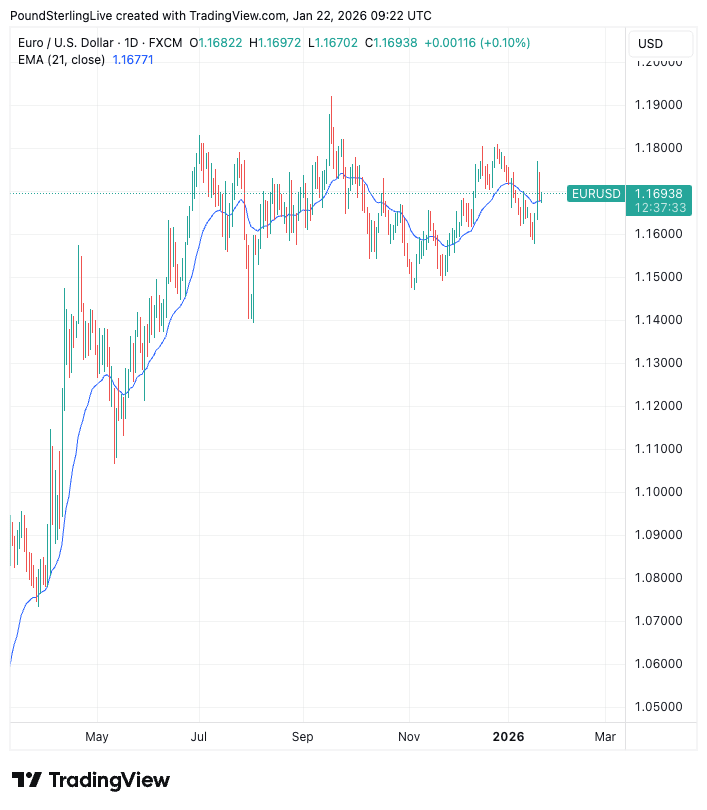
Valentin Marinov, Head of G10 FX Strategy at Crédit Agricole, explains why we're not in the same space we were in during 2026 when the euro surged from below $1.02 to $1.19.
"FX investors seem to view the spat as a replay of the price action in the wake of the tariff announcement on 'Liberation Day', 2 April 2025... we see some important differences, however:
(1) The current spat is a far cry from the global trade war that the Trump administration threatened to wage in 2025 and that risked tipping the US economy into a recession
(2) Investors no longer see a significant growth-positive impact from European fiscal stimulus in 2026
(3) The market relative Fed/ECB views have been little affected and the USD has retained its rate advantage over the EUR.
"Europe remains particularly exposed. The European Union exports more than €500bn of goods to the US each year, leaving major sectors vulnerable even to targeted measures," says Nigel Green, CEO of deVere Group.
Crédit Agricole also thinks that if the U.S. and EU had escalated the trade war, it would be the Eurozone economy that came off second best.
Marinov says this is because:
(1) its growing dependence on US energy
(2) its dependence on US military support amid the war in Ukraine.