Expect the GBP to EUR exchange rate to maintain its decline and having already hit one of our targets at 1.16, we see potential for more weakness down to 1.1400.
- Pound to Euro exchange rate today: 1.1472
- Euro to Pound Sterling exchange rate today: 0.8713
We are witnessing a fresh multi-year lows in GBP/EUR with the pair racing towards the target level we set out in our studies conducted ahead of this week's trading session.
Pound Sterling continues to weaken on concerns about the health of the post-Brexit economy and the aggressive actions taken by the Bank of England (BOE) to remedy any economic slow-down.
The significant support level at 1.1598 proved ineffective in stopping the marauding pairs and any suggestions the exchange rate may have bottomed temporarily have been washed away by the latest wave of selling.
The whole move down from the May highs forms a technical phenomenon known as an Elliot Wave pattern.
This large bearish wave, according to Elliot Wave theory, is composed of five smaller waves:
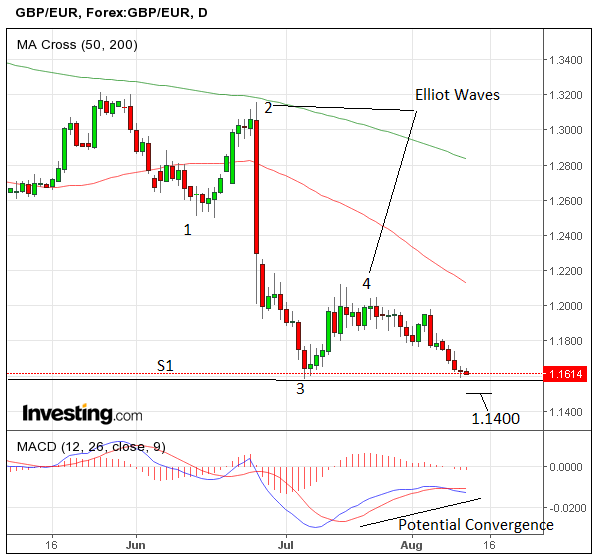
Of those five smaller waves four have already completed and the fifth is now probably in progress.
The fifth wave will almost certainly retouch the 1.1588 lows and probably surpass them eventually.
A break clearly below, confirmed by a move below 1.1530, would probably lead to a sell off down to the next target at 1.1400.
The MACD indicator crossing its signal line (circled) in the lower pane is further evidence of more downside to come.
Latest Pound/Euro Exchange Rates
  | Live: 1.1658▼ -0.02%12 Month Best:1.1828 |
*Your Bank's Retail Rate
| 1.1262 - 1.1308 |
**Independent Specialist | 1.1495 - 1.1541 Find out why this is a better rate |
* Bank rates according to latest IMTI data.
** RationalFX dealing desk quotation.
Staying GBP Bearish
The key driver for Sterling over coming days, and indeed weeks, will be the success of the Bank of England's reverse auctions, whereby they are to buy up government debt under their newly restarted quantitative easing programme.
The programme aims to keep the cost of borrowing in the economy down, and in turn it is hoped businesses will continue to invest, despite the uncertainty posed by the referendum.
How long Sterling remains weak is actually now a question of how long the Bank of England will continue its programme of easing.
"With our economists’ view that the BoE’s forecasts are too optimistic, this dovish stance supports their expectations of a second easing package in November," says Charles Rubenfeld at Morgan Stanley.
Morgan Stanley's economists are calling for another 15bp cut, which is larger than market's current pricing of 10bp, suggesting there is room for further GBP weakness.
"GBP real rates and yields have also fallen to negative levels, making it unattractive in the current yield-seeking environment. We remain GBP-bearish and like selling against EUR and USD which we hold in our portfolio," says Rubenfeld.
Sterling's Week: Inflation, Retail Sales, Wages and Earnings Data
With the Bank of England pumping money into the economy, and devaluing Sterling in the process, analysts will be watching for evidence in the economy that would suggest even more easing will be announced before the end of 2016.
One of the key numbers to watch will be inflation.
With Sterling falling following the EU referendum the Bank has recently had to ramp up their inflation forecasts, owing to the rising cost of imports.
The Bank notes the 2% level they are tasked with targeting could be hit a lot sooner than originally envisaged.
A faster-than-forecast rise in inflation could well prompt the Bank to consider holding back on that stimulus, which in turn is a positive for the Pound.
Analysts are forecasting a 0.5% rise compared to July last year.
On a monthly basis inflation is expected to rise 0.2%.
On Wednesday the UK will release important employment and earnings data, however, due to it covering only June which is mostly before the EU vote its significance this time will be lessened.
Average Earnings is expected to rise a basis point to 2.4% from 2.3% previously. The Unemployment rate stands at 4.9% and 3month/3month change was 194k in May
Retail Sales data on Thursday rounds off the week.
This data will be important because it is also for July, and so will provide an idea for how well certain parts of the economy are bearing up.
Recent data from the British Retail Consortium (BRC) showed an unexpected 1.1% rise in retail sales in July when investors had been forecasting a Brexit-inspired contraction.
The higher than expected result was explained as a ‘life goes on’ shrug of the shoulders response from consumers and due to households not yet feeling a material impact from the referendum result. Especially hot weather which increased barbeque, charcoal, food and drink sales, as well as fashion sales was also a factor.
The 0.2% rise from -0.9% previously and steady 4.2% gain y-o-y forecast by analysts reflect BRC data’s increased optimism about July.
Data to Watch for the Euro
The first big release for the euro will be the ZEW sentiment survey, on Tuesday which is expected to show a positive balance of 1.0, denoting investment professionals are marginally positive about the outlook for the next six months.
The second major release from Europe is inflation data on Thursday which is expected to show a 0.2% rise yoy in July as in the previous year. Clearly inflation will be an invaluable metric to gain guidance on what the ECB may be planning to do in September.
The central bank had said immediately after the Uk referendum that it stood ready to increase stimulus to soften the blow, however, Draghi somewhat backtracked from that position at the August meeting after it was noted the impact on the Eurozone had been somewhat muted.
Nevertheless, many analysts, such as Lloyds Commercial Banking’s Jaevon Lolay, expect the ECB to increase its measures in September anyway, and for this to weigh on the euro. If inflation on Thursday, however, is higher-than-expected, that expectation, will diminish, leading to rise in the euro, as stimulus weakens a currency and vis versa.
“While the recently announced policy measures from the Bank of England argue for a weaker sterling the strong likelihood of an extension to the ECB’s QE programme suggests that the ECB’s balance sheet will continue to expand at a more rapid pace than that of the Bank of England, which on a relative basis argues for higher GBP/EUR.” Remarks Lolay in a recent research note, adding that:
“Overall, we expect GBP/EUR to drift gradually higher towards 1.19 by year end, rising to 1.27 by the end of 2017.”
UK Politics and the Pound: Rearing its Head Again
It has been a quiet late summer period by way of UK politics - something that has been desperately needed by the Pound which has been battered by the seismic shifts seen in UK politics over recent months.
However, we would expect the tempo of UK politics to pick up over coming weeks.
A positive came over the weekend when the UK’s Chancellor Hammond said the Treasury would meet any shortfalls to EU funding until 2020.
This was particularly welcomed by the UK agricultural sector.
Research and development has also been boosted by the guarantee as many research projects are long-term in nature and funding commitments are key.
Remember that for Sterling and the UK economy the biggest problem posed by the Brexit vote was the uncertainty it posed.
Hammond’s announcement has gone a long way in smoothing over some of the anxiety.
Johnson vs Fox
Not even 24 hours after the good news comes the bad news.
The Telegraph has revealed that Liam Fox and Boris Johnson are locked in a bitter feud over who controls key parts of Britain's foreign policy
Johnson heads up the Foreign Office while Fox heads up the international trade role.
Fox has written to Johnson saying British trade with other countries would not "flourish" if responsibility for future policy remained with the Foreign Office.
He also listed a series of economic statistics which called into question the Foreign Office's ability to boost Britain's economic ties with other countries and suggested that Johnson focus instead on "diplomacy and security" including overseeing MI6 and GCHQ.
This is exactly what is not needed at a time when a common purpose is required to negotiate a strong footing for the UK in global trade.
Should more of these feuds come into the open, we would suggest Sterling would struggle to recover.