A decent outing from UK employment data has combined with a rock-solid wall of support at the 1.28 region to slow down the pound's decline to the multi-year lows being forecasted by some analysts.

If you are looking to buy euros with your battered sterling then a word of warning - you are not going to hear predictions of a miraculous recovery back to the 1.40's in this piece.
Rather you are going to hear why you have been offered a period of grace to exchange above the 1.28 level.
The pound to euro exchange rate is in a well-defined downtrend and momentum continues to advocate for further declines and we refer to any gains seen in GBP/EUR as being a classic dead cat bounce.
A dead cat bounce is defined as a temporary recovery in a financial asset's price after a substantial fall, caused by speculators buying in order to cover their positions.
The British pound was hammered across the board on Tuesday afternoon by a renewed sense sense of unease over the UK’s impending EU referendum.
But, as we note here, we believe the actual trigger to the decline lies with a technically-inspired sell-off in the pound to euro exchange rate.
Rather, EU-referendum concerns are providing a vacuum within which the pound can be bullied about by speculators.
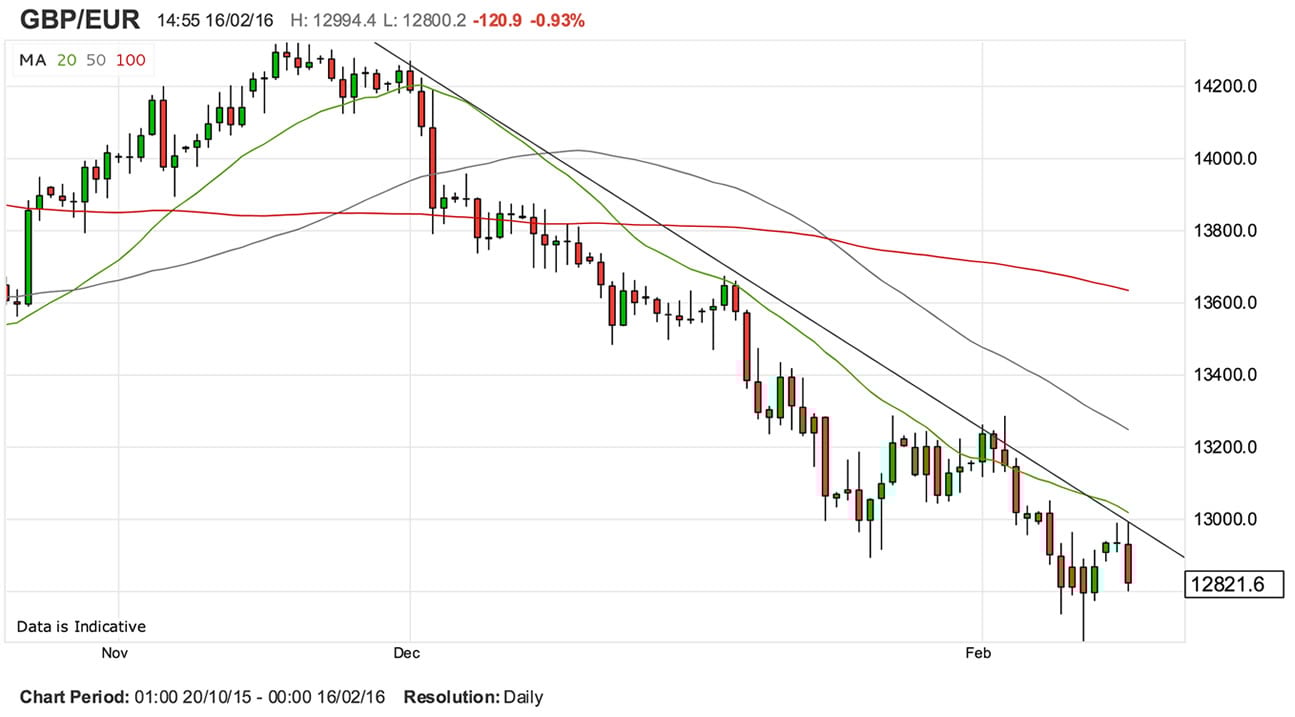
The GBP to EUR was sold on meeting a downward trend line that coincided with the pair’s 20 day moving average.
We believe the technical structure of the market is incredibly important in this environment as it invited the ‘Brexit bears’ to the table.
The trend remains lower and we have very little confidence in sterling's ability to sustain advances and imagine that any spikes will actually be sold ahead of an initial target at 1.25.
Of interest we have just reported that HSBC are actually predicting the GBP/EUR to fall all the way to 1.20 by mid year.
Latest Pound/Euro Exchange Rates
  | Live: 1.187▲ + 0.03%12 Month Best:1.1913 |
*Your Bank's Retail Rate
| 1.1466 - 1.1514 |
**Independent Specialist | 1.1704 - 1.1751 Find out why this is a better rate |
* Bank rates according to latest IMTI data.
** RationalFX dealing desk quotation.
1.28 Offers Solid Support, But a Break Below Here Spells Trouble
While we note that analysts are calling for declines towards 1.25 and even 1.20 we must give credit to the wall of support that lies at 1.28.
This region has not been broken in the 5 times it has been tested; if sterling closes above this marker today then this will mark the 6th day that it has sucessfully defended the level.
The reason for this success is that the market will be littered with buy orders around this psychologically important level - having witnessed how solid support is here traders will be buying sterling in anticipation of a small bounce.
The problem is that with so many market players congregating at this level once it is broken they will have to shut up shop and the rate will fall like a stone.
So beware, while 1.28 is offering support it is a long way down should it break.
Stock Markets Surge and Cap Euro Strength
With regards to the fundamentals driving the GBP/EUR pair we must remain attuned to the fact that the euro tends to outperform a host of G10 currencies in times of market selling, of which there has been a lot of lately.
The euro is a funding currency, i.e one that can be borrowed cheaply thanks to record-low ECB interest rates, and has been used to fund equity market investments. With those investments in reverse demand for the euro grows as those funds are repatriated.
With that in mind we are seeing the euro drift lower as European markets shake off a poor Asian session.
"Equity markets marching north again this morning despite a largely negative session in Asia. Investors are preferring to take a positive lead from US bourses and are ignoring a backtrack in oil from recent highs as hopes of global production freeze/cut wane without Iran on-board," says Mike van Dulken at Accendo Markets.
van Dulken says traders are also refusing to be perturbed by the prospect of surely market-moving Fed minutes this evening which could provide additional hints at US policy direction (up, sideways, even down?) and impact the USD and thus commodities.
Labour Market Figures Provide Support to Sterling
A degree of support for the pound has been found in the mid-week session thanks to the ever-reliable UK employment data.
The fall in the number of people claiming out of work benefits took the market by surprise with a drop of 14.8K recorded, it was expected that only 3K people would have moved off the dole.
The much-anticipated wage growth figure was at 1.9%, where analysts had expected it to be.
"Today’s UK jobs market data looks fairly bullish. The unemployment rate remains at its lowest level in almost a decade and wage growth has ticked up," says Dennis de Jong at UFX, "Chancellor George Osborne will be hoping that the introduction of the national living wage in April will see pay increase and help inflation rise further."
As we saw on Tuesday, UK inflation remains subdued but continues to tick up slowly. For the Bank of England a spike in wage growth would indicate that inflationary pressures were accelerating and open the door to that interest rate rise that markets are always expecting but never getting.
"Hours worked growth reassuringly strengthened to 1.6% y/y, and the employment rate rose to 74.1%, a record high. Today’s report is unlikely to significantly sway the MPC, as contemplation of a first hike in Bank Rate remains far off, and wage growth especially has plenty of time to continue firming before then," says a briefing from TD Securities.
More Reactions to Labour Market Numbers
Today’s UK labour market figures were a mixed bag, as expected. Employment posted another solid increase, rising by 205k in Q4, while the LFS unemployment rate held firm at 5.1%.
The headline unemployment rate remains close to the level at which capacity constraints might typically be expected to put upward pressure on wages.
Making sense of the data are the following industry commentators:
Lloyds Bank note:
"The ongoing combination of firm employment gains alongside weak wage growth remains difficult to reconcile.
"BoE officials have suggested that this partly reflects the recent run of near-zero headline inflation prints feeding through to pay settlements. Yesterday’s figures showed that inflation edged up to just 0.3% in January. They expect this to slowly unwind as inflation gradually firms over the course of the year."
James Sproule, Chief Economist at the Institute of Directors says:
"Today’s UK labour market figures were a mixed bag, as expected. Employment posted another solid increase, rising by 205k in Q4, while the LFS unemployment rate held firm at 5.1%.
"The headline unemployment rate remains close to the level at which capacity constraints might typically be expected to put upward pressure on wages.
"The UK’s strong employment remains one of the few bright spots in a world where there are an increasing number of economic uncertainties. Wage growth may appear modest in nominal terms, but this could be a feature of impressive increases in the number of young people who are in work.
"Moreover, with inflation still in the doldrums, real wage growth is providing a boost to employees and underpinning the UK’s consumer-led growth throughout 2016. But don’t bank on the lines continuing to go in right direction for ever."