The pound is under fresh selling pressure right across the board on Tuesday confirming our initial suspicions that the gains seen over the past two days were without foundation.

The pound to euro exchange rate has relinquished recent gains and is nearly a percent lower at the time of writing having reached 1.2817.
We, and other commentators, believe that GBP/EUR is the 'headline pair' to watch i.e. the pair who is dictating plays in the other smaller crosses. In short, if GBP/EUR falls, other pairs fall too.
The UK currency has depreciated 6.5% versus the euro since the start of December when a maximum of 1.42 was achieved.
Negative bets on the UK currency have built to their most extreme levels since 2008 on the unwinding of Bank of England interest-rate-raising expectations and an intensification of Brexit concerns.
Because momentum appears so firmly pitted against sterling we remains sceptical about the prospect of any recoveries to become entrenched.
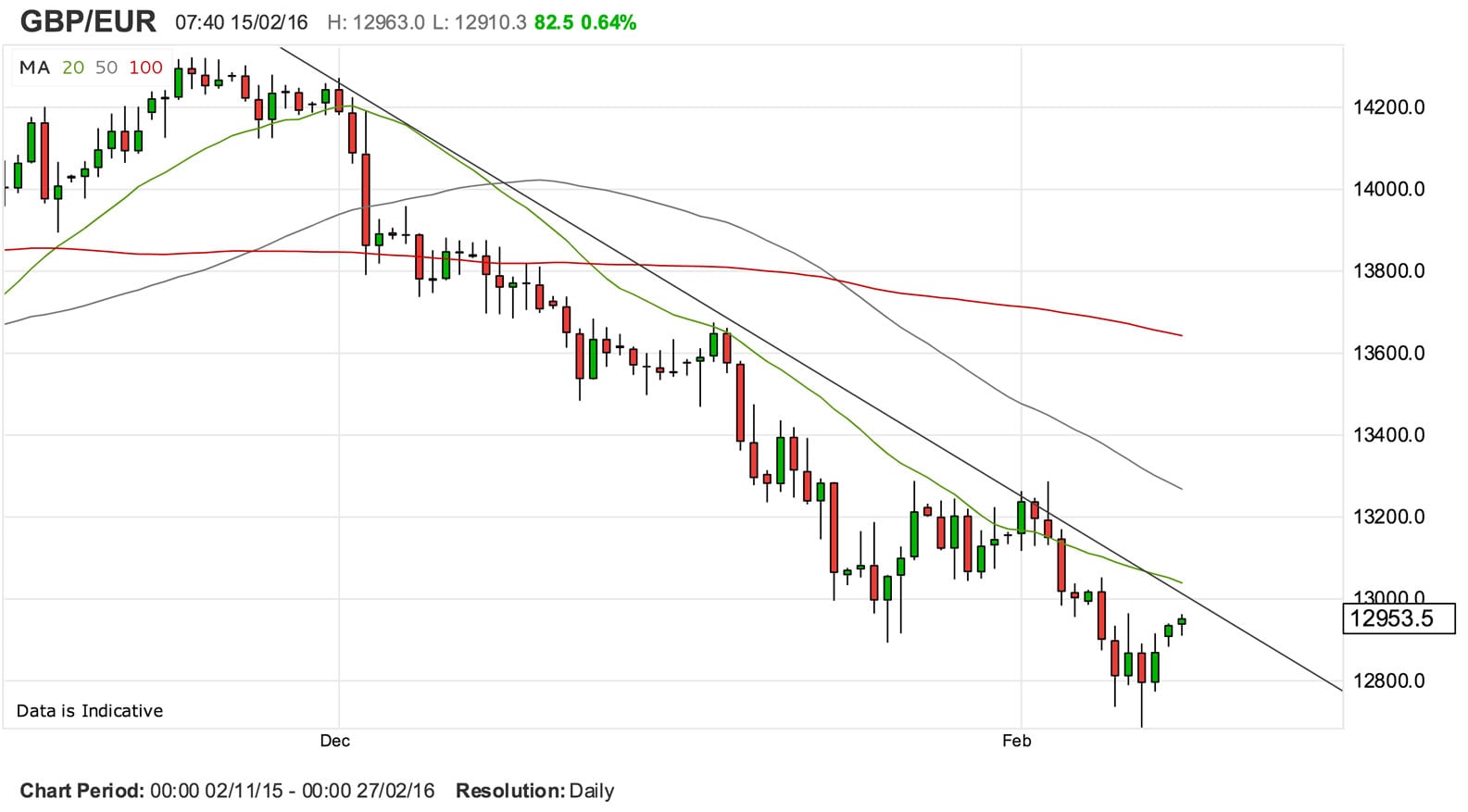
If we consider recent price action, as written into the below chart, we can see the move lower has been dictated by a declining trend line.
This line presents a neat visual as to where we can expect strength to fail and sterling-negative speculators to re-enter the market.
We published this image on Monday morning warning the downward sloping upper trend line would prove to be a big barrier.
And, on Tuesday afternoon subsequent price action in the graph below has only served to highlight how formidable the trend line is.
There is a good chance that big-name speculators are playing to the rules dictated by this technical structure and have had their sell orders fulfilled at these prices.
Whoever says technical analysis is irrelevant doesn't understand how markets are structured!
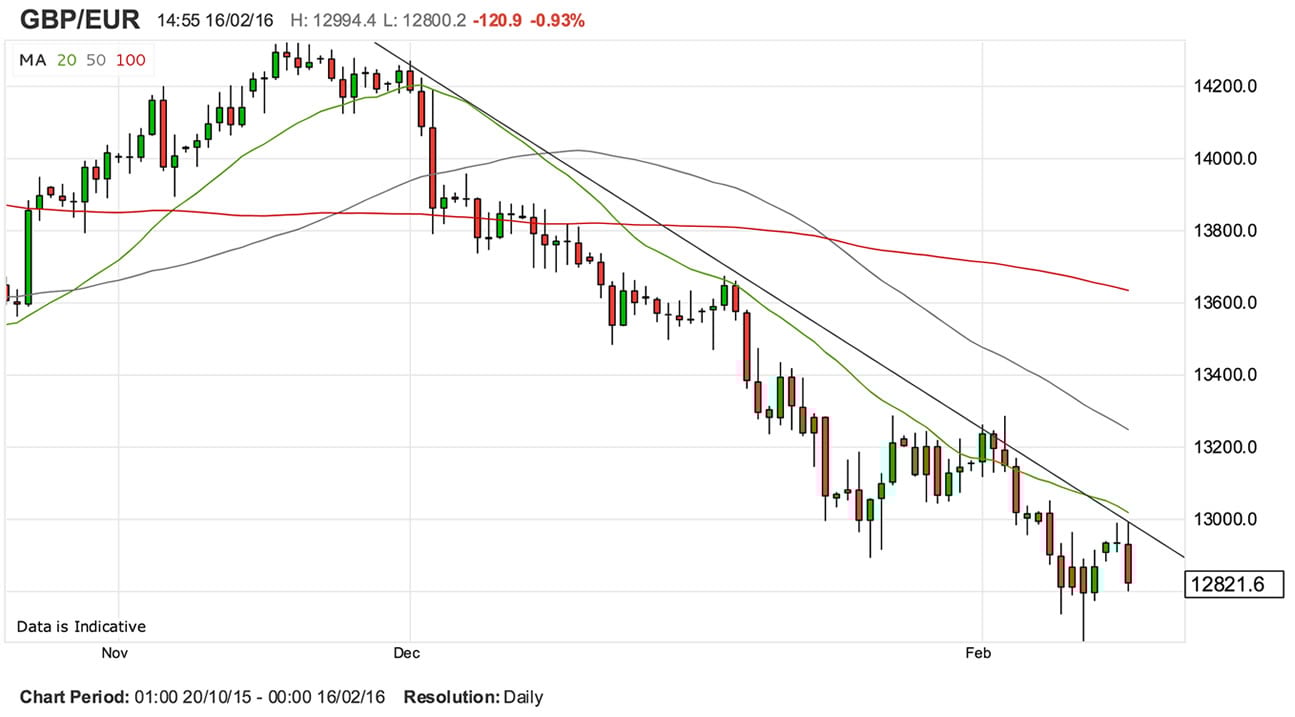
A big positive for sterling would have been a break above this trend-line, AND, a hold of the level. i.e it is no good breaking it for a day or two, we want to see the currency end the week above here before we call a base to the recent declines.
Further confirmation of a steadying in sentiment towards GBP/EUR would be a move above the 20 day moving average, shown by the green line which is also located close to the trend-line at present. In fact, the declining trend-line and the 20 day moving average appear to be one and the same.
Latest Pound/Euro Exchange Rates
  | Live: 1.1872▲ + 0.05%12 Month Best:1.1913 |
*Your Bank's Retail Rate
| 1.1468 - 1.1516 |
**Independent Specialist | 1.1706 - 1.1753 Find out why this is a better rate |
* Bank rates according to latest IMTI data.
** RationalFX dealing desk quotation.
Could Fall as Low as at 1.25
The UK currency lost ground relative to the euro for the third week in a row last week, which means that it has now fallen in eleven of the last twelve weeks – and that’s an unprecedented losing streak points out Bill McNamara at Charles Stanley.
Longer-term momentum is therefore skewed lower and we should view the present rally within this broader context.
Sterling is under pressure as traders reflect on the impact of a ‘Brexit’, while the fact that the first interest rate rise has surely been pushed into next year (at the earliest) is also having an impact.
"The result is that the currency is now more oversold than at any point since early 2013; however, there is still little in the current technical picture to suggest that the bottom is in and it is starting to look like the pound could slip all the way back to 1.25 or so before it finds meaningful support," warns McNamara.
Brexit Premium Pushes Sterling Lower
HSBC calculate the pound is oversold against the dollar by up to 7% - this move away from where it should be can be put down to a Brexit risk premium argue analysts at the UK's largest bank.
No doubt there is a similar degree of ‘oversold’ written into the pound / euro pair. Nevertheless, this premium must be absorbed by the markets and gives a sense of just how massive the rebound could be on an in-vote.
Also suggesting sterling should be higher are BNP Paribas, who in a recent exchange rate forecast to clients, say the GBP to USD conversion should potentially be as high as 1.64.
Their fair value models also work on the basis that the UK economy is stronger than its currency suggests.
This is evidence again that the issue over the EU referendum is playing a part in the gap between reality and the forecasts placed by leading economists.
The ECB summit due this week will also be key as the issue of the UK’s referendum on EU membership will become more clearer. Indeed, if the path to a June vote is opened we see this as being pro-GBP.
"The summit will provide details on the renegotiation of Britain’s EU membership terms. With the market seeing the summit as a potential GBP risk event (EUR/GBP 1-week implied volatility remains elevated and did not normalise to the same extent as other non-GBP G10 vols did following Monday’s rally in risk assets), good UK data points will be heavily discounted, while disappointing data will fully feed into GBP," says Chris Turner at ING.
When it comes to the EU vote, the earlier the better, as Prime Minister Cameron will want to get the country to the polls before further potential migrant surges.
The popularity of an exit vote has grown alongside the rising numbers of immigrants into the EU.
Stock Market's Rout Not Yet Over
The pound / euro exchange rate is also highly attuned to risk sentiment in global stock markets with the recent sell-off sending the pair lower.
The euro benefits as global equity positions are liquidated ensuring hefty demand for the euro as many of those positions were originally built using cheap euros borrowed over recent years.
Phil Seaton, a momentum trader at LS Trader, points out that each of the four stock indexes that he trades fell to new lows last week, “but all have bounced higher having found some support. This has resulted in some momentum divergences, so we may see a bit more upside follow through next week, but the long-term trend is down across the board for stock indexes.”
“The S&P 500 tested support but was unable to break below the prior low,” says Seaton, “the long-term trend remains down, and the RSI is in the bear range, so we may yet see another test of the recent lows.”
The Nasdaq 100 continued with weakness and completed a change of long-term trend to down as expected. However, having printed its lowest level since October last year, the Nasdaq subsequently bounced higher.
As with the S&P 500, the trend remains down in spite of the bounce.
We therefore don’t fancy the prospects facing the pound and stock markets longer-term based on recent momentum studies.