The services sector shone in February's surprisingly strong GDP release. Image © Adobe Images
Britain's economy was in surprisingly robust shape in the month leading to the Iran war shows new monthly economic growth figures from the ONS.
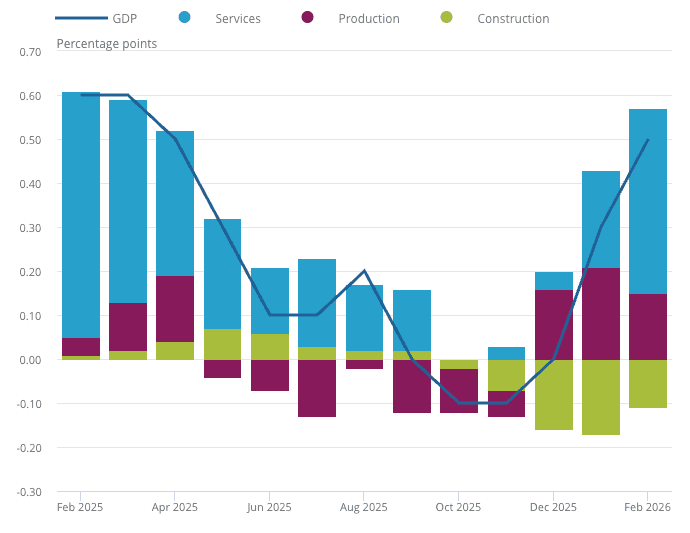
"The 0.5% m/m expansion in monthly GDP in February was a genuine surprise given that consensus was 0.1% m/m and that it has been more than two years since this pace was last recorded," says Lloyds Bank in response to Thursday's data release.
The services sector - the largest sector of the economy - drove the growth with an outturn of 0.5%.
The ONS also revised higher January's growth to 0.1% from 0% in the first estimate.
"Even if March sees no expansion, overall Q1 GDP could grow 0.6-0.7% q/q. That would be well ahead of the BoE's expectation," says Lloyds Bank.
The Bank of England was expected to cut interest rates on at least two occasions in 2026 in response to a deteriorating jobs market and signs of slowing growth.
Today's data from the ONS shows that the "employment activities" activities of the services sector rose 2.5% m/m having suffered a fall of 6/6% m/m in January. Economists say this is further evidence that the labour market is stabilising.
That should offer the Bank some assurance that it can afford to hold rates at current levels as it prepares to navigate the impact of the Iran war.
Bank of England Governor Andrew Bailey earlier gave an interview to the BBC, where he said it was "too early to form strong judgements" on how the central bank should respond to the incoming surge in energy prices caused by the war in the Middle East.
Previously, he had said the bank was "ready to act", suggesting a cooling in guidance that limits the odds of a hike to Bank Rate on April 30.
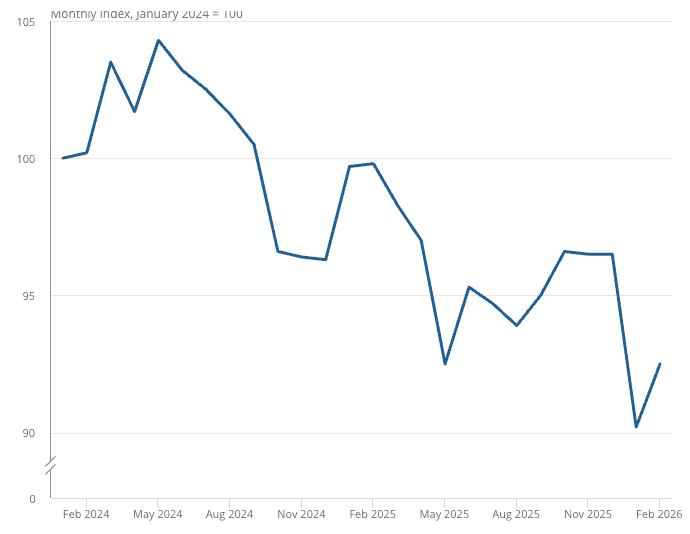
Above: The employment activities component of growth has been a concern, reflecting a deteriorating labour market.
The war, which has resulted in the closure of the Strait of Hormuz, a key shipping passage, limits the supply of energy to the global economy, thereby pushing up prices.
Although the impact on oil and gas supplies is obvious, there are other critical downstream industrial products that will be negatively impacted. It's reported today that a secret government analysis has been conducted, which finds a "worst-case scenario" whereby a lack of critical carbon dioxide supplies would hit farming and the hospitality sector.
As a result, Britain faces shortages of chicken, pork and other supermarket goods this summer if the war in Iran continues.
The worst-case scenario envisages the Strait being shut until June, which would represent a massive failure by Iran and U.S. to reach a deal, something they are apparently keen on achieving as talks are set to resume in the coming days.