Image © Adobe Images
Ask someone who just got back from Barcelona how much they spent, and they will give you a number in pounds. Ask them how much they got for those pounds, the actual euros in their wallet, and most will shrug. They remember the price of the holiday. They do not remember the conversion rate.
That gap in attention is costing British tourists a significant amount of money, and it has been widening for ten years.
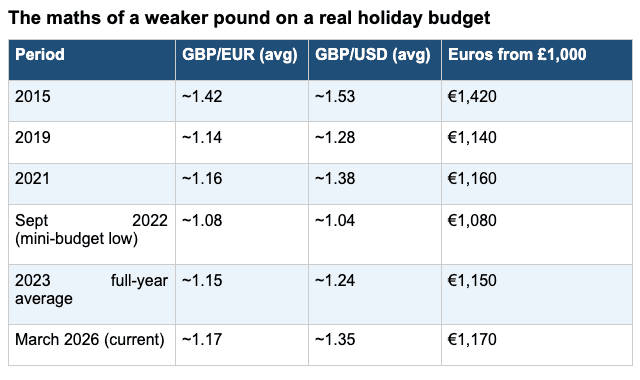
In 2015, one pound bought roughly €1.42 in Europe. Right now, in March 2026, it buys around €1.15. That is a swing of 20%, and it did not happen because Spain got richer.
It happened because sterling got cheaper. The person sitting on a Barceloneta terrace ordering a €14 gin and tonic paid about £12 for it in 2015.
Today they pay closer to £12.80 - for the same drink, at the same price in euros. Over a two-week holiday, across food, activities, transport, and accommodation, those fractions add up to something you would notice if someone handed it to you in cash.
Pound Sterling Live
Currency moves reward careful attention, which is something gamblers and frequent travellers both learn early. Someone placing a bet on spinwinera checks the odds before committing. A trader checks the rate before converting. British tourists, as a group, tend to check neither - and the data on where they exchange money shows it.
Around a fifth of UK travellers still use airport bureaux de change, where the margin runs between 8% and 12% above the mid-market rate. On a £500 exchange, that is up to £60 gone before you have cleared customs.
Ten years of slow decline
Sterling's fall against the euro did not start in 2022 with the mini-budget crisis, though that made headlines. It started in June 2016, in the hours after the Brexit referendum result came through. GBP/EUR had been trading consistently above 1.30 for most of the preceding decade — at points touching 1.40 and above.
After the night of June 23rd, it never went back. Markets repriced the pound and left it there.
What followed over the next nine years was a series of additional pressures, each one chipping away a little more.
The 2022 fiscal crisis sent GBP/USD briefly below 1.04 - a figure that most currency analysts had not seriously modelled as a possibility. It recovered, but the recovery was partial. Then came the Bank of England's rate-cutting cycle through 2024 and 2025, which reduced the yield advantage that sterling had previously offered international investors. The euro strengthened against the pound by 5.48% across 2025 alone.
By early 2026, GBP/USD was averaging around 1.35. That looks reasonable compared to the 2022 low. Against its pre-2016 norm of 1.50 to 1.70, it tells a different story entirely.
The table above shows something that tends to get lost in the annual conversation about holiday costs. The current rate - €1.15 per pound - is not terrible by the standards of the last decade. It is meaningfully better than the 2022 crisis low. But it is 20% below 2015, and that comparison matters because 2015 is when many British tourists formed their mental baseline for what Europe costs. They remember it feeling affordable. It was. The pound was stronger.
Put it differently: a British couple with £2,000 to spend in Italy this summer converts that to roughly €2,340. The same couple with the same budget in 2015 had €2,840 to spend. That €500 difference covers round-trip domestic train tickets between Rome and Florence, four or five restaurant dinners, two nights of three-star accommodation. It is not trivial. It is the difference between a holiday that feels comfortable and one where someone is checking the app before every purchase.
The United States is a different problem
Against the dollar, the story has a different shape. GBP/USD has actually recovered from its worst 2022 levels, and at around 1.35 in early 2026, it looks more stable than it did three years ago. But the pre-2016 norm for this rate was 1.50 to 1.70.
Someone paying for a mid-range hotel in New York at £150 per night in 2013 was covering a room that cost around $225 to $255. At today's rate, £150 buys $202. That same room, if the dollar price has held, now costs roughly £163 in sterling terms. Across a ten-night trip, that gap becomes over £130 — without accounting for the dollar inflation that has also pushed US prices upward in the interim.
The ONS figures show that 4.1 million UK residents visited the United States in 2024, making it the fifth most visited country for British tourists. Those travellers were operating in one of the most expensive tourist environments in the world, at an exchange rate that gives sterling considerably less purchasing power than it had when most of them first visited.
Where the additional losses happen
The exchange rate itself is only the first layer of the problem. On top of it, British tourists consistently shed additional money through transaction costs that are avoidable but widespread. The losses stack at predictable points in every trip:
- Airport currency exchange desks charge 8%-12% above the mid-market rate as standard - changing £500 at a Heathrow bureau costs between £40 and £60 more than converting at the mid-market price
- Standard UK bank debit cards typically apply a 2.75% foreign transaction fee plus a fixed ATM withdrawal charge of £1.50 to £3 per transaction; three cash withdrawals during a one-week holiday adds £10–15 before any exchange margin is counted
- Dynamic currency conversion - accepting a terminal's offer to charge you in pounds rather than the local currency - adds 3%–5% on top of the live rate, and is commonly offered at tourist-facing businesses in Spain, France, Italy and the US
- Pre-loaded travel cards sometimes carry loading fees, inactivity fees, or weekend exchange rate surcharges that are buried in terms and conditions - the headline rate looks competitive; the actual rate at point of use does not always match
A tourist who makes all four of these mistakes across a week abroad - airport exchange for their initial cash, three ATM withdrawals, two dynamic conversion transactions, and a travel card loaded at a premium rate - can easily lose £120 to £160 on mechanics alone, before the underlying exchange rate loss is counted. That sum, added to the structural pound weakness against the euro, represents real money that goes to intermediaries rather than the holiday.
How British tourists are actually responding
None of this has stopped people going. Spain took 17.8 million British visitors in 2024, its highest share of outbound UK tourism. France drew 9.3 million. In the first half of 2025, ONS estimates show UK residents made 44.7 million trips abroad and spent £38.6 billion outside the country - numbers that do not suggest a population retreating from overseas travel because of currency concerns.
What the data does show is adaptation. ABTA's research on holiday habits found 61% of UK travellers who went abroad in 2023 chose a package holiday, with a majority citing price as the main reason - up significantly from previous years. All-inclusive packages remove the day-to-day currency exposure; once the pounds are spent on booking, the conversion risk is largely removed. That structural shift toward package travel partly explains why the booking numbers hold up even as discretionary spending power has fallen.
Average reported spending per person on overseas holidays has also risen in nominal terms - ABTA put it at £660 per person for a longer trip in 2023, up from around £429 in 2021. But nominal figures include inflation in destination countries, which has run high since 2021 in most of Europe and the US. The pound you convert today buys fewer euros than it did, and those euros buy fewer goods than they did five years ago. Both pressures apply simultaneously, and neither is going away.
What this looks like going into summer 2026
The pound is not in freefall. It has stabilised against the euro at around 1.17, which is a long way from the 2022 low of 1.08. Against the dollar, 1.35 represents something like a holding pattern. Bank of England rate decisions through the rest of 2026 will matter — if the MPC cuts rates further to support a flagging UK economy, sterling will face downward pressure again. If it holds or reverses, the rate could improve modestly.
What is not going to change before summer bookings become summer trips is the structural picture. A pound that buys €1.17 is 18% below where it was when many current British tourists formed their sense of what a European holiday should cost. The practical response - using fee-free travel cards, ordering currency online rather than at the airport, always paying in local currency when a card terminal asks - saves money at the margins. It does not fix the underlying rate.
The honest calculation for anyone heading abroad this summer: take your sterling holiday budget, apply the current exchange rate, subtract the likely transaction friction, and that is what you actually have to spend. For most people the result is noticeably less than the same exercise would have produced in 2015, or even 2021. That is not a prediction or a warning. It is arithmetic.