
Image © Adobe Images
Bank of England Faces Mounting AI-induced Labour Shock as UK Job Losses Mount.
Morgan Stanley says AI adoption is already driving measurable job losses across advanced economies, with the UK consistently emerging as one of the most exposed labour markets in its surveys of major industries.
Its latest AlphaWise survey of firms in banking, software, tech hardware, semiconductors and professional services found companies reported a 5% net job loss over the past 12 months, as 12% of roles were eliminated and 15% were not backfilled, partly offset by 22% new hires.
For the UK, the findings were worse than the global average.
Morgan Stanley said UK firms in the latest “Wave 2” survey reported a 6% net job loss, above the 5% all-country average, while Germany recorded a 1% net gain in jobs.
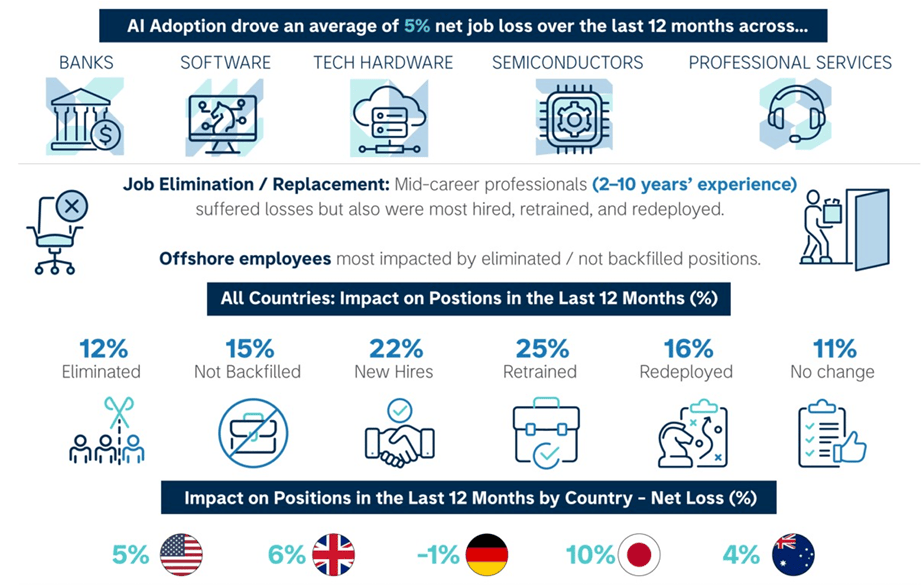
The more striking detail is that the UK was already the worst-performing labour market in Morgan Stanley’s earlier “Wave 1” survey, where British firms reported an 8% net job loss against a 4% all-country average.
Morgan Stanley says the UK “remains among the most impacted in terms of net job losses” across both waves of research.
The report does not identify a single definitive reason why Britain appears especially vulnerable, but several clues emerge from the research.
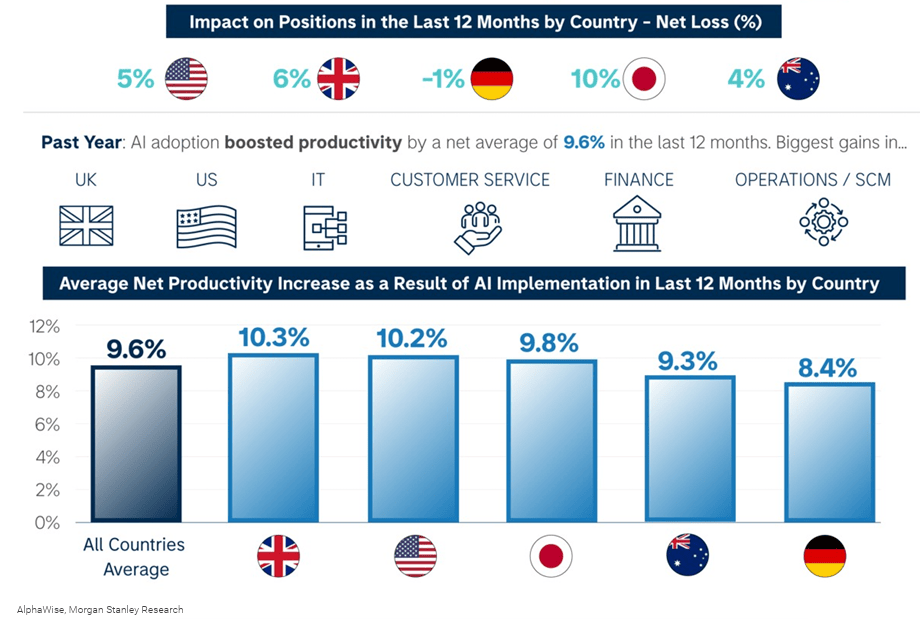
The UK also recorded the highest productivity gains from AI implementation in Wave 2, at 10.3%, above the 9.6% all-country average.
Morgan Stanley’s European strategists argue this likely reflects faster AI diffusion and a stronger corporate focus on productivity optimisation, particularly in sectors such as software and banking where European corporate references to AI-related headcount reductions have risen sharply.
The bank also notes that European equity markets have increasingly rewarded firms that sustainably reduce headcount, arguing that labour optimisation has become an important driver of corporate outperformance in Europe.
The report adds further detail on how AI is already reshaping hiring decisions.
Morgan Stanley says firms are not simply cutting staff outright, but increasingly slowing replacement hiring, particularly for junior and early-career roles.
Across sectors, employees with less than 10 years’ experience were the most exposed to positions being eliminated or left unfilled, while companies said candidates with 2-10 years’ experience would remain the most attractive hires over the next year.
Graduate hiring remains relatively resilient at around 40%, but the report suggests firms are increasingly prioritising mid-level workers capable of supervising or integrating AI systems, rather than expanding traditional junior staffing structures.
Morgan Stanley repeatedly characterises the shift as “workforce reshaping” rather than mass unemployment, with retraining and redeployment occurring alongside outright cuts.
Nevertheless, the findings arrive as official UK labour market data already point to softer hiring conditions.
The ONS said in April that payrolled employee numbers had fallen by 74,000 over the year, while vacancies dropped to 711,000, the lowest level since 2021 and below pre-pandemic levels.
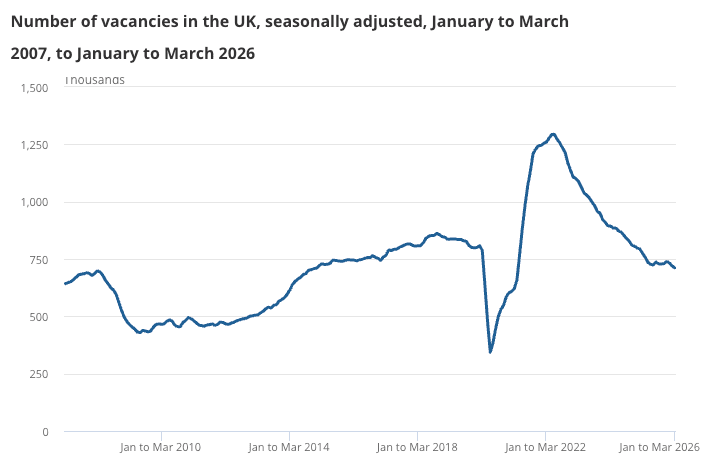
Above: UK job vacancies are falling.
The UK employment rate stood at 75.0% in December 2025 to February 2026, while unemployment was 4.9%.
However, beneath the headline figures, labour demand has weakened materially.
ONS data show vacancies have fallen by 65,000 over the year, while payroll employment has continued to edge lower.
Recent labour market commentary has also pointed to subdued hiring intentions, weaker wage growth and rising inactivity levels.
That presents an increasingly difficult backdrop for the Bank of England.
The MPC is already grappling with renewed inflation risks linked to higher energy prices and geopolitical instability, while simultaneously monitoring signs of weakening labour demand.
Under its remit, the Bank must return inflation sustainably to target while supporting growth and employment where possible.
Morgan Stanley’s findings strengthen the argument that AI could become an additional disinflationary force through weaker hiring, slower wage growth and lower labour demand, even as productivity improves.
But the transition could also prove politically and socially difficult if the gains from AI accrue faster than the labour market can absorb displaced workers.