Image © Adobe Images
Economists at Rabobank say they no longer anticipate two Bank Rate cuts this year.
The Middle East conflict has put paid to any hope of further interest rate cuts this year says a new note from Rabobank, which, if correct, will steady short-term UK bond yields and the pound.
Economists at the investment bank had until recently forecast Bank of England rate cuts in March and June 2026, based on the view that domestic demand growth was weak enough for the risk of further labour market weakness to outweigh the risk of persistent inflation.
But, as the Stoic principle states, events "happen as they do happen", and five days of Middle East conflict put paid to those predictions.
"The surge in natural gas and oil prices has now put that expectation into question. Unless the situation in the Middle East resolves quickly, the UK economy faces a negative supply shock," says Stefan Koopman, Senior Macro Strategist at Rabobank.
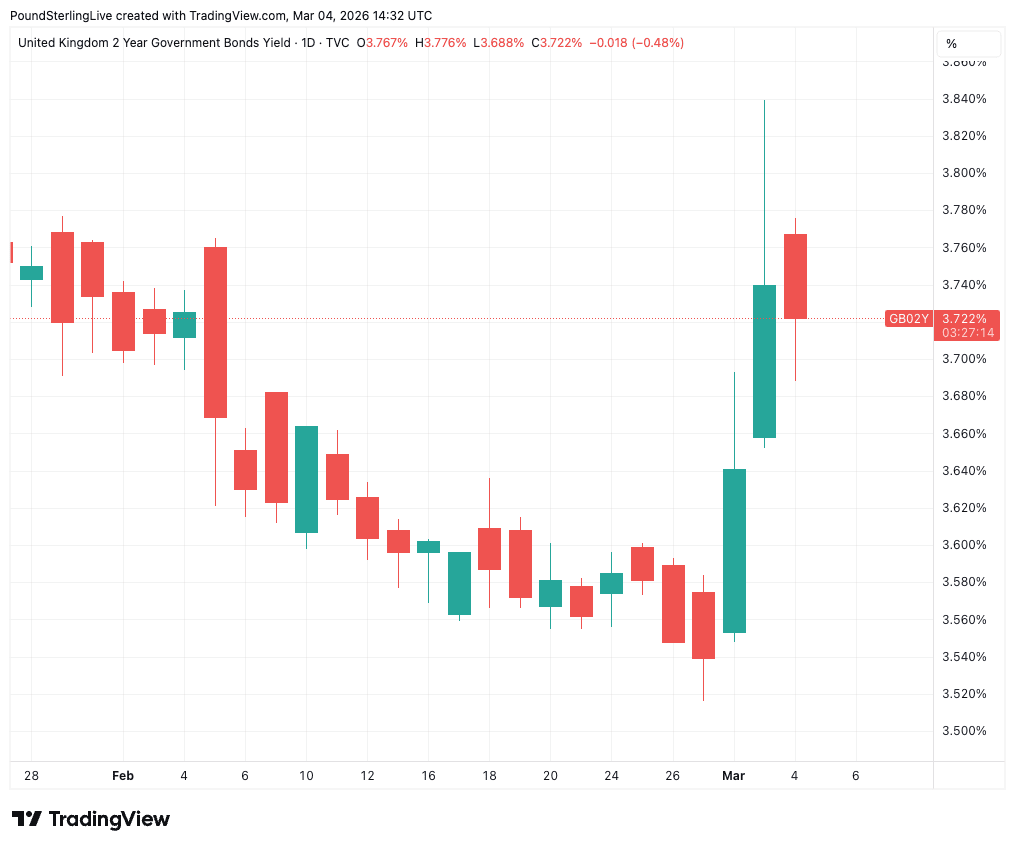
Above: The two-year bond yield has risen as markets pare expectations for Bank of England interest rate cuts.
He says higher oil prices will feed through quickly in UK inflation, and - if sustained - higher natural gas prices will push inflation higher from July onward.
"We have therefore decided to remove the rate cuts from our 2026 forecast. If the energy market stabilises earlier than we expect, we will re-evaluate," says Koopman.
Money markets agree; where they saw 80% chance of a cut on March 19 there's just 25% chance of a 25 basis point reduction today.
Beyond March, the window starts to close as April looks set to mark a low point in CPI inflation.
📈 UK two-year bond yields have moved higher over the course of this week from a low at 3.548% to a high of 3.84% on Tuesday before settling at 3.72%. They're important because they are closely tied to Bank of England interest rate expectations and reflect directly on where investors see the direction of travel in Bank Rate.
This is an important financial product that underpins swaps and mortgage rates, and if the steady decline witnessed in two-year yields stops, so too will the fall in mortgage rates.
For the pound, it could nevertheless mark a turning point. The GBP/EUR currency pair has steadily tracked two-year bond yields lower, and its stabilisation and potential recovery would be expected to translate into a higher exchange rate.
➡️ Analysts at Rabobank's fellow Dutch lender, ING, are also out today with their views on Bank Rate.
They say UK inflation could peak at 3.5% this year if energy prices stay around current levels into the second quarter.
However, they think the Bank will delay lowering rates and not cancel the move outright.
"We now expect the next Bank of England cut in April, though March is still a distinct possibility if Middle Eastern tensions rapidly de-escalate. With the jobs market still under pressure, further easing is still more likely than not," says James Smith, Developed Markets Economist for the UK at ING.