Image © Adobe Images
The Bank of England is close to resuming its easing cycle, with fresh labour market data reinforcing expectations that the next move will come sooner rather than later.
According to DNB Carnegie, the Monetary Policy Committee is likely to cut Bank Rate in March, before bringing the current easing phase closer to completion towards mid-year.
“Subsequent data releases have confirmed a softening in the labour market, which is expected to translate into slower wage growth and reduced services inflation. As a result, we now anticipate that the MPC will deliver its next rate cut at the March meeting (rather than in April), followed by a final reduction in late July this year,” says DNB Carnegie analyst Knut A. Magnussen.
The call reflects a growing sense that inflation momentum has peaked and that slack in the labour market is building fast enough to give policymakers cover.
Inflation has eased from last year’s 3.8% peak to 3.0% in January, while unemployment has risen to 5.2%, the highest level since 2020.
Vacancy metrics have also rolled over sharply, signalling reduced wage pressure ahead.
Even so, the path to lower rates has not been straightforward.
Recent policy votes have been split five-to-four, underscoring divisions within the committee.
But February’s guidance from the Bank of England signalled the door is open: “If the economy and the outlook for inflation evolve as we expect, there should be scope for some further cuts to Bank Rate this year.”
DNB Carnegie argues that two further reductions would still leave policy mildly restrictive, with Bank Rate at 3.25%, slightly above the midpoint of the Bank’s estimated neutral range of 2.5–3.5%.
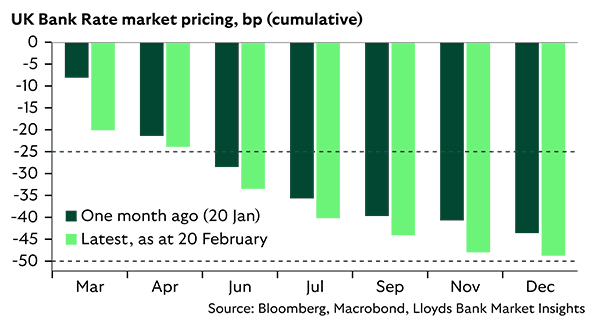
Markets are largely aligned, pricing an 80% probability of a March move and one more cut before year-end.
Magnussen says that final cut will fall in July.