
Image © Adobe Images
The British economy was in "robust" shape in February, but employment is one area of weakness.
There's growing evidence that private companies are looking to grow with fewer staff, a classic hallmark of a British productivity revival.
This is the main takeaway of today's PMI survey data for February that showed a firming growth story driven by an accelerated upturn in new work.
S&P Global's Composite PMI read at 53.9 in February, up from 53.7 in January, and ahead of expectations at 53.4.
"The economy has held on to the momentum seen at the start of the year, with private sector activity expanding at a solid pace for a second consecutive month. That marks a clear improvement on much of last year," says Jake Finney, Senior Economist at PwC.
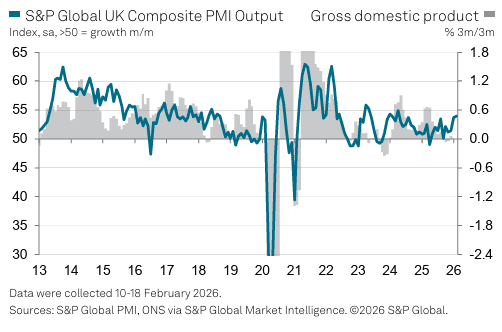
Above: The PMIs show economic growth will rise in Q1.
The services sector, the economy's largest, expanded comfortably at 53.9 (cons: 53.6) and the manufacturing revival stepped up a gear with a PMI of 52 (cons: 51.8).
What's becoming increasingly clear is that British companies are looking to grow with fewer staff: the PMI's measure of employment showed another decline. S&P Global explained that employment numbers decreased for the seventeenth successive month, led by another marked reduction in the service economy.
"Companies remain focused on boosting productivity to cut costs, resulting in yet another month of steep job losses to prolong the continual jobs downturn that was initiated by the 2024 autumn Budget," says Chris Williamson, Chief Business Economist at S&P Global Market Intelligence.
The current government has steadily raised the cost of employing people via hiking National Insurance costs and raising the minimum wage.
"The weakness in the employment component still stands out. Employment declined for a seventeenth consecutive month, in line with the softness seen in the payroll data. This adds to a growing body of evidence that rising labour costs are weighing on hiring decisions, particularly in the services sector," says Finney.
This incentivises firms to look to technology to do what employees might have done in the past. The upside is that those staff who are retained are made more productive and can eventually look forward to higher wage returns for increased output.
These job data tally with official figures that show a steady rise in UK unemployment, making it increasingly likely that the Bank of England will lower interest rates next month.
That expectation for a cut is keeping the pound on the back foot, meaning it is looking through an array of positives and tending to focus on where jobs are going.
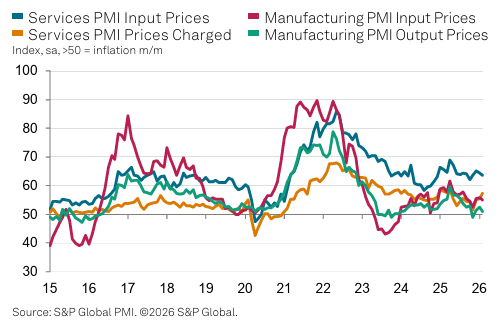
Above: Price pressures facing firms are also robust, suggesting the current trend of disinflation in the economy has its limits.