Our studies confirm more downside is expected in GBP/CAD in the short-term despite the Canadian currency being hurt by Friday the 5th's underwhelming employment data.
Pound Sterling is seen lower across the board as the Bank of England starts to buy UK government bonds, also known as Gilts.
The strong demand for Gilts created by the Bank's actions has forced the yield paid by those gilts to record lows ensuring the divergence in yield between the UK and Canada grows.
It is this divergence that is pushing the GBP/CAD exchange rate lower, and will likely continue doing so as the Bank targets the purchase of £50BN worth of Gilts.
The GBP/CAD exchange rate is quoted at 1.7126 at the time of writing, and could well test the 1.7044 low that was struck on Thursday the 4th, the day the Bank announced its intention to buy UK Gilts.
However, downside in GBP/CAD has been protected by recent Canadian Dollar underperformance - the currency suffered on Friday after data showed a -31k fall in jobs in July, a figure which stood in marked contrast to its US neighbour's 255k rise.
Nevertheless, the GBP/CAD remains in a precarious position owing to the hefty 2% gains seen on Thursday the 4th, the day the Bank of England cut interest rates and announced an unexpectedly-large quantitative easing programme.
The event allowed the GBP/CAD to break out of a wedge pattern that has dominated trade of late.
The pair now looks set to resume its broader medium-term down-trend.
Scotiabank’s FX strategist Shaun Osborne is extremely bearish:
“Intraday gains in the GBP likely represent nothing more than a retest of yesterday’s break out (expect resistance in the 1.4325 area for now).
"Weekly patterns are bearish (outside range) and trend oscillators are aligning bearishly again for the GBP after the July consolidation. We think the GBP will test 1.67 shortly and risks dropping to the 1.50/1.60 range in the medium to longer term.”
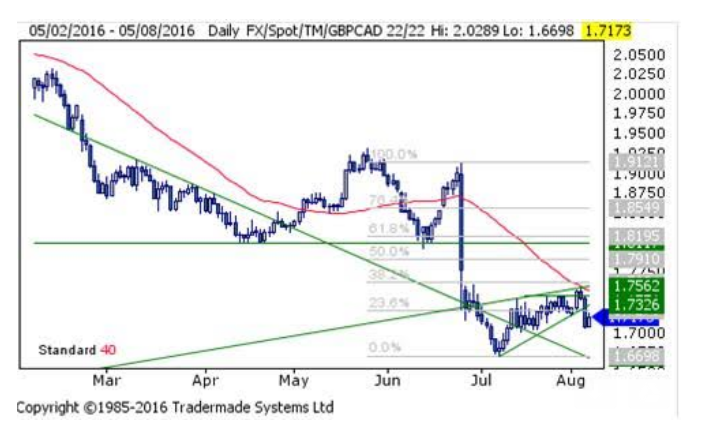
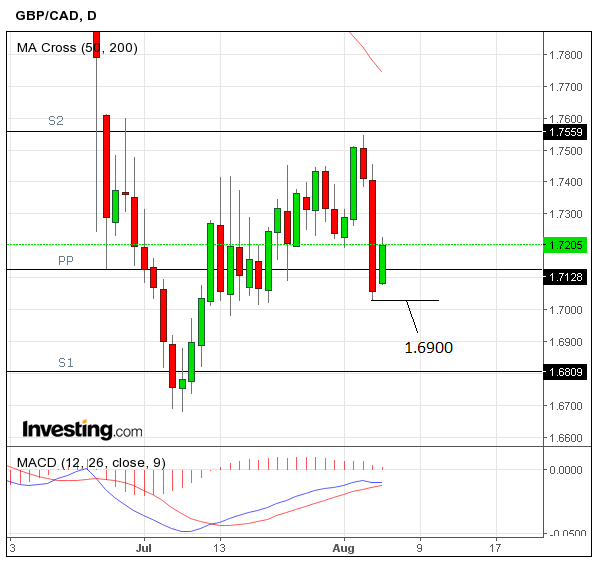
We also note the breakdown, however, we are more cautious in our downside estimates, looking for a move below the 1.7087 lows as providing a signal for more downside to 1.6900.
Canadian Dollar: Deteriorating Fundamentals?
The Canadian dollar has through 2016 enjoyed the supporting of positive fundamental drivers, which have allowed it to strike a bullish tone against many of its peers.
However, these positives have been offset by recent poor unemployment data, which showed a much higher than expected rise in the number of people out of work
Capital Economics’ Paul Ashworth commenting on the data said: “The 31,200 decline in employment in July illustrates that the disruption caused by the Alberta wildfires back in May was clearly not the only factor holding the economy back. (Data released on Friday).
"The unemployment rate edged up to 6.9%, from 6.8%, and the increase would have been even greater if not for a 12,800 decline in the labour force. Data on June’s Trade Balance were also a mini-disaster. The monthly trade deficit widened to $3.6bn in June, from an upwardly revised $3.5bn in May.”
Latest Pound / Canadian Dollar Exchange Rates
  | Live: 1.8738▲ + 0.04%12 Month Best:1.9044 |
*Your Bank's Retail Rate
| 1.8101 - 1.8176 |
**Independent Specialist | 1.8476 - 1.8551 Find out why this is a better rate |
* Bank rates according to latest IMTI data.
** RationalFX dealing desk quotation.
Kathy Lien, of BK Asset Management, points out that the fall was all the worse as it was entirely due to a loss of full-time jobs:
“What was particularly worrisome was the fact that all of the job losses were full time, and without the rise in part-time work, job losses would have exceeded 70k.
The unemployment rate also increased while the participation rate declined, which was completely opposite to the U.S.”
Nevertheless, there are several broader fundamental themes supporting CAD too, one of which is the continued high demand for Canadian bonds in an environment where most mainstream sovereign bonds yield less than zero percent per annum, (which led to a surplus of 10bn in capital portfolio inflows in May).
Indeed, this trend has probably increased in June and July due to the impact of Brexit on pushing down mainstream yields yet further.
The yield-seeking environment is expected to continue into late summer, according to Swissquote’s Yann Quelenn:
“The current macro-environment should continue to support dominate yield-seeking carry trade. With volatility subdued, G10 yields nearly non-existent (making EM yields appealing) and steady improvement in economic activity (although merely a rationalization to take extra risk) demand for EM looks to last the summer.”
Another factor in the Loonies’ favour are the still quite bullish forecasts for oil, which include $62 a barrel by the end of 2016 from Bank of America Merrill Lynch and most other forecasts above 50.
Currently oil has fallen to 40 dollars a barrel, however, this is seen as a seasonal effect, due to lower-than-expected demand in the summer when people normally use more petrol holidaying.
The fall to 40 dollars is seen, therefore, as a correction, with the price of oil expected to soon climb back up to 50 or so mark at least, which would be positive for CAD as it remains highly correlated to the commodity.
The Pound: Data to Watch
In relation to the pound there are some who think ‘the worst may be behind the currency’, although that does not mean there will necessarily be much upside ahead in the short-term either.
Financial markets sold off heavily after the UK voted to leave the EU, but they have now recovered and made new highs – we maintain that if the fallout was still a major risk factor equity markets for one would not be in such good shape.
The Bank of England (BOE) also appears averse to lowering interest rates any further, and of the various different forms of monetary stimulus this would be the most negative for sterling; monetary stimulus in general, globally that is, also appears to be losing its impact, the UK included.
Nevertheless, as pointed out by Broker TD Securities, the key to the pound remains data for the period after Brexit, in other words for July.
The problem is that there is still a lack of data for July on which to base a fair assessment of the impact of the referendum on the economy, and in the week ahead this remains a problem as there are only two release for the period.
One is the British Retail Consortium's (BRC) retail sales figures out on Tuesday, and the other is the NIESR GDP Estimate for July on the same day.
Whilst BRC sales is normally a tier three release of little significance, in the week ahead its importance will be temporarily exalted.
Clearly a positive result for July data could help sterling recover; whilst a negative would confirm fears that the economy is declining steeply following the impulsive breakaway from Europe.
Has the Pound hit Bottom?
For BK Asset Management’s co-founder and FX guru Kathy Lien, the big question is, has sterling bottomed?
According to her analysis there is a strong possibility the pound has since she sees it as unlikely that the BoE will cut interest rates any lower, after BOE governor Carney expressed a clear aversion to negative interest rates at the last press conference:
"Yes, the central bank is ready to lower the bank rate further if needed and increase all elements of Thursday’s package but Carney also made it very clear that the “lower bound in interest rates is above zero” and he is “not a fan of negative interest rates,'" notes Lien.
Carney believes that helicopter money is a “flight of fancy” and he doesn’t see a scenario where negative rates is discussed, so if BoE were to ease again, it would be in other ways like additional bond purchases. The bank reduced its GDP outlook for 2017 but kept its 2016 forecasts unchanged.
It also believes that inflation will rise given the weakness of the pound.
"Having taken such an aggressive stance, the Bank of England is now in wait-and-see mode, which could actually lift sterling because of the extreme level of short positioning,” says Lien.