Highly accurate consensus projections for the next four quarters, compiled from leading investment banks.
Access the full forecast →

Image © Adobe Images
New data shows disinflation joins list of dollar headwinds.
The U.S. Dollar is set to stay under pressure as domestic data and broader trends continue to apply pressure.
Annual inflation in the U.S. fell to 2.4% in January, versus market expectations of 2.5%, offering a textbook reason to sell dollars.
Monthly inflation fell to 0.2% in January, from 0.3% in December, putting it below market expectations of 0.3%. Annual core inflation - which excludes energy and food - fell to 2.5% in December.
"US inflation has surprised to the downside, showing disinflationary progress is the US is on track and that rate cuts could well be on the cards as we move through 2026," says Isaac Stell, Investment Manager at Wealth Club.
The dollar index is slightly down on the day at 96.92, which lifts GBP/USD up to 1.3636 and EUR/USD to 1.1874.
"Today's data is telling us annual inflation pressures are fairly subdued as firms are still absorbing tariff costs, shelter costs are coming down and a softening labour market is keeping wage pressures subdued," says Ali Jaffery, an analyst at CIBC Capital Markets.
Disinflation is another headwind for the dollar and the coming weeks will likely see ongoing weakness help EUR/USD trade above 1.20.
"Given our expectations for further USD weakness, this should drive EUR-USD higher with 1.20 to become support not resistance," says a note from strategists at HSBC.
"We continue to favour EUR/USD edging up to 1.22 area in an orderly manner," says ING.
More broadly, U.S. economic and stock market exceptionalism is behind us with the current selloff in U.S. technology stocks making the point perfectly.
Investors are now rebalancing portfolios away from a long-running U.S. overweight and at the same time, hedging of U.S. exposure by internationals is rising.
Improved prospects elsewhere add to the ex-U.S. diversification theme.
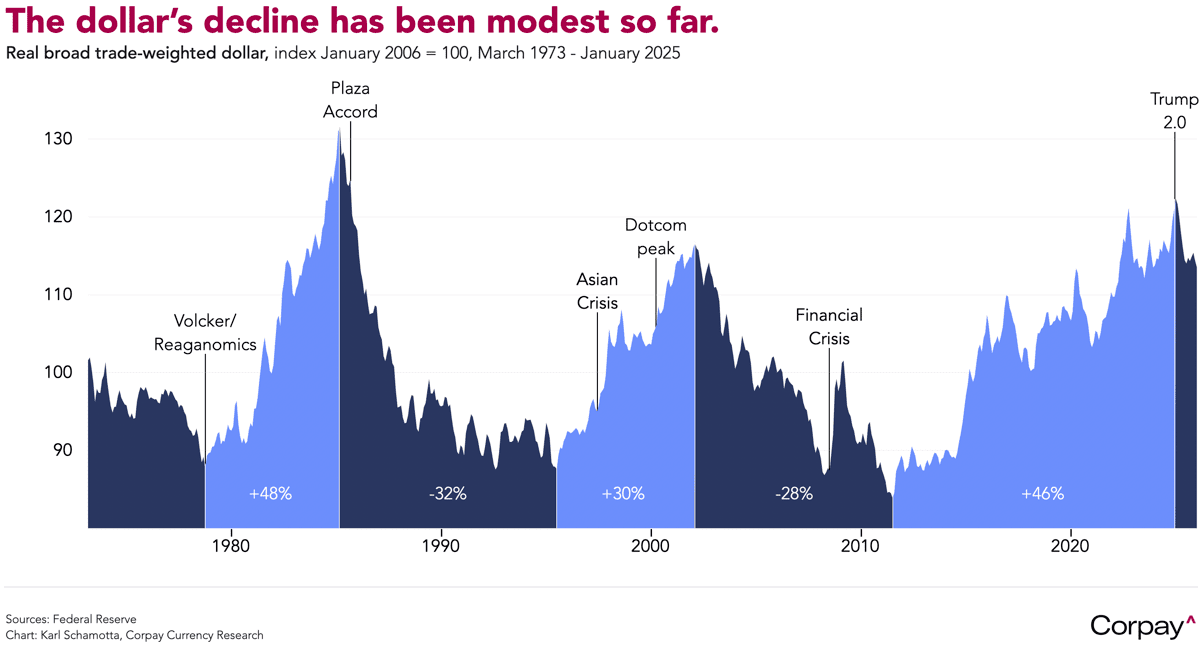
"US outperformance is behind us, and global investors are realising that their portfolios now have too many US assets in them. There is room for more USD weakness, but this process takes time," says a note from Nordea Markets. "Even after quite a heavy USD weakening over the last year, the USD is still not very weak in a historical context."
Consensus projections for the next four quarters, compiled from leading investment banks.
Access the full forecast →
This week's USD response to U.S. labour market data was instructive: a strong beat on expectations, which would normally send the dollar higher.
Instead, USD saw its post-release strength quickly fade. "That points to entrenched bearishness, and serves as a warning to those—ourselves included—who have been expecting stronger US fundamentals to play a supportive role" - FX strategist Karl Schamotta.
"By historical standards, the greenback’s decline so far remains modest (see chart above), leaving scope for further downside if the mood doesn’t shift," he adds.
Institutional analysts are consensus bearish on the dollar and most see EUR/USD above 1.20 this year.
However, there's also an agreement that the decline will be slow, with periods of USD recovery.