
The Australian Dollar remains dominant thanks to solid underlying economic fundamentals and a central bank that looks increasingly unwilling to cut interest rates any further.
Pound Sterling remains at risk of moving back towards 2016 lows in the A$1.68 region having faced one-way traffic lower since the 15th of September.
A bounce in GBP/AUD is being seen ahead of the weekend, and month-end, but even a positive close on Friday the 30th September would not be enough to invalidate the downtrend.
The GBP/AUD is in a strong short-term downtrend (shown below on the 4-hour chart) which, despite bouncing over recent days and looking a little over-stretched is still technically intact:
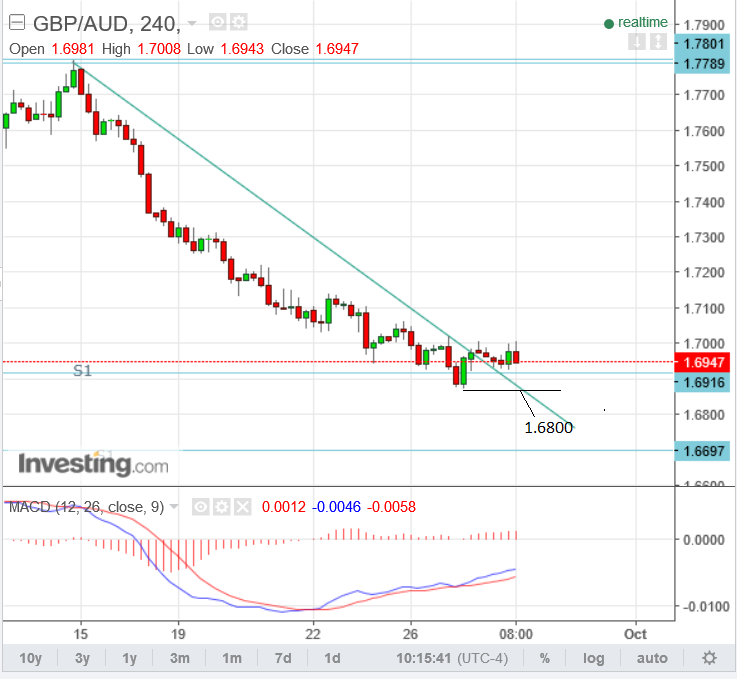
The pair has also broken above the down-trend line but despite that, the trend remains in force and overall the probabilities still favour a continuation lower.
MACD momentum is also weakening and moving higher to converge with falling price, which is an early indication price-action will probably start to recover bullishly.
Nevertheless, we stick with a bearish interpretation, and a break below the 1.6873 lows would probably confirm a continuation lower to support at 1.6800 where we would expect some notable buying interest in Sterling to arrest declines.
The down-trend on the chart mainly reflects the recent sea-change in the outlook for the Aussie dollar, which has climbed after the new governor of the Reserve Bank of Australia (RBA), Philip Lowe hinted that no more interest rate cuts would be forthcoming from the central bank for now.
This came on the back of similar hawkish commentary from the deputy Governor Kent only days before.
A more positive outlook for the economy, especially for mining investment and commodity prices, seemed to underpin the reluctance to cut rates any lower unless necessitated.
CIBC’s Jeremy Stretch mentions a report from the RBA that highlights the country’s robust labour market and low employment.
He states that the low level of joblessness despite the economy’s recent ups and downs has been as a result of positive trade relations between workers and management, which meant shorter working hours could be negotiated instead of layoffs.
Latest Pound / Australian Dollar Exchange Rates
  | Live: 1.8755▼ 0%12 Month Best:2.0851 |
*Your Bank's Retail Rate
| 1.8117 - 1.8192 |
**Independent Specialist | 1.8493 - 1.8568 Find out why this is a better rate |
* Bank rates according to latest IMTI data.
** RationalFX dealing desk quotation.
The Pound Faces Notable Headwinds
The Pound has been supported by relatively strong data of late, which seems to show the economy in rude health after Brexit.
However, headwinds continue to blow.
Sterling should be higher were it not for growing speculation that the government is gearing up for a complete withdrawal from Europe, including the trading club element called the common market.
International Trade Secretary Liam Fox has now sought for the UK to become an independent member of the World Trade Organisation - some would argue this is a pragmatic development but according to analysts at Citibank it could be seen as, “a clear signal of preparing the ground for an 'hard Brexit', which would involve leaving the EU’s single market entirely.”
The problem for Britain is that access to the EU's single market also requires the handing over of inter-European immigration controls, which is at odds with the sovereignty desired by the majority who voted for Brexit.
The issue has also been highlighted by Switzerland whose government has been making efforts to negotiate tighter immigration controls whilst maintaining access to the common market.
In the Swiss case, the EU would not budge on the principle of freedom of movement, so the Swiss had to hold a referendum on whether to quit the common market or tighten immigration controls.
“The Swiss parliament has chosen continued access to the EU’s single market over immigration controls demanded by a 2014 referendum, after unsuccessful negotiations with the EU. This points to a tough EU stance and difficult negotiations ahead for the UK as well,” argue Citi.
Indeed, we have heard from many analysts over recent days that one of their core reasoning for expecting a weaker British Pound remains the uncertainty posed by the difficult Brexit negotiations that lie ahead.
Continue to watch the newswires for further developments on this story as we expect GBP to remain sensitive to such headline risks.