The Reserve Bank of Australia opted to cut interest rates at their August meeting; move that cautions against AUD weakness over coming days.
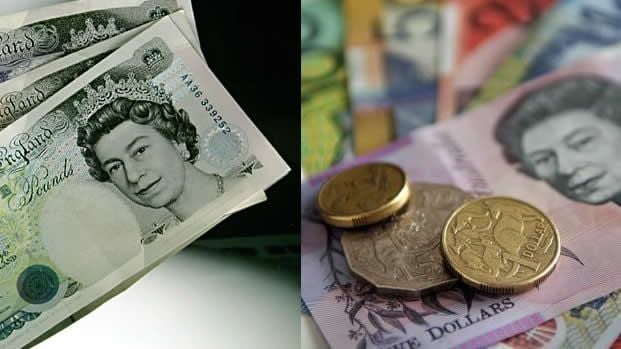
The Pound to Australian Dollar exchange rate (GBP/AUD) trades softer at 1.7454 despite an interest rate cut being executed by the Reserve Bank of Australia on the 2nd of August.
The RBA cut the cash rate by 25 basis points to a new record low of 1.5%. The cut comes just two days ahead an important meeting at the Bank of England where analysts are forecasting a similar cut to be implemented.
The RBA cited lower inflation, a mixed labour market and a cooling housing market for the move.
Typically rate cuts trigger currency weakness, but the reaction of the Aussie Dollar suggests to us that the country's interest rate remains high enough to attract capital inflows, something the RBA won't be pleased with.
The Australian Dollar has long found support from Australia's superior interest rate yield - global investors are able to borrow at near-negative rates in places like Australia and the Eurozone, and invest in accounts in Australia.
This 'hunt for yield' in turn creates demand for the Australian currency, in which higher-yielding assets are priced.
Will this incredibly important trade remain popular now that the rate has reached 1.5%?
If the profit in the so-called 'carry trade' has been diminished then the Australian currency could well find support fade. Particularly if further rate cuts are coming down the line.
"Although the RBA cash rate was this morning cut to a record low, Australian rates remain attractive as a carry trade. Measured since June 24 2016 – the date the results of the UK’s Brexit referendum became known, the AUD has been the best performing G10 currency as anticipation of more central bank easing has supported risk appetite," says Jane Foley at Rabobank in London.
Looking ahead, though, further cuts may further eat into the AUD's supportive bedrock.
"We think that the RBA retains an easing bias. Although the policy press release did not spell it out, we think that the RBA would retain an easing bias given Friday’s Statement on Monetary Policy should continue to show underlying inflation remaining well below the 2.5% midpoint of the target band for an extended period," says Kieran Davies at ANZ Research.
Davies argues the strong currency will also be an input into the decision given the RBA again warned that a rising exchange rate could complicate the recovery.
Having a look at the major pairs we would say the damage to the currency is minimal with the AUD trading higher against the US Dollar than it was a mere week ago, at 0.7548.
The RBA will have to cut by a good deal more to encourage a weaker currency.
Latest Pound / Australian Dollar Exchange Rates
  | Live: 1.8949▼ -0.34%12 Month Best:2.0851 |
*Your Bank's Retail Rate
| 1.8305 - 1.838 |
**Independent Specialist | 1.8684 - 1.8759 Find out why this is a better rate |
* Bank rates according to latest IMTI data.
** RationalFX dealing desk quotation.
Pound Pointed Lower Against Aussie Dollar
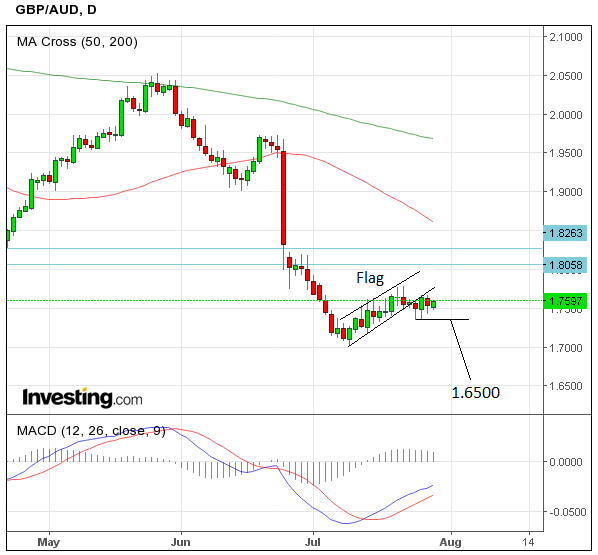
The GBP/AUD pair remains caught in a concerted medium-term down-trend on the daily chart (see below).
The correction higher, seen over the last few weeks looks, very much like a ‘flag’ continuation pattern, which if true, would forecast substantially more downside for the pair to probably around the 1.650 level, dependent on confirmation from a break below 1.7300.
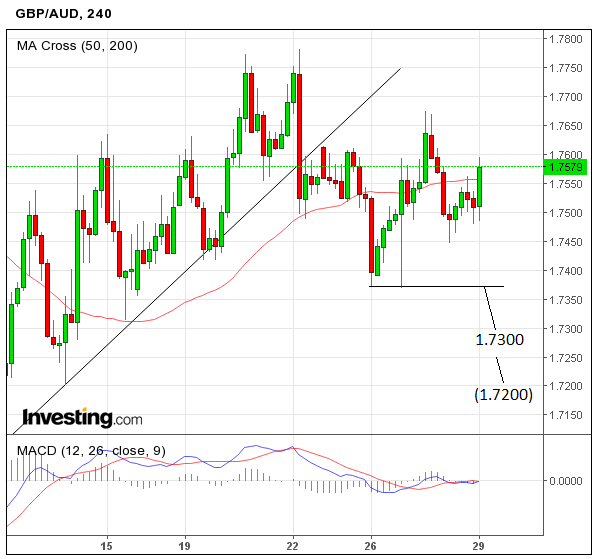
On the four-hour chart and we can see that the pair has broken down below its rising channel.
After almost falling down to the 1.7350 target, the pair has recovered and is currently trading at 1.7534.
The strong up-bar on the four-hour chart, indicates the likelihood of more upside.
It is less likely now that the pair will resume its descent and reach the 1.7350 level.
From a technical perspective the pair seems roughly balanced at this juncture.
Bank of England Meet to agree stimulus package
While the RBA will be of interest, arguably it is the Bank of England (BoE) meeting on Thursday that will be the big driver of GBP/AUD.
It is not a question of whether or not they will announce more stimulus, but rather how much stimulus.
Broker TD Securities are not the only FX professionals who expect a combination of a 0.25% interest rate slice with an increase of 50bn in quantitative easing (QE).
They say the market has priced in the interest rate cut so the pound will probably not fall further on that alone, but taht markets have not priced in the 50bn in QE, which if included will weaken sterling.
“Next week the BoE finally unveils its long-awaited stimulus package, and we’re looking for a 25bps rate cut, £50bn of QE, and an expansion of FLS or something similar to help preserve financial institution profitability. The rate cut is fully priced in, but we don’t think that FX or rates markets have fully priced the amount of QE that we’re looking for, especially coming all at once alongside the rate cut.”
We see a risk of more downside in the pair from the BOE meeting.
Exports improve
One of the reasons the RBA previously wanted to cut interest rates was to weaken the Aussie dollar in order to make Australian exports more competitive, recent data, showing Export prices rose 1.4% in the June quarter, however, indicated an improvement in Export income, and Australia’s terms of trade (ratio of exports to imports).
According to St George Economics, the increase in export prices should have led to an increase in income, and this might be a factor against the RBA ‘pressing the button’ on Tuesday:
“The data indicates that the terms of trade (ratio of export to import prices) likely rebounded in the June quarter, the first increase in 2½ years. The improvement will help to provide incomes with a boost.”