The Australian dollar should maintain a positive bias over the Pound Sterling in coming days despite a seemingly AUD-negative deadlock being delivered by weekend elections.
The Australian dollar starts the new week with a positive bias against both the USD and GBP courtesy of investor-friendly conditions across the financial market place.
With stock markets rising we are seeing the kind of 'risk-on' conditions that tend to favour the Aussie unit.
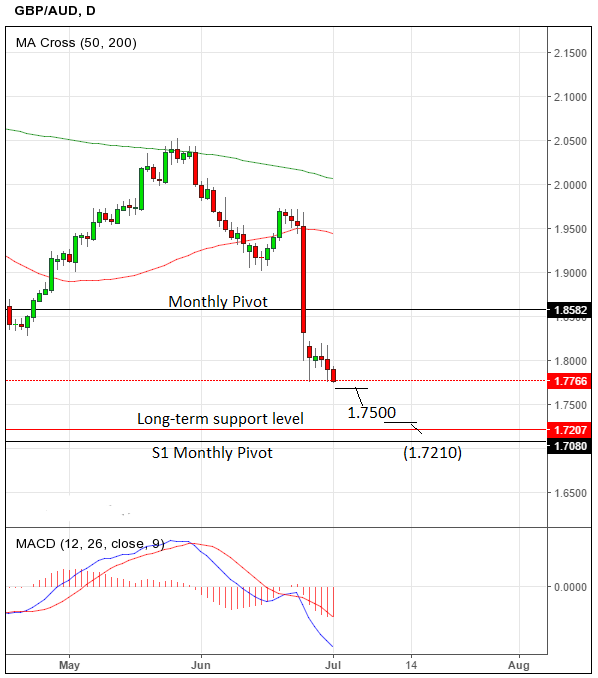
The GBP/AUD conversion has extended lower and confirmed a break below some key obstacles, including the 50-month moving average (MA) at 1.80 and the 200-week moving average at 1.82.
Moving averages are significant levels to be aware of as they are often where a long-term trend is reinforced. This is because traders often place buy and sell orders around these big technical levels in anticipation of a reversal, or an acceleration in the prevailing move should the barrier be broken.
The long-term underlying trend in GBP/AUD has been higher since September 2014 and we would have expected the afformentioned moving averages to remain unbroken were the trend to remain valid.
In short, we are slipping into a long-term downtrend.
In the event of a pull-back higher these two moving average’s are likely to act as ceiling levels capping gains in the early 1.80s.
Currently trading in the 1.7750s, the exchange rate has a definite downside bias post-Brexit, and a break below 1.7700 would provide added confirmation of a continuation lower to the next target at 1.7500.
A further break below 1.75 – confirmed perhaps by a break below 1.7450, would probably then also see an extension down to the next set of support lines starting with a historic level which could act as a break on further weakness 1.7207 and then the S1 monthly pivot at 1.7079.
Expectations of weakness for the Australian dollar due to global risk aversion are counterbalanced by a trend in investors seeking higher-yielding investments, such as Australian Government Bonds, which offer over 2.0% return, against the negative or barely positive return on most UK, German, US and Japanese sovereign debt.
"At 1.75%, the base rate is very attractive to overseas investors; especially with interest rates at virtually 0.0% elsewhere and an expected cut from the BOE in the coming months," says David Johnson at Halo Financial, a foreign exchange brokerage in London.
Which driver wins out is difficult to assess, however, according to one expert:
“Say Brexit risks fade, which they certainly will on the global financial market, then the carry trade comes into favour once more.”
So it’s possible the Aussie could actually have a brighter outlook then many had feared.
"GBP buyers are eyeing the A$1.75 support level and AUD buyers are hoping for a bounce to A$1.84. These are both good technical targets," says Johnson.
Latest Pound / Australian Dollar Exchange Rates
  | Live: 1.88▲ + 0.07%12 Month Best:2.0851 |
*Your Bank's Retail Rate
| 1.8161 - 1.8236 |
**Independent Specialist | 1.8537 - 1.8612 Find out why this is a better rate |
* Bank rates according to latest IMTI data.
** RationalFX dealing desk quotation.
Australian Dollar Could be Hampered by Political Uncertainty
The big issue for AUD over coming days will be the apperent deadlock delivered by the elections held over the weekend.
PM Malcolm Turnbull called early elections in an attempt to secure a majority administration which would allow him to deliver fully on policy wishes.
However, voters appear to defied Turnbull's wishes and look set to extend what has been ten years of instability.
"A backlash against mainstream politics has also left the Australian election in limbo as no major party seats to form a majority government and the result has increased the risk of a cut to the country’s AAA sovereign rating," say UOB in a foreign exchange briefing to clients.
Vote counting is set to resume on Tuesday (5 July) and the political uncertainty is likely to keep the RBA unchanged on Tuesday due to the uncertain domestic political backdrop
“This election result is the worst possible outcome for Australia,” said John Brogden, Chief Executive of the Australian Institute of Company Directors. “We need certainty and an environment for long-term policy-making.”
As we have noted of late, currency markets hate uncertainty and the polticial situation in Australia is certainy adding to an AUD-negative environment.
As far as data goes the week ahead includes Retail Sales on Monday (0.3% exp, 0.3% prev), and then the Reserve bank of Australia Rate decision on Tuesday.
The consensus amongst analysts appears to be that Brexit has lead to most central banks all around the world taking an easier monetary policy stance, and this has increased the chances the RBA will cut interest rates – perhaps not in July, but most think in August.
According to broker TD Securities analysts should look for an explicit guidance in July’s statement on a cut:
“The fresh global downdraft could see the RBA reintroduce an explicit easing bias, citing offshore risks, but is far from a done deal. We still look for an August cut to 1.5%.”
This would be expected to weaken the Aussie.
Australian Dollar at Risk of Weakness Against US Dollar
While GBP/AUD is pointed firmly lower, we have observed of late that there are a good number of analysts who are turning negative on the Australian currency's outlook against the US dollar.
ANZ Bank’s Head of FX Strategy, Daniel Been, sets out the fundamental case for why AUD/USD might fall in a recent note, saying of AUD first that:
“Uncertainty around Brexit will keep the AUD under pressure. Medium-term, if the trend towards less global integration were to continue, this wouldm justify a bigger premium on AUD assets and weigh on the AUD.”
The dollar, however, will be the “main beneficiary” of the risk-off climate, he says, “but it may not be the only one.”
ANZ see AUD/USD falling to 0.67 by the end of the year, and to 0.72 in September, from its current 0.74 level.
Westpac’s Head of FX, Robert Rennie, is more bearish on AUD/USD after Brexit, changing his previous forecast that gains would be capped at 0.76 with gains now being capped at 0.75.
His chief reason is increased uncertainty due to Australian Federal Elections and an increased likelihood that the RBA will cut interest rates, due to “global developments.”
“Weaker UK growth, a summer of European discontent and lots more political risk to come all suggest the A$ should now be capped closer to 0.7500.”