The GBP to AUD dollar exchange rate appears to have found a temporary floor in what is turning out to be an extended period of weakness.
The pair has been in decline since August 2015 with declines from the peak above 2.20 taking the market to levels last seen in January 2015; the impressive 2015 rally has been erased.
The Australian Dollar recovered ground in the first quarter of 2016, rallying to its strongest position against the pound and US Dollar in over nine months in March.
Concerns of an economic slowdown in China, Australia’s largest trading partner, have begun to abate allowing the Aussie to catch a bid.
AUD has also benefitted from a rebound in commodity prices, which account for the bulk of Australia’s exports.
Moreover, investors continue to delay their expectations for an interest rate cut in Australia, despite risks to growth from a stronger currency.
The benchmark interest rate was maintained at 2% for the tenth straight month at the Reserve Bank of Australia’s (RBA) February meeting, with policymakers remaining upbeat in their assessment of the Australian economy.
April has however seen some respite for the GBP/AUD exchange rate with the pair finding good buying interest at the base at 1.84.
Subsequent sterling strength has moved the pair above the 20 day moving average, something that has not been seen since February.
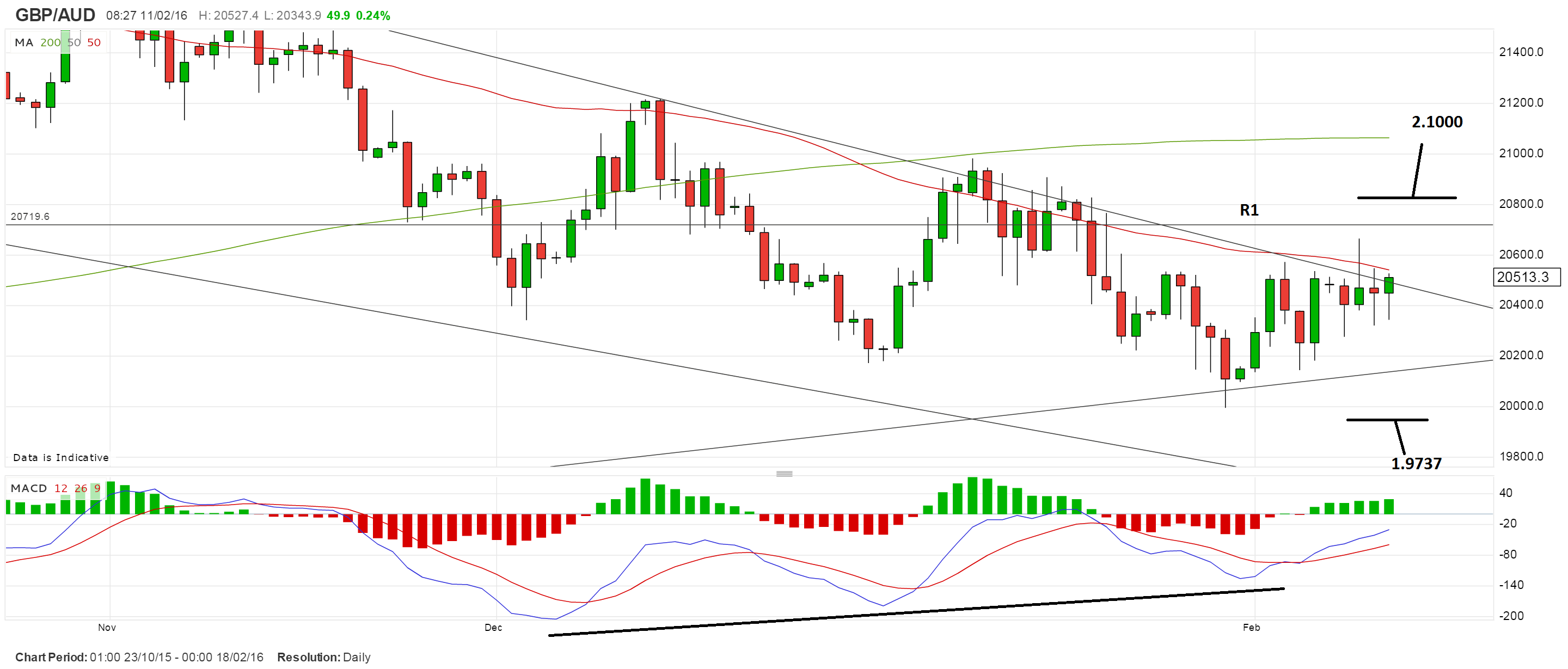
Often such a technical break invites further buying interest as sellers are forced out of the market.
We would however caution that the GBP/AUD has failed to trade above this key technical pointer on a sustained basis for many months now. It could well prove to be a false signal.
Nevertheless, the support floor at 1.84 also look solid and there is an expectation for consolidation to occur over the next couple of weeks.
However, there is little sign that the Aussie intends to do anything other than dominate over coming months.
Latest Pound / Australian Dollar Exchange Rates
  | Live: 1.9114▲ + 0.27%12 Month Best:2.0664 |
*Your Bank's Retail Rate
| 1.8464 - 1.854 |
**Independent Specialist | 1.8846 - 1.8922 Find out why this is a better rate |
* Bank rates according to latest IMTI data.
** RationalFX dealing desk quotation.
BNP Paribas: Australian Dollar to Still Fall
However, not everyone is forecasting one-way traffic for the Australian dollar to extend indefinitely.
Analysts at French bank BNP Paribas continue to maintain their position, intact since the start of the year, that 2016 will see the Australian dollar fall against its US counterpart.
Indeed, the AUD/USD is likely to fall below 0.70 against the dollar in 2016.
Such a move could well aid the pound higher against the Aussie which would likely move in sympathy with the USD.
"We think rate market pricing for the RBA could quickly turn more dovish if data disappoint, and the release of January employment data (18 February) could be a trigger for a repricing," says a forecast note from BNP Paribas.
Furthermore, the BNP Paribas STEERTM model suggests AUDUSD is overbought versus its current shortterm fair value of 0.6830 while market positioning and currency valuations suggest the AUD will fall in 2016.
China’s shift away from manufacturing towards the service sector and the continuation of two-speed growth in China will not be supportive for Australian export prices.
Analysts believe there is also scope for the RBA to turn more dovish, particularly in the face of the AUD's ongoing appreciation.
RBA Could Prompt a Weaker Aussie Dollar
Watch the Reserve Bank of Australia.
Should they, over coming months, indicate that they are not happy with the pace of Australian economic growth, or the strength in AUD, they may cut interest rates again.
Currently no interest rate cuts are expected in 2016; a scenario that has further supported the AUD. But this could change with some analysts suggesting an AUD/USD exchange rate above 0.80 could force the Bank into action.
The RBA reduced their cash rate by 50 basis points in the first half of 2015 to weaken the dollar and assist struggling exporters, whilst also hoping to support a transformation of the economy into a more services-orientated model and away from the current raw-materials bias.
Despite the RBA’s efforts, the trade deficit widened to -3.54bn in December, one of its widest readings since records began, so it’s not clear the weaker dollar has particularly helped much.
As far as the transition to a more services-based economy, there appears to be some progress on the employment side, although recent data showing a fall in business confidence suggests this may wane, or could be in threat of waning, it is in fact true that ìBusiness confidence is key to the economic transformation’s success, a view recently promulgated by John McIntyre, Chief Economist at Macquarie.
Recent unemployment figures showing a lower-than-expected headline rate of 5.8% were spoilt by a fall in the participation rate of two whole basis points from 65.3 to 65.1, nevertheless the RBA remains positive on this note, saying in its Feb 2 statement that:
“Employment growth over 2015 was stronger than was expected a year ago and the unemployment rate fell by more than had been expected. Despite this, output growth has remained below average.”
It finished the statement with the what seems like a ‘wait-and-see’ comment with a marginally pro-AUD bias:
“The Board will continue to assess the outlook over the period ahead. New information should allow the Board to judge whether the recent improvement in labour market conditions is continuing and whether the recent financial turbulence portends weaker global and local demand.
“Continued low inflation may provide scope for easier policy, should that be appropriate to lend support to demand.”