We look at the fundamental economic events that will driver the Aussie dollar this week as well as the charts to better understand the technical setup in the GBP/AUD and AUD/USD pairs.
The Australian dollar has been knocked lower by the dual impact of poor global market sentiment and news that the business sector continues to weaken into 2016.
Business conditions fell to the lowest level in a year in January, with conditions softening across most states. This report is broadly consistent with other business surveys which suggest that conditions have eased in recent months.
"Business confidence remains subdued. Softening business conditions at the global level are clearly weighing on the spirits of Australian firms. As the global economy continues to face a challenging growth environment and heightened financial market volatility, a substantial improvement in Australian confidence appears unlikely," says Daniel Gradwell at ANZ Research.
Further Aussie dollar declines come on the back of another lurch lower in commodity prices, a familiar theme for those watching the currency.
"For those who have traded the overnight move it almost feels like something big is brewing, similar to 24 August and the quasi-flash crash capitulation move we saw. These markets need a strong shake up and sharp downside move, followed by a wave of buying to settle things down. But until that comes there will be no clarity, absolutely no confidence and a bucket load of concern," notes Chris Weston at IG in Melbourne.
Unless confidence improves we remain cautious on backing any AUD advance.
Latest Pound / Australian Dollar Exchange Rates
  | Live: 1.8756▲ 0%12 Month Best:2.0851 |
*Your Bank's Retail Rate
| 1.8118 - 1.8193 |
**Independent Specialist | 1.8493 - 1.8568 Find out why this is a better rate |
* Bank rates according to latest IMTI data.
** RationalFX dealing desk quotation.
Watch Aluminium, Coal and Wheat
With the commodity complex being so important for the Australian dollar, what commodities have a particularly strong bearing on the currency? Iron ore, oil? No suggest Societe Generale who have released an insightful note into the commodity currency complex.
According to analysts the AUD/USD exchange rate has a strong relationship with aluminium, coal and wheat prices.
“The Australian dollar has fallen significantly since the end of the commodity super-cycle. The RBA’s proactive policy has facilitated the AUD’s adjustment and this has provided an important buffer to the economy. The downward momentum on Australia’s terms of trade has persisted with the Chinese slowdown still underway, and this should continue to drag down the AUD over the coming months,” say Soc Gen.
Regarding the outlook for aluminium, analysts say the oversupplied market and lower production cost support argue for the risks to remain to the downside.
No recovery in all-in aluminium prices is likely to act as an incentive for producers to cut output.
GBP to AUD Technical Forecast
Still showing upside potential.
Both MACD and OBV indicators are converging bullishly with price while the MACD has converged on three separate occasions. These signals advocate for more gains
The pair broadly remains in a short-term down-trending channel within a larger long-term up-trend.
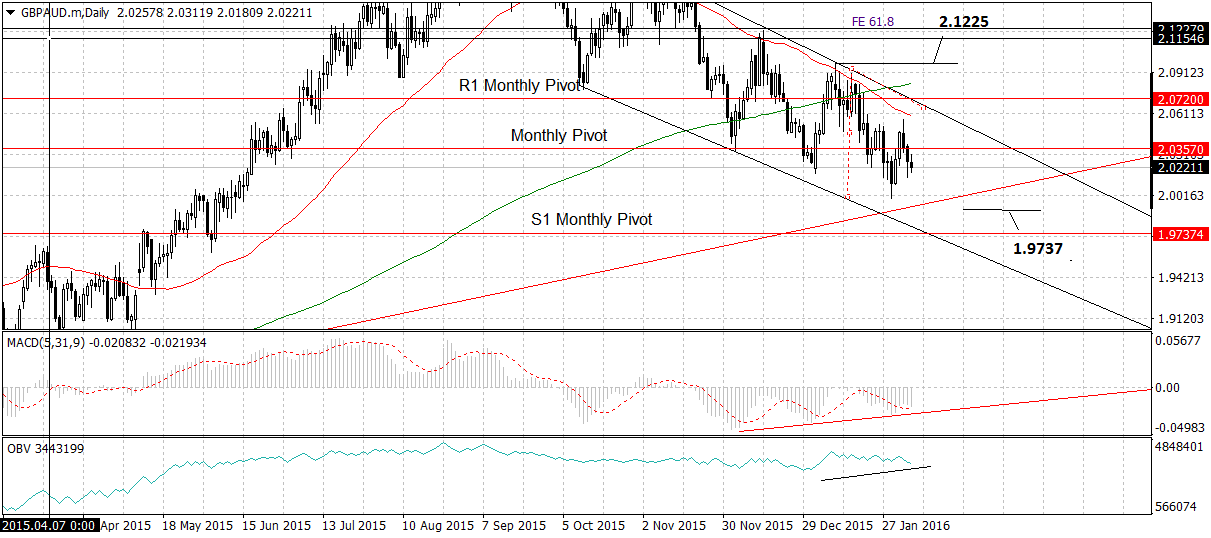
Upside is capped by the 50-day MA and the upper border of the down-sloping channel at around 2.0600.
The S1 Monthly Pivot is situated at 2.0720, followed by the 200-day MA at 2.0827 – revealing several strata of strong resistance above the current level.
Ideally I would want to see a clear break above 2.0979 for more upside, with a target at 2.1225, the 61.8% extrapolation of the height of the channel from the predicted break.
Any further downside is stymied by the trend-line at 1.9970 as well as general round-number psychological support at 2.0000.
A clear break below the trend-line, which would be confirmed by a move below 1.9890, would probably signal a continuation of the bear trend to the S1 Monthly Pivot at 1.9737.
AUD to USD Forecast
The pair has sold off heavily following U.S Non-Farm payrolls data and is moving down.
Resistance from the lower border of a triangle pattern is also putting a cap on gains, and lending fuel to the sell-off.
The small up-trend – or dead monkey bounce – as it has been referred to, may indeed be losing steam, and we could see a capitulation back down beginning, however, the monthly pivot at 0.7068 stands in the way of further downside, and could provide major support to the exchange rate.
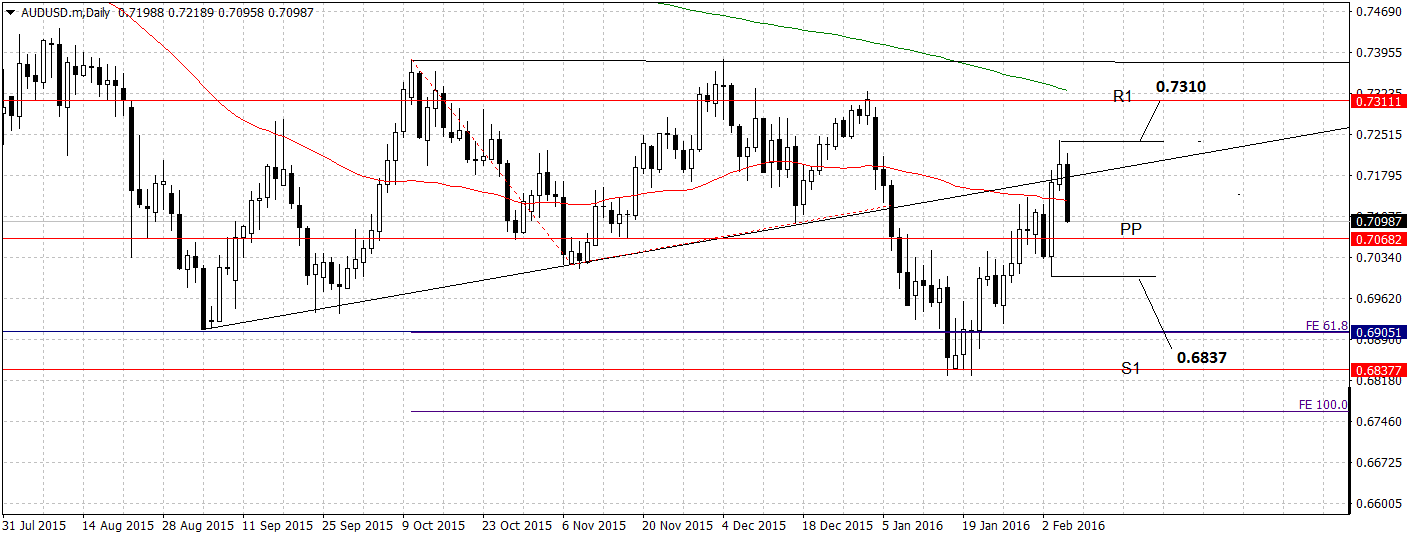
To forecast a stronger move lower, the pivot would need to be definitively breached, confirmed by a move below 0.6980, with a target then being activated at the Jan 20th lows and the S1 Monthly Pivot situated close to 0.6837.
Alternatively, a break above the 0.7243 highs would probably confirm more upside to a target at 0.7310.
Westpac's G10 Model Signals AUD and NZD Weakness
News in from Westpac where they have just revealead their weekly forecasts based on their G10 Model.
The Westpac G10 FX model is a multi-factor approach to systematically trading the G10 currencies. The overall system includes a forecast model and a currency portfolio model.
The forecast model identifies the relative attractiveness of the G10 currencies based on 9 dynamically weighted macroeconomic factors. The 9 factors are based on a combination of; 1) modifications to the "standard FX model" (i.e. carry, trend and value); and 2) various signals sourced from Westpac's suite of FX indicators.
According to the G10 Model, the commodity bloc bears the brunt of heightened risk aversion and a bullish US data surprise index signal.
"After opening small longs in AUD and NZD for the first time in many months the model jumps ship and runs with small shorts for the week ahead, -0.7% in AUD and -4% in NZD," says Westpac's Richard Franulovich.
Furthermore, the model turns more negative on NZD than AUD due largely to a more bearish terms of trade valuation signal for NZD, that coming on the heels of the renewed downswing in dairy prices in recent weeks.
The CAD short is rebuild from -11% last week to -17.2% this week.