A recovery in steel prices could provide some support to the Australian dollar over coming weeks and months says a leading international foreign exchange researcher.

"If underlying demand for steel improves over the coming months, Australia’s key exports of iron ore and coal are likely to benefit,” - Adarsh Sinha, Bank of America.
The Aus dollar could find support on the back of an expected uptick in the price of steel argue Bank of America Merrill Lynch Global Research in a new note on the Australian currency.
While steel is not often attributed as a factor behind moves in the aussie dollar it does of course tie into the whole dynamic surrounding the Chinese market slowdown and the general decline in commodity prices.
Australian exports are a key component in the Chinese steel market and are therefore important to values in the AUD as higher demand boosts prices and thus bids the Aussie higher.
In a ‘Liquid Insight’ note published on the 23rd of September FX Strategist Adarsh Sinha says:
“We have often argued that steel prices provide the best metric of China’s underlying demand for Australia’s key exports of iron ore and coal, both inputs for steel production.”
Indeed, steel prices tend to be far more stable and less influenced by inventory swings compared to iron ore.
“Steel prices have fallen by 4.3% since China’s fixing reform on August 11, consistent with the decline in AUD that we expected following the RMB depreciation,” says Sinha.
Latest Pound / Australian Dollar Exchange Rates
  | Live: 1.8778▼ -0.12%12 Month Best:2.0851 |
*Your Bank's Retail Rate
| 1.814 - 1.8215 |
**Independent Specialist | 1.8515 - 1.859 Find out why this is a better rate |
* Bank rates according to latest IMTI data.
** RationalFX dealing desk quotation.
Steel Prices Predicted to Firm
In a positive development for the Australian dollar’s outlook BofA suggest that steel prices may tick up towards the end of 2015.
“On the surface, indicators of China’s steel demand remain weak, if not contractionary. However, as our mining and metals analysts highlight the “second derivative” in most cases is turning positive,” says Sinha.
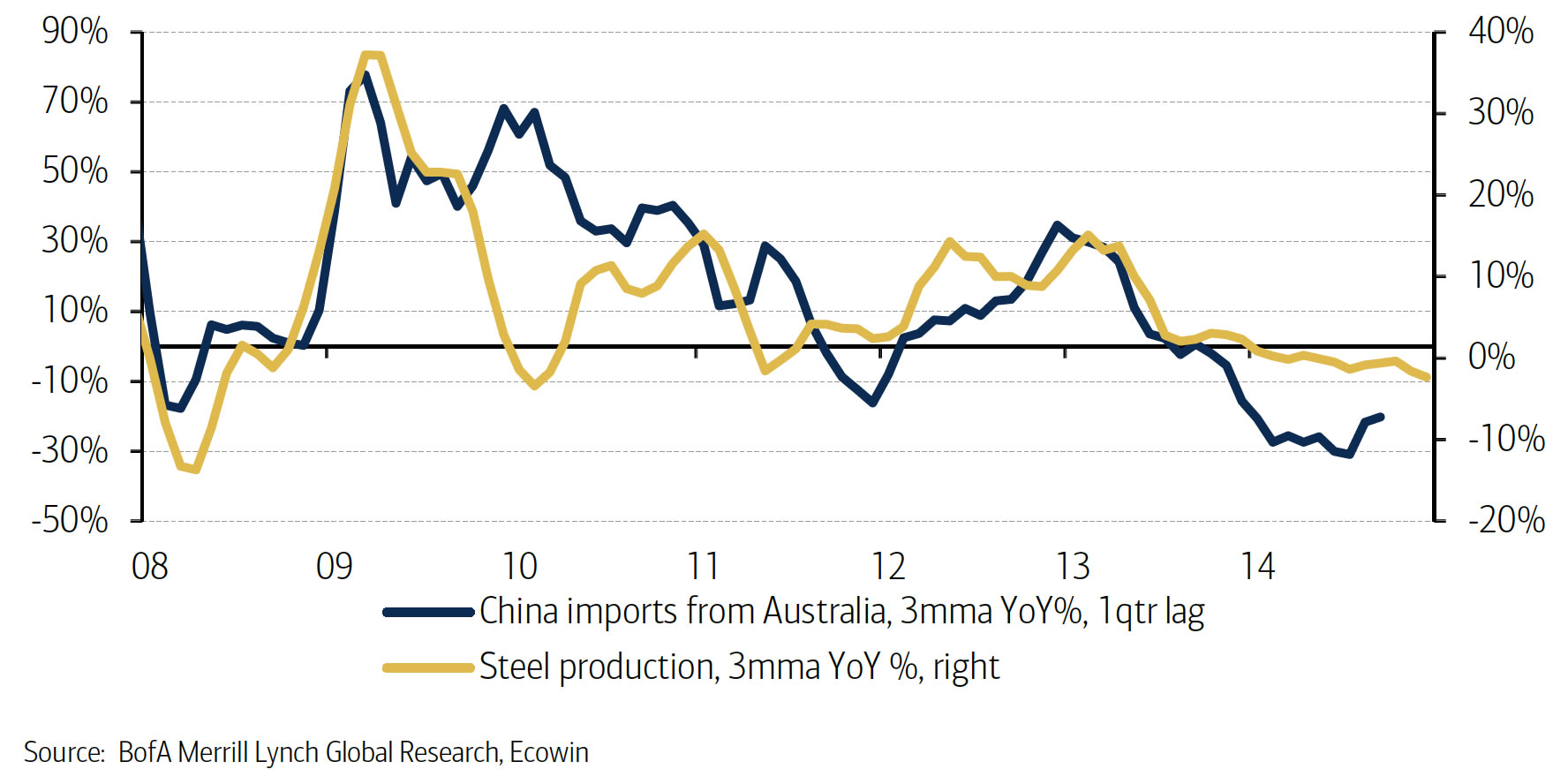
Steel production is falling at the fastest pace since 2010.
It is however notable that the steel PMI has shown a sequential recovery in both July and August, with both the production and new orders component driving this move.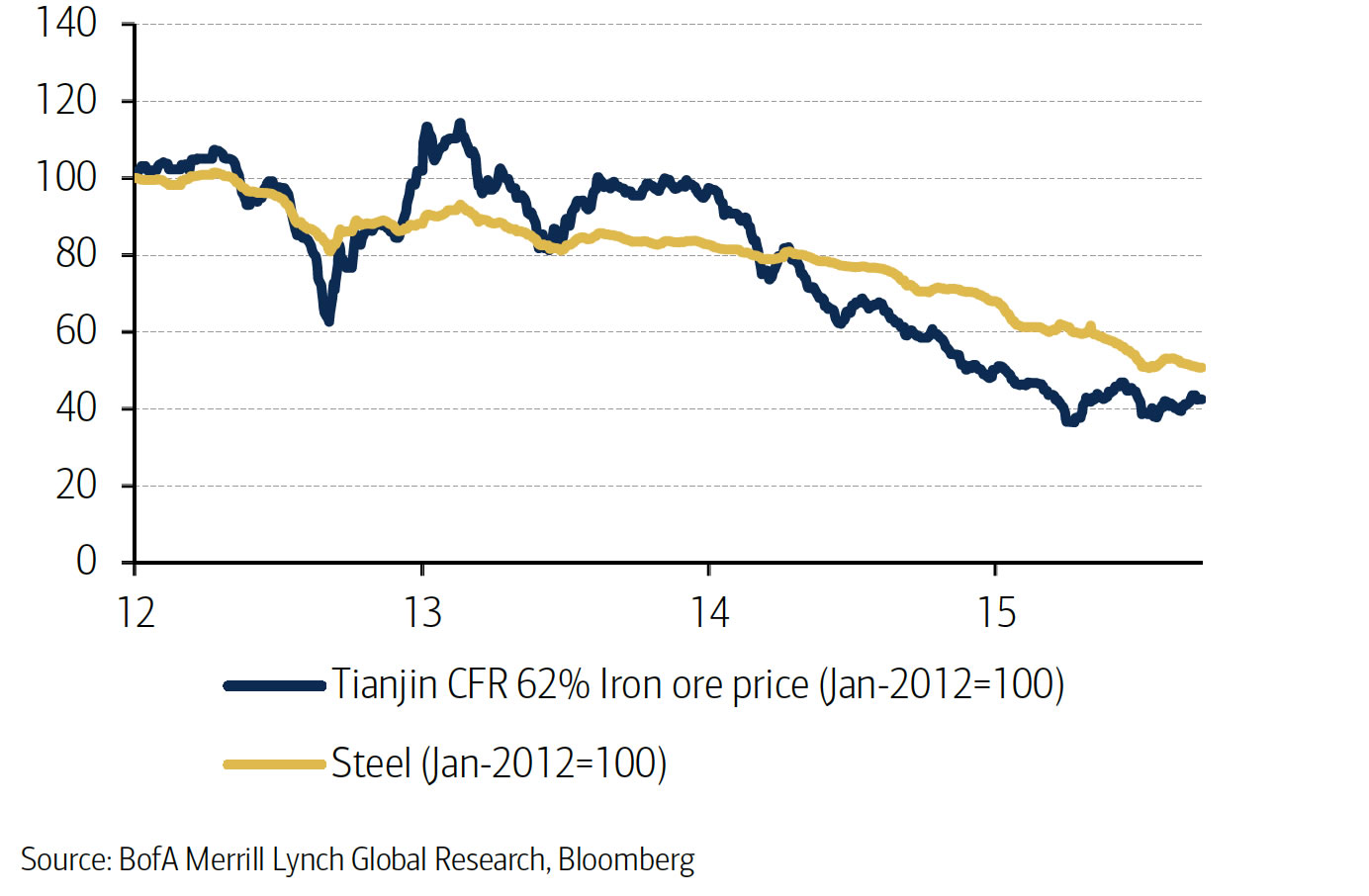
BofA point out that China’s steel PMI leads steel production rates by roughly one quarter, which in turn leads China’s imports from Australia by one quarter.
A stabilisation or recovery in production rates could, at least temporarily, bode well for Australia’s exports to China.
Forecasting a Lower Aussie Dollar, But a Better Fourth Quarter
“Our bottom line is the pervasive bearishness on China is not as evident in some of the key steel related metrics discussed above. If underlying demand for steel improves over the coming months, Australia’s key exports of iron ore and coal are likely to benefit,” suggests Sinha.
Bank of America argue, like most institutional analysts, that the broader macro backdrop for AUD remains negative, especially if the RMB continues its depreciation path and capital inflows into the resource sector slow.
“But with the Fed delaying lift-off, the Reserve Bank of Australia (RBA) sticking to a firmly neutral stance and steel prices looking set to stabilize, we are comfortable with our “conservative” end-2015 forecast of 0.69 for AUD/USD,” say Sinha.
From a trading perspective, the FX strategist thinks there is scope for EUR/AUD to move lower towards 1.52, as the policy divergence between the ECB (expected to extend QE in October) and an on-hold RBA becomes a stronger driver of the pair.