The Australian dollar has risen following the release of the official Housing Price Index, which rose more than forecast at 4.7%.

This morning, Australia released its Housing Price Index, which rose more than forecast at 4.7%.
The GBPAUD edged lower on the strong release having advanced a day earlier courtesy of another set of house price data which pointed to a cooling in the market.
We believe the Aussie dollar outlook will become increasingly prone to house price movements as this is a factor which will decide whether Australian interest rates are lowered once more over coming months.
National auction clearance rates were shown to be at their lowest month in three years on Monday, and most significant auction clearance rates in the red-hot Sydney and Melbourne property markets are steadily easing as well.
The slowdown comes after the Australian Prudential Regulation Authority (APRA) increased the amount of capital the banks are required to hold against residential mortgage exposures, and capped the annual growth allowed in investor loans at 10%.
“The likelihood of the Reserve Bank of Australia (RBA) cutting interest rates down to 1.75% or even 1.5% within the next twelve months increases dramatically,” says Angus Nicholson Market Analyst with IG in Melbourne.
Currently, the bond market probability for an RBA rate cut by December sits at 38%, dropping from 42% prior to Glenn Stevens’s speech on Friday.
Should the probability start rising once more then we could well see the Australian dollar weaken further as any interest rate cut will further limit the desirability of Australia as a destination for foreign exchange flows.
Latest Pound / Australian Dollar Exchange Rates
  | Live: 1.8778▼ -0.12%12 Month Best:2.0851 |
*Your Bank's Retail Rate
| 1.814 - 1.8215 |
**Independent Specialist | 1.8515 - 1.859 Find out why this is a better rate |
* Bank rates according to latest IMTI data.
** RationalFX dealing desk quotation.
Incoming Chinese Money Drying Up?
No doubt one important leg of support to the Australian dollar could be about to dry up.
Major development over recent months has seen a renewed clamp down on capital flight out of China by Chinese authorities.
China’s stock market crash and unexpected currency devaluation prompted a significant uptick in capital flight.
In response, on 8 September the State Administration of Foreign Exchange (SAFE) imposed a 20% reserve requirement on Chinese financial institutions’ currency forward sales, and exhorted them to closely investigate their currency businesses.
“Previously, it was quite common for Chinese to bypass the US$50,000 annual currency exchange restriction by pooling together a number of family members’ limits in order to get a large sum of money out of the country. This popular method has also been sternly cracked down on as well,” notes IG’s Nicholson.
It does seem fairly significant that these regulations corresponded with a slowdown in Australian property clearance rates and is therefore a key risk to the outlook for the Australian dollar.
The Pound to Australian Dollar Outlook
The GBPAUD is looking to carve out a base on recent declines around the 2.150 zone – rallies off this area could open the door to recent range highs around 2.20:
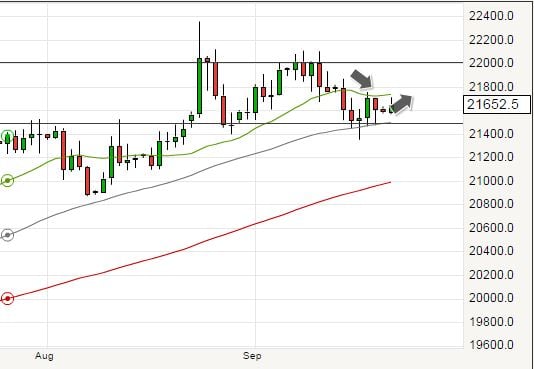
Those looking to buy Aussie dollars should set buy orders at this level to automatically trigger as we don’t see any indication that momentum will deliver any higher rates at this stage.
Barclays: Sell the AUD
G-10 commodity currencies face the unfavourable combination of falling commodity prices, lower global demand and high volatility.
“Our Dutch Disease analysis suggests AUD and NZD are most vulnerable. Both countries have large net foreign debt obligations and have experienced the greatest deterioration of their manufacturing sectors, only partially offset by high labour mobility/efficiency, Barclays says as a rationale behind this call,” says a new strategy note from Barclays.
Furthermore, the bank adds:
"In the context of ongoing downside Chinese growth risks, to which New Zealand and Australia are more exposed, we recommend selling AUD and NZD against the CAD," Barclays advises.