
Image © Adobe Images
The pound shows some hesitation as an important graphical resistance line approaches, but the global picture remains supportive.
It's been a solid run of late for the pound-to-Australian dollar exchange rate, the pair hovers near three-month highs and a steady advance, in place since May looks to be intact.
That suggests further gains in the coming days should remain possible, although there's some hesitation around the approach of 1.94 which hints at a shallow pullback being in store.
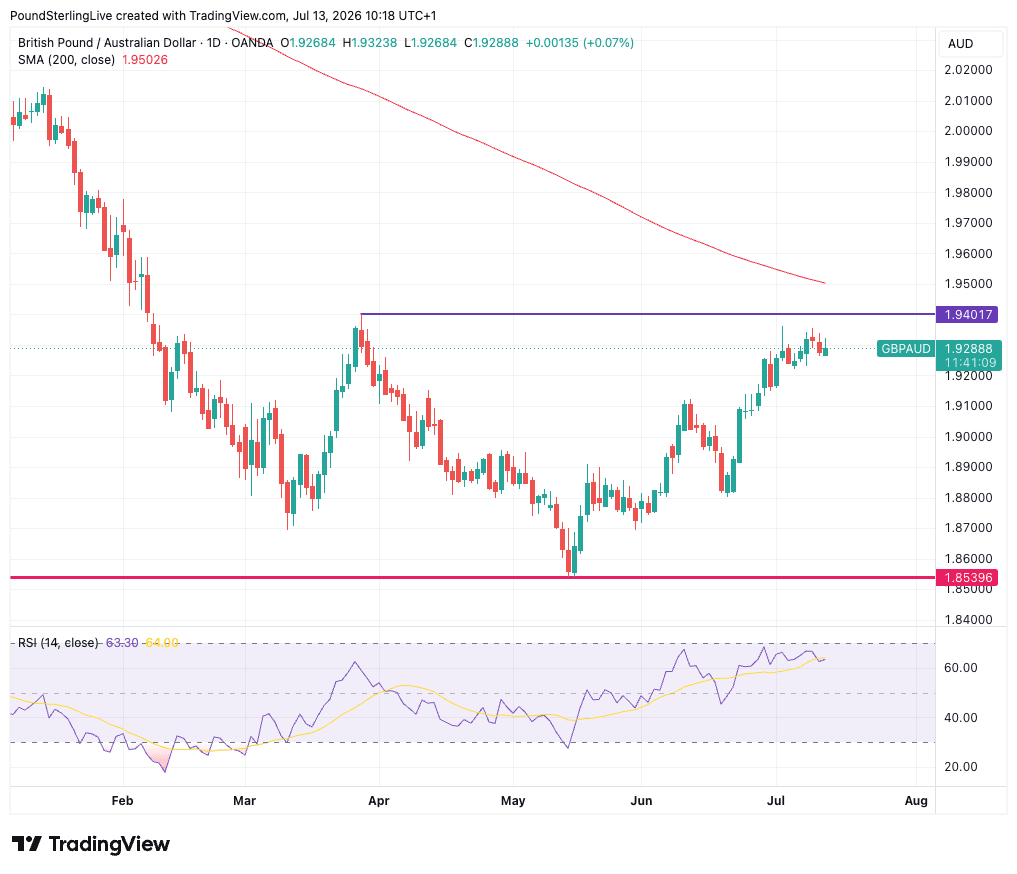
The immediate obstacle is 1.9402, which marks the March peak and represents the first meaningful chart resistance.
The hesitation seen here is entirely consistent with profit-taking at a prior swing high rather than evidence that the broader recovery is failing.
The technical picture has strengthened materially over recent weeks; the price is trading comfortably above both the 50-day and 100-day moving averages, confirming that short- and medium-term momentum has turned positive.
This sequence of higher highs and higher lows suggests Sterling has regained control after several months of weakness.
A break above the aforementioned obstacle at 1.9402 would leave relatively little chart resistance before the 200-day moving average at 1.9503.
That moving average is not currently capping price action, but it is likely to become the next major test because it often acts as the dividing line between longer-term bearish and bullish trends.
A successful move through both levels would significantly improve the longer-term technical outlook and expose 1.9600.
What the Aussie is Watching this Week

Image © Adobe Images
There's no front line Australian data scheduled for the week ahead, meaning the Aussie will be taking cues from global developments.
Here, a strengthening dollar has been particularly disruptive to the AUD's performance: we note that during times of strong USD performance AUD/USD tends to fall faster than GBP/USD.
The laws of cross-currency trends mean that it automatically lifts GBP/AUD in the absence of any sterling-centric developments.
Renewed attacks by the U.S. and Iran, and the recolsure of the Strait of Hormuz, is helping the USD, and that support will build the longer the situation is allowed to escalate.
Markets are neverthless sanguine: traders believe U.S. President Donald Trump will act in a contained manner, for fear of upsetting markets. The playbook is well understood.
The risk? That Trump is looking to re-establish U.S. dominance, knowing that without it Iran will continue to try and establish its dominance over the Strait of Hormuz.
"It is important to note that the U.S. strategy, with the ceasefire having been declared "over," is shifting to a priority of re-establishing deterrence," says Peter Tchir at Academy Securities.
Neil Wiley, former Principal Executive in the Office of the Director of National Intelligence, explains that Iran will calculate that they can strike when it suits, confident that they can comfortably endure whatever comes back at them.
"In this circumstance, there is fundamentally no deterrence. I am concerned that this is now where we find ourselves. Establishing or re-establishing deterrence requires, ironically, a very disproportionate response," he adds.
If this is the case, we could be heading for a USD-supportive setup, which means GBP/AUD could be afforded the chance to rally further.
U.S. Inflation: The Big Set-piece
Also of relevance to the USD-AUD-GBP interplay is the release of U.S. inflation data, which will be one of the most important set pieces in the dollar's calendar.
Here, any unsavoury heat in the figures risks boosting bets that the Fed must raise rates, which will simultaneously boost the USD and GBP/AUD.
The market forecasts a reading of -0.1% month-on-month for June, a decline that would reflect the paring of energy price gains that followed the initial stages of the Middle East conflict.
Core CPI - arguably more important for policymakers and financial markets, is nevertheless seen staying at an uncomfortably high 0.3% m/m, up from 0.2%.
Evidence of passthrough from CPI into core is the real issue at hand. How this week's data answers that question will determine how the market reacts.
Looking for a potentially below-consensus read are analysts at Westpac: "In June, the sharp reversal in oil prices following the US/ Iran memorandum of understanding will suppress headline inflation."
"Market participants will remain on the look out for pass-through to other components of inflation. Given the state of the US consumer, we expect this to be limited, with core inflation instead determined by domestic capacity constraints," says Westpac in a weekly economic note.
A setback for USD would be consistent with GBP/AUD retracing recent gains.