
Image © Adobe Images
Expectations for another Reserve Bank of Australia interest rate hike this year are misplaced, according to Commerzbank.
New analysis finds that the risks facing the Australian economy are shifting away from inflation and towards weaker growth.
And with markets continuing to assign roughly a 50% probability to another increase in the cash rate before year-end, but "we continue to believe that this will not happen," says Commerzbank in a daily FX research update.
Fading rate hike bets would, all else being equal, weigh on the Aussie dollar.
The Commerzbank analysis finds recent global developments strengthen the case for the RBA to remain on hold when it next meets in August.
"Regarding risks, the discussion primarily centres on an ongoing conflict in Iran and the associated high fossil fuel prices. However, the price of oil has only continued to fall since the last meeting. So this risk no longer exists for the moment."
Commerzbank says attention will also be on Australia's housing market as the minutes of the RBA's last meeting highlighted the risk that falling property prices could undermine consumer spending, and recent data suggest that concern is becoming more relevant.
"Nationwide real estate prices fell by 0.4% in June compared to the previous month - the sharpest decline in three years," says Commerzbank.
The downturn has been even more pronounced in Australia’s largest cities: "In Sydney and Melbourne, prices actually fell by more than 1% each in June compared to the previous month."
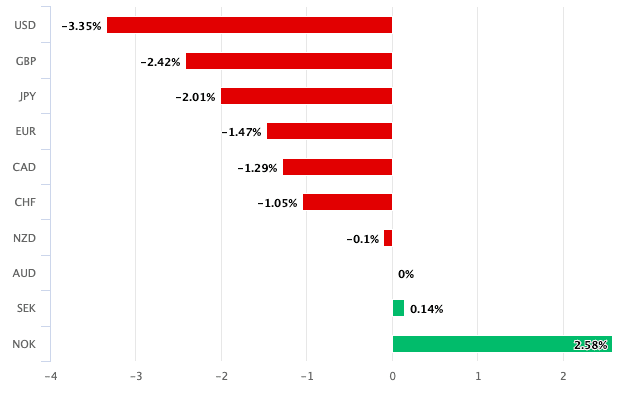
Above: AUD performance over the past month confirms a recent underperformance relative to G10.
Commerzbank says the pace of decline appears to be accelerating, raising the prospect of a broader slowdown in household demand. "The trend thus suggests that prices are not only continuing to fall - the decline appears to be accelerating."
That leaves the Australian dollar without the prospect of additional support from higher interest rates.
"The risk profile therefore seems to be shifting," says the analysis.
The Australian dollar was the second-best performing G10 currency in H1 of 2026, helped by a weaker-dollar environment, rising stocks and a 'hawkish' RBA interest rate hiking cycle.
Looking into H2, those tailwinds are significantly diminished.
For the RBA to tighten policy again, inflation would need to surprise materially to the upside. "In our view, inflation would have to rise significantly for the RBA to raise interest rates again this year. And as mentioned, we do not expect this to happen."
For currency markets, the implication is that expectations for another RBA hike may gradually fade, removing a central pillar of Australian dollar outperformance in recent months.