
Image © Adobe Images
The pound is trading a tight range against the Aussie dollar, but a meaningful directional move is drawing closer.
The pound to Australian dollar exchange rate (GBP/AUD) is softer on Monday at 2.0126, but losses are relatively shallow and price action speaks of the becalmed conditions in this market.
As the chart shows, the range occupied by the pair has steadily shrunk over recent weeks, leaving the pair stuck on the 21-day exponential moving average:
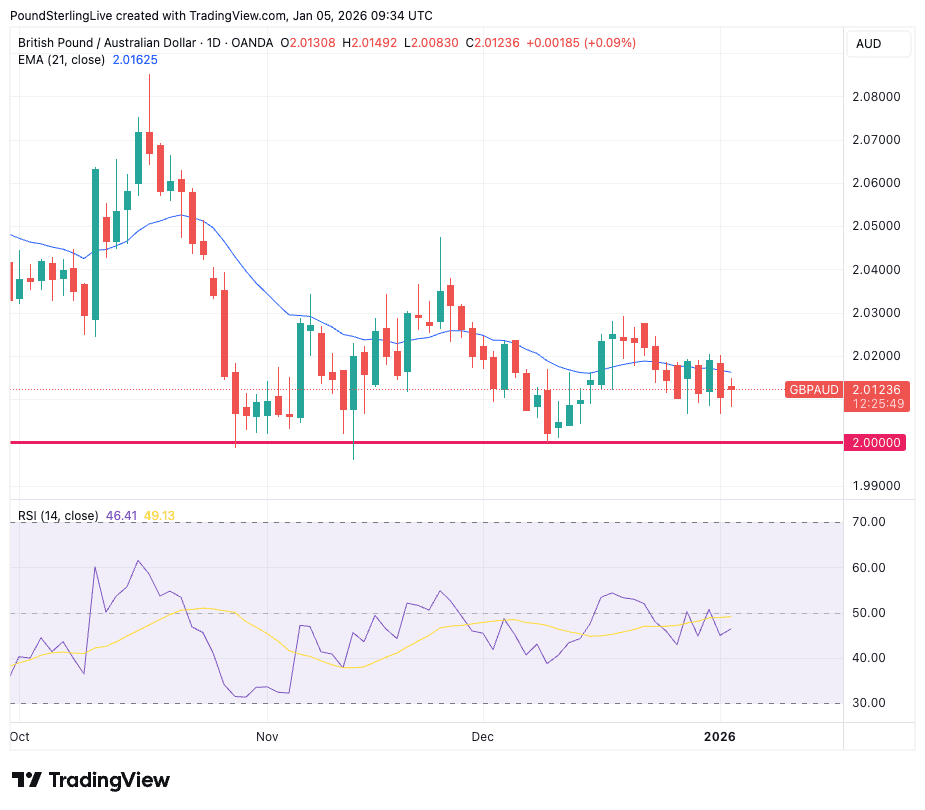
The unhurried nature of recent GBP/AUD price action is confirmed by the Relative Strength Index (RSI) - seen in the lower panel - where a flat near-50 reading confirms a market that is waiting for its next directional pulse.
There's solid support down at 2.0, which is providing a firm base, forcing bears to abandon the late-2025 selloff and forcing the pair into a constricting wedge.
Our view on the matter is that the constricting wedge will eventually unspring itself and offer new directional impetus and provide some welcome action for an increasingly staid exchange rate.
The big question, of course, is whether the pound breaks out of this wedge to the upside or downside.
The solid support at 2.0 advocates for a rebound, as does the longer-term multi-year uptrend that is still intact over longer-term technical timeframes.
However, the downtrend we saw during the August-December period that brought us here advocates for a break lower.
And, the Aussie is a favourite bet with investment bank strategists to outperform this year, which would suggest sub-2.0 levels in GBP/AUD are likely.
"All in all, it feels like a good time to own some Australian dollars," says Kit Juckes, head of FX research at Société Générale. "GBP/AUD has downside as soon as sterling’s short-covering support runs out of steam."
✳️ Secure today's exchange rate for a future payment. You may also book an order to trigger your purchase when your ideal rate is achieved. Learn more.
For now, GBP continues to prove resilient in the wake of the November budget that merely had to pass the test of not being an outright trainwreck of an event to muster some relief-style buying.
There's potential for that rebound in GBP to extend in the coming days, particularly as there's little in the way of UK data to bother sterling.
There's also a popular view amongst traders that the post-budget relief should trigger a rebound in consumer and business confidence, which should reflect in better-than-expected data releases in early 2026.
This week's main highlight will be the release of Australian CPI inflation numbers, where analysts look for headline CPI at 3.6% y/y vs. 3.8% in October.
The RBA will be interested in core inflation - or trimmed mean CPI inflation - which is seen at 3.3% y/y vs. 3.3% in October.
These readings are too high to be compatible with the RBA's objective of bringing inflation down to 2.0% and would therefore advocate for the RBA to hold interest rates unchanged for a period of time, or even consider raising them.
At its last December meeting, the RBA stressed it's done easing, warning "the risks to inflation have tilted to the upside." Money market pricing meanwhile shows investors see nearly 50 basis points of rate increases in 2026.
We think the risks are that the data and RBA push back against this rich pricing, triggering a retreat in AUD. That's why a lower-than-expected Aussie CPI release on Tuesday is the market-moving outcome to watch out for.