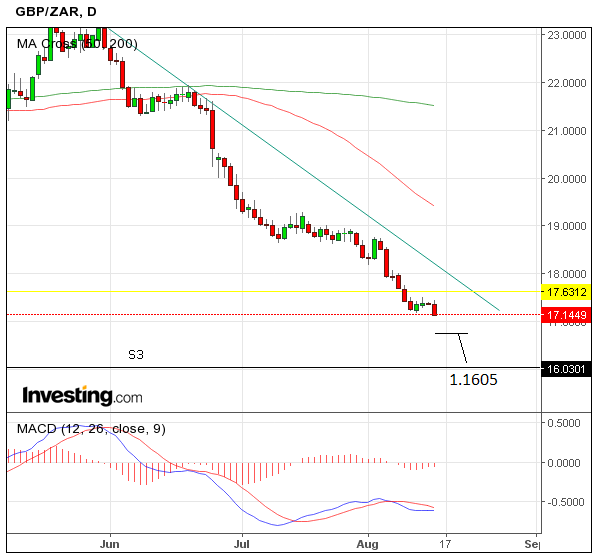
The GBP/ZAR exchange rate looks set to continue moving lower in line with our latest studies on the pair.

The GBP/ZAR rate is pointed unambiguously lower: One Pound now only buys you just over 17 Rand, when only two months ago a Pound would buy you over 23 Rand – it’s a substantial decline by any standards.
It is a clear indication of where momentum has been directed of late.
The question now for those with an interest in the pair is whether to wait for better days, or whether to buy their Rand before Sterling weakens anymore.
From a purely technical standpoint there are no signs of a let-up in the down-trend, so the latter may apply.
That the pair looks overextended is not especially significant, as financial markets do not follow a normal distribution and are susceptible to overextension more regularly than over data series.
Therefore, technically, we must expect the down-trend to go even lower, with the next target at 1.1605, just above the S3 monthly pivot at 1.1603.
Such an extension would gain confirmation from a break below the 1.1695 level.
On the fundamental plane, South Africa's governing ANC party lost a substantial 11% of the share of seats in local elections recently, with their winning seats falling from 63% to 52%.
Views on whether this is positive or negative for the economy are mixed: those who see it as positive say it will help clean up corruption as the ANC will have less of a majority and so less power; other say it will also lead to more balanced policies.
Those arguing it is negative say it will cause weak leadership and the government will struggle to push through key budget reforms aimed at saving the country’s credit rating from falling to junk status.
Latest Pound / SA Rand Exchange Rates
  | Live: 21.8612▲ + 0.02%12 Month Best:23.3448 |
*Your Bank's Retail Rate
| 21.1179 - 21.2053 |
**Independent Specialist | 21.5551 - 21.6426 Find out why this is a better rate |
* Bank rates according to latest IMTI data.
** RationalFX dealing desk quotation.
The truth may be immaterial, however, as according to Rand Merchant Bank’s (RMB's) Isaah Mhlanga, the main drivers of the rand are not local factors, but global forces:
“The local unit has receded from its recent highs despite manufacturing and mining production data released last week almost guaranteeing that 2Q16 economic growth will be positive, thus avoiding a technical recession for now.”
Adding:
“This is a firm reminder that the fate of the local unit is in global forces, particularly the course of US monetary policy. San Francisco Fed official, John Williams, dropped the first hint of a change in tune in a post Brexit vote, pointing that the Fed is likely to hike its fed funds rate at least once this year.”
With S&P 500 Index futures, which are considered a good estimate of risk appetite, currently trading at new 2.190.00 yearly highs, and crude oil rebounding on OPEC supply constraint hopes, the outlook looks reasonably solid for risk - possibly with the exception growing concerns over China.
Lloyds Commercial Banking’s Jaevon Lolay is however, are sceptical of the sustainability of gains made on the basis of purely international macro forces:
“The fact that much of the support for the rand has been driven by developments external to South Africa, such as signs of stability in China and higher base metals prices, supports our view of short-term overvaluation.
Adding:
“There is, in our opinion, a significant risk that the external environment could again quickly prove highly negative for the rand due to its high external vulnerability.”
More UK data for July
For the pound, the release of more hard July data on Tuesday and Thursday could be either positive or negative.
Higher-than-expected inflation is expected on Tuesday as a result of the pound weakening and this causing a rise in the cost of imports.
Producer prices are also released at the same time and will provide a gauge of whether the weaker pound is pushing up costs for manufacturers by making imported parts more expensive.
A larger-than-expected rise in inflation is likely to weigh on the pound as it will suggest household incomes will not be able to stretch as far in the future, and this will impact negatively on growth.
Then on Thursday July Retail Sales will be released.
If the figures are positive then that is likely to boost the pound a little, however, much BRC retail sales figures for July which roundly beat expectations last week failed to lift the pound as the data was dismissed as unrepresentative of Brexit’s impact, since there had been no “material” impact on household finances so soon after the referendum, so people had not changed their spending habits.
The hot weather and price fierce price competition was a further reason stated for the rise.