The rand faces an absolutely key week ahead with the budget set to determine whether the recent recovery in ZAR can extend.

The ZAR's woes over recent months need no introduction but it appears the South African currency is finding its feet once more.
The week starts with further blistering gains versus the British pound and, as our technical analysis shows below, we could be about to witness a key support level give way.
February has been kinder to ZAR which has managed to force the pound from highs around 23.70 down to the 22.00 support zone. At the time of this article's most recent update the GBP to ZAR exchange rate is trading at 21.9218.
The US dollar to rand exchange rate also remains biased to the downside having been in decline since mid-January.
USD/ZAR has fallen from just below the 17.00 resistance point back towards the mid 15's and shows no sign of stopping until the psychological support zone noted at 15.00.
Pound to Rand Forecast, Initial Target Broken, Where Next?
Forecasts that the rand would appreciate have proven true, with the GBP/ZAR pair falling down below the neckline of a slanting head and shoulders top (rise in rand equals fall in GBP/ZAR).
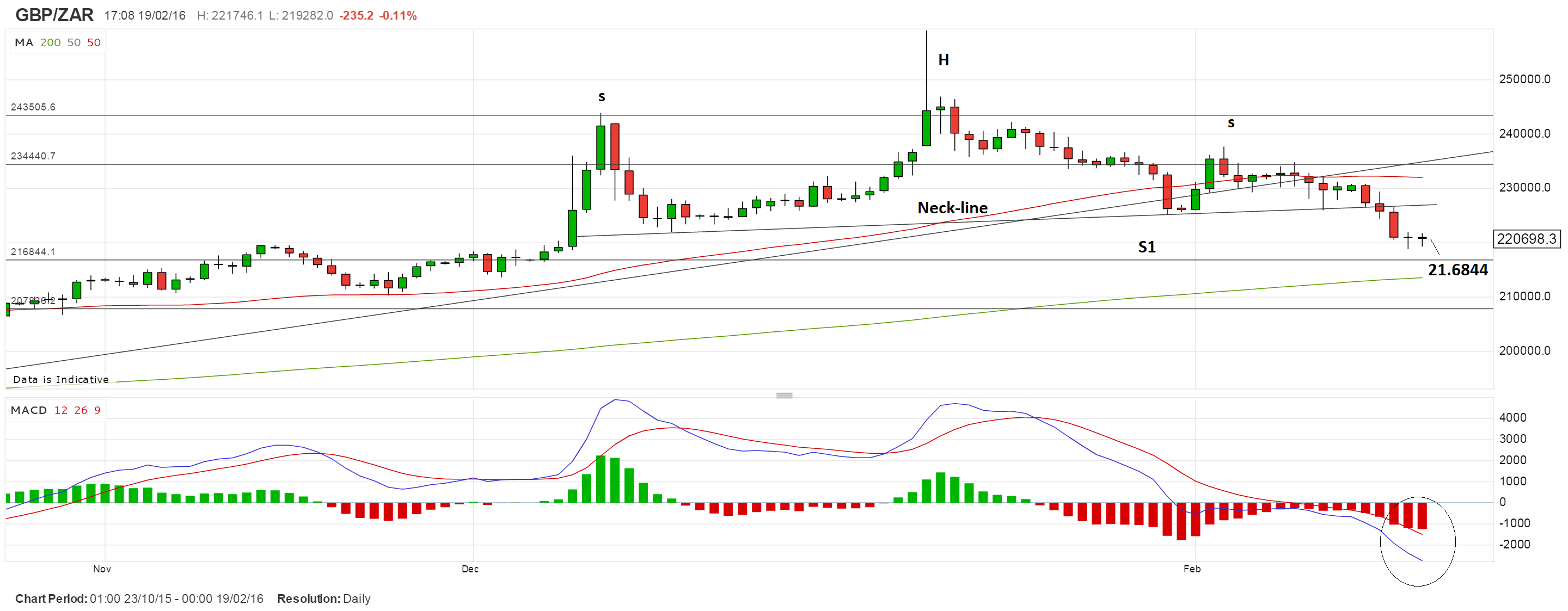
The exchange rate has rapidly moved lower since the break and has reached and broken through our revised initial target of 21.6844 roughly at the S1 monthly pivot.
The MACD indicator is supporting the down-trend, which could extend further to an eventual target at 20.1900 calculated from the height of the head and shoulders, however, the 200-day MA provides a formidable obstacle for bears to overcome.
But, Could ZAR Strength Unravel?
The rand's newfound strength could stall later this week if the government misses a golden opportunity to restore investor confidence in the country when they unveil the 2016/17 budget.
If the budget disappoints thete are concerns that South Africa’s sovereign bonds may lose their investment grade credit rating which will heap pressure on the currency as fund managers are forced to exit their investments in the country.
“In South Africa, the country’s investment-grade credit rating is in more danger than ever,” say Swissquote Bank in a foreign exchange briefing to clients, “the deteriorating growth outlook, which could be exacerbated by further interest rate hike by the SARB, has put the country’s investment-grade credit rating at stake.”
If markets believe the government has not done enough to boost credibility, the ZAR may be sold.
Latest Pound / SA Rand Exchange Rates
  | Live: 21.8688▲ + 0.05%12 Month Best:23.3448 |
*Your Bank's Retail Rate
| 21.1253 - 21.2128 |
**Independent Specialist | 21.5627 - 21.6501 Find out why this is a better rate |
* Bank rates according to latest IMTI data.
** RationalFX dealing desk quotation.
“Finance Minister Gordhan will have to deliver a sizeable and sustainable fiscal correction, but also take steps to preserve fragile growth and the social wage. We think an adjustment package of 1% of GDP would be sufficient to restore confidence in South Africa’s fiscal path,” says Peter Worthington at ABSA.
Credit rating agency concerns about growth will likely persist no matter what the Budget produces.
“Material expenditure cuts, working principally through reduced transfers to provinces, would be a welcome step towards fiscal sustainability,” says Worthington.
The Budget is likely to outline a welcome new openness to public private partnerships for infrastructure development, and a more stringent approach to state owned enterprises like SAA and Eskom.
“While we do not expect the Treasury to announce any big privatisation plans, there is scope for a surprise,” says Worthington.
Rising Inflation Supports ZAR’s Outlook
The Rand found support over the past week on news prices are rising faster than anticipated.
Inflation data showed that price’s had accelerated to above the upper band of the SARB’s target zone between 4%-6%:
After having accelerated to 5.2%y/y in December, headline CPI broke the upper band of the target range (3%-6%) as it surged 6.2% in January, beating the median forecast of 6.0%.
Driving prices higher are a the heavy pressure on the rand together with the sharp increase in food prices, mainly due to a worsening drought.
“The pressure on the government has increased another notch as the market expects officials to step in to curb budget deficits.
There are no significant data releases for the SA Rand in the week ahead, but as John Cairns of Rand
Merchant Bank explains, the pair is heavily influenced by global risk trends, and when they are pro-risk the Rand tends to benefit.
“Essentially the mood has gone from panic, which is rand negative, back to only mild concern over the global economy, which is rand positive because of the implication for global monetary policy,” says Cairns.