The South African Rand has started recovering after weakening at the start of the week; the outlook still looks bullish for the currency as the commodity block recovers.

The lower-than-expected South African Manufacturing data on Monday (43.5 vs 45.1 expected and 45.5 prev) led to a sell-off in the rand, but since then the currency has recovered on the back of a rebound in oil which has spurred a global recovery in commodity currencies and riskier assets.
Looking at the daily chart of the pound to South African rand exchange rate, we can see that the move down from the December spike highs has reversed and broken back above its trend-line.
It does not represent a definitive reversal, however, the declining sequence of peaks and troughs confirms the down-trend is still intact.
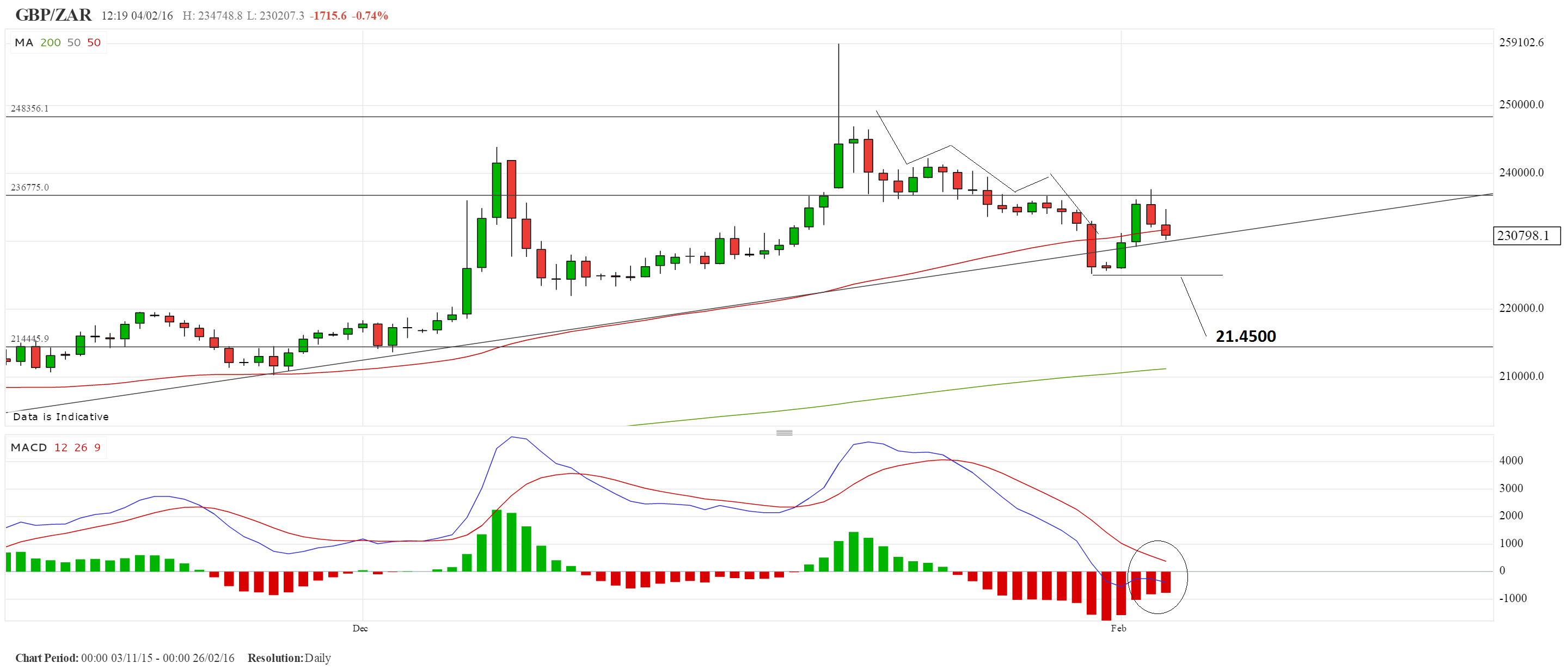
The MACD indicator is also still below the zero-line signalling an overall bearish trend dominates.
Therefore, I still see the pair weakening again and a re-break below the trend-line sending it well clear.
As such we forecast a move below the 22.5207 lows would probably confirm a continuation down to the S1 Monthly Pivot at 21.4500.
Latest Pound/Euro Exchange Rates
  | Live: 1.187▲ + 0.03%12 Month Best:1.1913 |
*Your Bank's Retail Rate
| 1.1466 - 1.1514 |
**Independent Specialist | 1.1704 - 1.1751 Find out why this is a better rate |
* Bank rates according to latest IMTI data.
** RationalFX dealing desk quotation.
Weak Global Data is a Positive for the Rand
The rand remains highly attuned to global developments as it is the large transfers of capital across the globe that ultimately matters for the currency.
The ZAR has weakened as large amounts of cheap, borrowed money, is returned to the United States from liquidated higher-yielding investments made in South Africa.
The US Fed is looking to raise interest rates further in 2016 ensuring the flow of money out of countries such as SA continues. It was record-low interest rates and the printing of money through quantitative easing that allowed investors to borrow and then fund higher-yielding investments in places like SA.
But - data in the US has been weaker than expected of late - and this could result in the US Federal Reserve paring back on those rate rises.
"From a rand perspective, weaker global data remains a positive because of the hope of easier global monetary policy," says John Cairns at RMB.
Cairns stresses that this is only a pattern observed in the post-crisis world of monetary printing as prior to around 2010, weak global data would have been rand negative.
"Be that as it may, weak global data is a much-needed help to the rand," says Cairns.
Business Report Shows Weak Rand Increasing Production Costs
Data this week has been supportive with the SA Standard Bank PMI (a measure of private sector Business activity, sponsored by Standard Bank and conducted by Markit) showing a rise to 49.6 from 49.1, and Business Confidence, rising to 80 from 79.6 .
The Markit report highlighted that private business output continued to contract at the beginning of 2016, but the rate of deterioration had declined:
“South Africa’s private sector remained in decline at the start of 2016, with employment, new orders and output all falling since December.”
However, it added the qualification that the contraction was only “marginal.”
In commenting on the rand, it suggested the weak rand had helped exports to stabilise, but had also pushed up input prices since many components imported from overseas had risen in price.
The last point about Input costs, may be a clue as to how the central bank approaches monetary policy in the near-term, and would assume a bias towards more tightening, in order to strengthen the weak currency.
Commenting on January’s survey findings, Kuvasha Naidoo, Economist at Standard Bank said:
“The increase in input costs, as a result of a weaker rand, is negative for producers’ margins, especially for producers that supply to the domestic market; we anticipate SA will fall further into a downward phase of the business cycle in 2016 and that rising producer costs will not be easily passed onto consumers.
Nevertheless Naidoo goes on to say that lower staff costs may offset the rise in input costs:
“However, if the slower growth in staff costs experienced in January is sustained, this could counter margin compression to some extent and provide support for both domestic and export orders in the future.”
He argues the weak currency may have a positive effect on industries which are import substituting (producing domestic goods which compete directly with imports):
“We expect the weak currency will start to have a positive effect on those industries which are import substituting, and may result in the PMI gaining ground later in the year.”