The Rand has strengthened after the South African Reserve Bank increased rates by 50 basis points at their January rate meeting opting for the more aggressive choice rather than a simple 25bps hike.

The South African Reserve Bank increased its repo rate by 0.50% to 6.75% on Thursday on the back of higher inflation, which had reached the top of the 'band', and in order to support the beleaguered rand which fell massively in a currency crisis in December.
Whilst most market-watchers had expected a rate rise of some sort, the consensus view was for a milder 0.25% rise in line with previous increases.
However, recent strong data, including a higher-than-expected Retail Sales result in November and CPI rising to 5.2% in Q4 may have pushed the SARB to bite the bullet and raise interest rates more boldly.
In general, the move was well-received by commentators.
Adam Phillips, for example, an Independent Treasury Specialist to Corporates at Umkhulu Consulting, was reported by fin24.com as saying in his morning note:
"I think that the Sarb has been brave in putting up rates by 50 basis points.
"Yes, consumers and anyone with some sort of debt is going to be unhappy, but in a year's time we might be thanking the Sarb.
"They have put a mark down and maintained their independence as an institution. I am sure the rating agencies will agree with what they did."
According to Fin24, Phillips highlighted that Governor Kganyago said that structural changes are needed and he emphasised that the fall in the currency was caused by domestic internal matters: "in which he was clearly describing the sacking of (former finance minister Nhlanhla) Nene as being a reason for the ZAR weakness".
Another commentator quoted by fin24.com, Wichard Cilliers, Director and Chief Dealer, TreasuryOne, said the move to hike rates shows that the MPC has some backbone.
"It could well be that we still have some (more rate) increases to come, but I think they will be in 25 point moves. For me getting the pain out of the way quickly is a good recipe."
"The MPC also stated unequivocally that its focus is on inflation targeting, and they will not intervene in the currency markets.
"With inflation threatening to the topside of the band, expect the MPC to keep their stance of a tightening cycle, until such a time that inflation pressures have subsided," said Cilliers.
Nevertheless, he added that oil played a bigger role in the rand's pull-back as most market players thought the rates move was priced in.
John Cairns of Rand Merchant Bank, said that he thought the SARB were at the top of their tightening cycle:
"..the tone in the statement was moderately hawkish, with no panic, and this has led the market to discount less aggressive hikes going forward.
"Our CPI and GDP views remain well-below the SARB’s and we still think the peak in the policy cycle is near — we expect a 25bp hike in March or May."
Latest Pound / SA Rand Exchange Rates
  | Live: 21.8688▲ + 0.05%12 Month Best:23.3448 |
*Your Bank's Retail Rate
| 21.1253 - 21.2128 |
**Independent Specialist | 21.5627 - 21.6501 Find out why this is a better rate |
* Bank rates according to latest IMTI data.
** RationalFX dealing desk quotation.
Link with Oil
The recent recovery in the price of oil, which has correlated by 94% with the currency, has also helped push the currency higher.
RMB’s rates analyst Gordon Kerr highlights the relationship between the two in a recent report:
“Yesterday we saw our local rates market trade to the tune of the oil price. With oil above US$30/bbl, risk sentiment improves, EM currencies rally and with that our local bonds. When oil drops below US$30/bbl, we see a reversal of the above.
"For now it seemsthat a higher oil price is being viewed as a barometer for global growth, with higher growth meaning higher demand for oil.”
Basically the current primary driver for the currency appears to be global market sentiment, which is being measured predominantly in the price of oil – the higher oil is the better the global outlook and therefore the outlook for ZAR; the lower, the inverse ie worse global outlook and weaker ZAR.
Technical View: Pound Weakens to Rand as Forecast
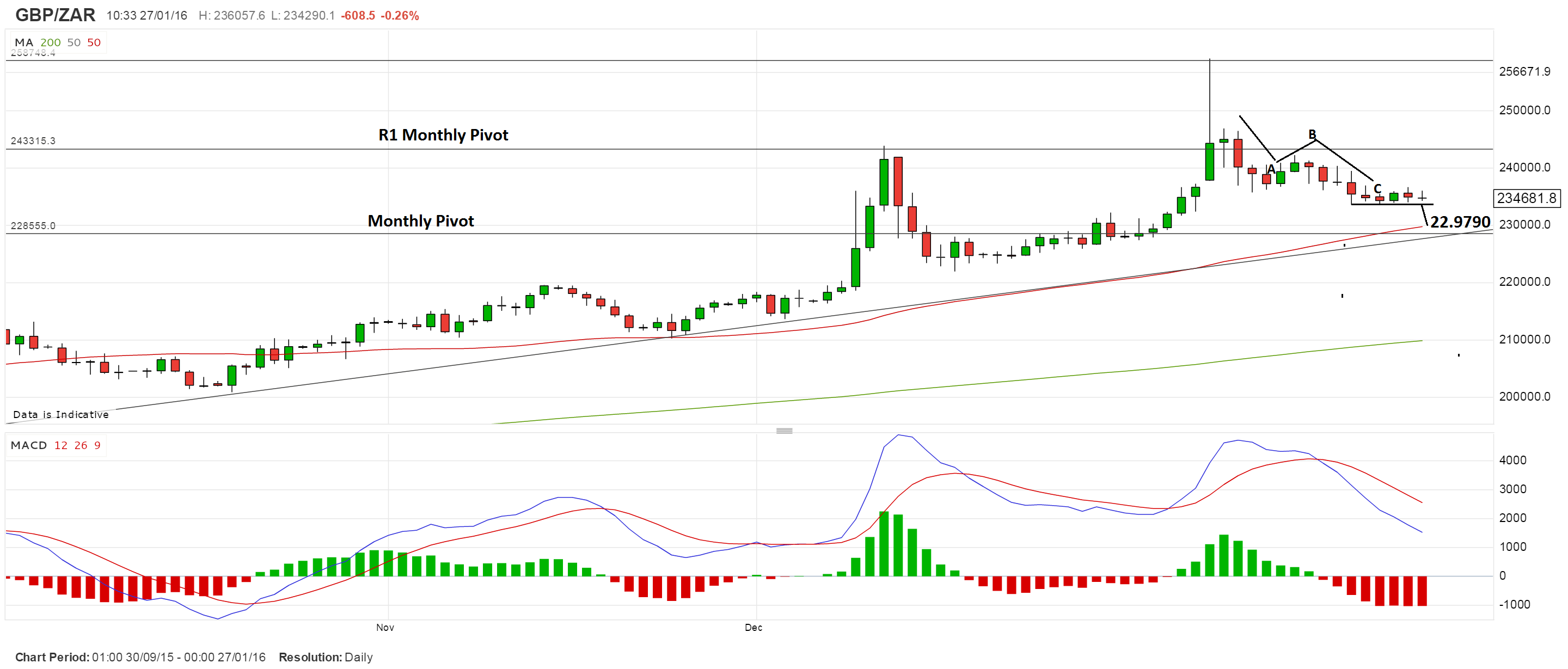
The charts show that GBP/ZAR pair is falling in line with our recent forecast.
In this we said:
"..the pair has been in a longer-term up-trend, it has been correcting in the most recent period, after the blow-off spike highs of December the 10th.
"This post-blow-off correction has now completed an a-b-c correction, and the question is whether this signals an end of the bear move and a possible resumption of the up-trend higher, or whether the correction could evolve into a more prolonged move down."
"A break below the ‘C’ wave lows at 23.3596 would probably confirm a continuation down to the 50-day MA at 22.9790."
"I think it unlikely there will be a move higher at the moment, but given the strong longer-term up-trend the possibility cannot be discounted completely."
"A move back above the 24.6916 highs would open the way up to an initial target at round-number resistance at 25.0000."
The chart below illustrates our pre-SARB meeting stance - since then the exchnage rate has moved even lower, and closer to its 22.9790 target at the 50-day.
Diverging Central Banks
There is a fundamental down-side bias as a result of steadily diverging central bank policy outlooks, as reducing BOE rate hike expectations contrast with potentially aggressive moves from SARB.
There is also a very bearish looking long-tail shooting-star on the monthly chart following the blow-off of the 10th.
This would be expected to indicate a reversal for a relatively extending time, and therefore an overall bearish outlook.