We take a look at the fundamental and technical picture behind the SA rand and question where the currency is heading in the near and medium term timeframes.

South African’s visiting the U.K for Christmas in 2014 would have received roughly £560 for their 10,000 Rand.
Those unfortunate enough to visit this year however would have seen their buying power reduced by over a quarter, receiving only £410 for their 10,000 Rand – an almost 27% decline.
Although the currency had been weakening steadily all year due to increasingly negative economic fundamentals, it was in December that it took its worst hit, after President Jacob Zuma dismissed the country’s finance minister Nhlanlah Nene, following the news that the country’s credit rating had been down-graded.
Nene had been widely respected as a hand of moderation in the Zuma administration, and his shock dismissal was seen as opening the floodgates to a tide of potentially irresponsible spending, in a government already reeling from accusations of wide-spread corruption and cronyism.
It didn’t help that Nene was replaced by near unknown with little experience in Finance, David Van Rooyen, and the Rand continued heading south.
It was only until Van Rooyen was himself ejected after only 5-days in office and replaced by respected operator and former finance minister Pradhan Gordhan that the currency stabilised.
Latest Pound / SA Rand Exchange Rates
  | Live: 21.8703▲ + 0.06%12 Month Best:23.3448 |
*Your Bank's Retail Rate
| 21.1267 - 21.2142 |
**Independent Specialist | 21.5641 - 21.6516 Find out why this is a better rate |
* Bank rates according to latest IMTI data.
** RationalFX dealing desk quotation.
Rand gets off to shaky start in 2016
The rand has started 2016 by weakening on both the trading days so far, reaching a low of 23.1253 on Monday, which is 1.4% lower than it opened the new year.
According to Reuters there is little sign of a let up in the pressure on the rand, which is set to continue weakening:
“South Africa's rand was under pressure on the first trading day of 2016, with pressure on the currency set to continue as weak domestic fundamentals weigh.”
Extremely high levels of unemployment, with over a third of young people out of work, increasingly fraught and endemic conflict between government and unions, falling commodity prices hitting mining exports, China slowdown fears which is a major trading partner and finally a flight of western capital which had been invested in emerging markets but is now rapidly being repatriated due to Fed hike concerns, are all factors weighing on a grim horizon.
The main immediate risk – and source of volatility - for the rand going forward is what the Reserve Bank of South Africa decide to do at their next few meetings.
The SARB might even raise rates as soon as their meeting on the 28th of January, given recent exchange rate volatility.
The bank moved to raise rates by 0.25% to 6.25% in November ‘15 amidst fears the Rand would devalue as a result of a Fed rate hike.
Now that it has devalued , and devalued probably more than expected due to the December currency crisis, there is an even greater risk the central bank could raise rates yet further, in an attempt to defend the currency.
The weak currency is making inflation grow out of control, but raising rates to defend it has the side-effect of increasing borrowing rates and dampening growth, in an economy which needs all the growth help it can get.
One of the major themes for the Rand going into 2016, therefore will be how the country’s central bank balances the need of the economy with inflation and the Rand’s exchange rate.
Rand Daily Chart View
The daily chart is showing a short-term correction in an longer-term uptrend.
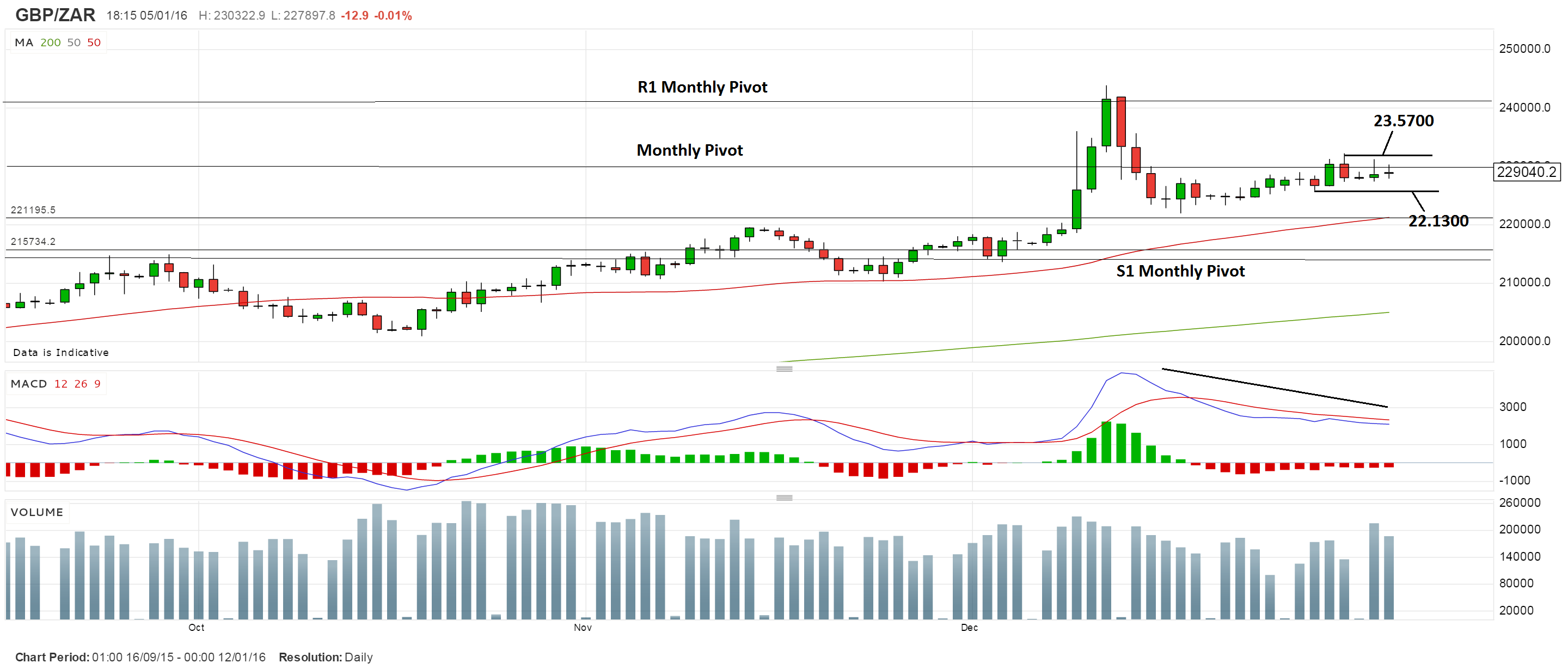
Recent days have seen upwards pressure into the Monthly Pivot which is successfully resisting at 22.8501.
If this is breached and the exchange rate moves above the 23.2232 highs, then that would probably indicate a move up to a target at 23.5700.
Falling momentum, in the form of the MACD, which is diverging with price, however, is threatening weakness instead, so there is also a possibility that the pair will be repulsed by the Pivot and forced lower.
A break below the key 22.5904 recent-range lows would help confirm more down-side, to an eventual target at the 50-day MA, situated at around 22.1300.
Long-term View
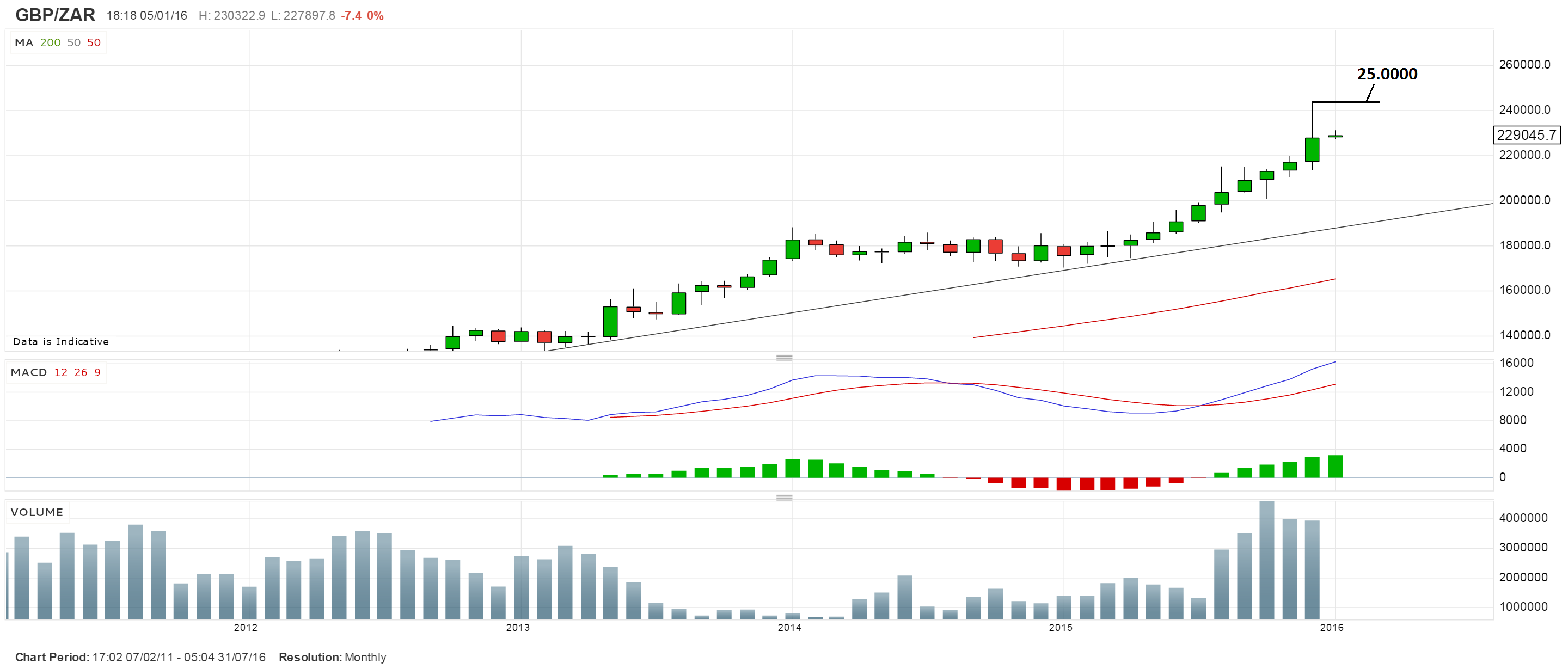
The Monthly Chart shows the rand in a very strong up-trend.
MACD is rising and supporting the up-trend showing there is no underlying weakness.
Buying Volume has also strong in recent months further supporting the up-trend.
The only slight sign of weakness is the shooting-star looking monthly candlestick in December – although it is not sufficiently bearish to be classed as a ‘pure’ shooting star and therefore its significance is diminished.
With such a chart technically there are not reasons to see further weakness except the funny slightly bearish looking December candle, so if we were to see a break of the 24.3890 highs, it would confirm for me further upside, initially to the 25.000 handle which has psychological significance making it a major resistance level.